Newsletter
The Fear of Missing Out (FOMO) and Greed Index dropped to 56 on Monday (neutral), lower than 67 from a week ago, and significantly lower than the peak of 82 set on August 26 – which was this year’s highest reading.
Bitcoin fell by about 6%, dropping from $86,978 to $81,749.83; at the same time, oil prices broke through $101, the yield on 30-year U.S. Treasury bonds rose to 5.70%, and there was spot...
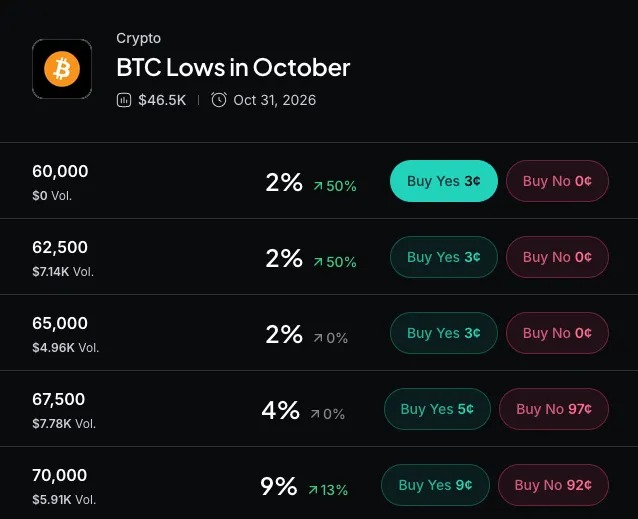
Myriad Traders currently believe that the probability of Bitcoin reaching $87,500 in October is 45%, and the probability of it falling to $80,000 is 56%, both of which are lower than the levels seen on October 7th.
After pulling Bitcoin and other crypto assets out of a brutal bear market during a hot summer, market sentiment has now clearly turned around, breaking the usually reliable seasonal trends.
Currently, the trading price of Bitcoin is slightly above $82,000, with a decline of nearly 5% within the week; the Fear & Greed Index in the cryptocurrency market dropped to 56 on Monday, returning to a "neutral" reading, whereas in late August it was still in a state of "extreme greed."
The Fear and Greed Index is a metric ranging from 0 to 100 that is used to measure investors' preferences, where 0 represents extreme fear and 100 represents extreme greed. The index reached 82 on August 26, the highest level of the year, compared to a reading of 68 just one month prior.
Bitcoin once rose to $86,978 at the beginning of last week, then fell to $81,749.83 on October 8, a decrease of about 6%. It later rebounded to around $83,800 on Monday. This means that this largest cryptocurrency is still about 34% below its historical high. That historical high was reached on October 6, 2025, exceeding $126,000, a time when extreme greed was the norm.
This round of decline marks the continuation of a difficult period that lasted until August this year. The rebound in August pushed Bitcoin prices up by 24.9%, which was enough for industry insiders such as co-founder of Fundstrat, Chairman of Bitmine Tom Lee, and Kim Yong Yu of Crypto Quant to declare the end of the bear market.
But at least for now, the enthusiasm for encrypted betting has cooled down, and the fear and greed indices also reflect this.
Spot Bitcoin ETF saw a net outflow of $484.9 million last Wednesday, marking the worst single-day performance since June, followed by another outflow of $244.1 million the next day. After a net inflow of $21.1 million on Friday, these funds have still seen a cumulative net outflow of $386.3 million since October; Ethereum funds have experienced capital outflows for nine consecutive days, with a total outflow of $635 million this month.
From the perspective of catalytic factors, macroeconomic headwinds have been dragging down Bitcoin and other crypto assets.
Last week, as attacks on vessels in the Strait of Hormuz increased, Brent crude oil prices briefly exceeded $101 per barrel; the yield on 30-year U.S. Treasury bonds rose to 5.70%, the highest level since 2002. On that day, stocks, gold, and Bitcoin all fell simultaneously, indicating that this was more of a macroeconomic event rather than a problem inherent to cryptocurrencies themselves. Despite U.S. President Donald Trump stating that the United States would not be involved in a war until at least November, Brent crude oil is still trading around $110 today.
Oil is a cost factor in shipping, manufacturing, agriculture, and travel; therefore, continuous increases in crude oil prices often get passed on to consumer prices. Higher inflation makes it more difficult for the Federal Reserve to cut interest rates and more likely that it will raise them, which is precisely the path described in the latest minutes of that central bank's meeting.
Bond investors will therefore demand higher yields, as inflation erodes the fixed interest payments on government bonds. Since U.S. Treasury yields serve as the benchmark for "risk-free" returns, a 30-year yield of 5.70% will draw funds away from riskier investments and raise the borrowing costs for the entire economy. Bitcoin does not pay dividends and is traded alongside stocks as a risky asset; therefore, rising yields and expectations of interest rate hikes tend to push down its price, which was the case on October 7th as well.
The aforementioned background may explain why the fear and greed index has plummeted significantly. Traders have become more cautious, especially when it comes to high-risk assets such as Bitcoin.
On the prediction market Myriad developed by Dastan, the parent company of Decrypt, traders believe that the probability of Bitcoin reaching $87,500 in October is 45%, which is lower than the 55% on October 7th. The probability of Bitcoin reaching $90,000 has also decreased from 36% to 28%.
Myriad Traders currently estimate a 56% probability that Bitcoin will fall to $80,000; there is a 33% probability of it falling to $77,500, and a 20% probability of it falling to $75,000.