Co-founder Fundstrat warned that a collapse in the South Korean stock market could bring further selling pressure to Ethereum, as the country's benchmark KOSPI index fell by more than 6% on October 13, 2026.
Tom Lee indicates that selling pressure in the South Korean stock market could be transmitted to the cryptocurrency market through forced liquidations.
South Korea's KOSPI once fell by more than 6% during trading, prompting the implementation of emergency trading control measures during the trading session on Tuesday.
According to CoinGecko data, Ethereum has fallen by 6.16% in the past 7 days, and its trading price is now close to $2,530.
BitMine purchased 12,532 ETH, increasing its disclosed holdings to 6,028,946, which accounts for approximately 4.9% of the total Ethereum supply.
Ethereum technical indicators show weakening momentum, with the $2,400 support level and $2,600 resistance level being closely watched.
He described the potential impact on Ethereum as "short-term pain," but did not provide a specific price target, nor did he estimate the possible scale of cryptocurrency liquidations.
Tom Lee Warning: Ethereum may face more selling pressure
This warning appeared after a significant decline in the South Korean stock market, with the drop mainly led by large technology and semiconductor companies. Samsung Electronics and SK Hynix recorded substantial declines, as investors expressed concerns about the competition in memory chips and the financial prospects of artificial intelligence infrastructure.
According to data from the Korean exchange, at around 9:48 a.m. Seoul time, the programmed trading of KOSPI was suspended for 5 minutes. Due to the 200 futures of KOSPI falling by more than 5%, the exchange activated the selling-side sidecar mechanism, triggering market control measures. The benchmark index had already fallen by 3.1% at the opening and continued to see a widening decline during the trading session.
At one point during the session, KOSPI fell by more than 6%, while Samsung and SK Hynix saw declines of nearly or over 8%. At the same time, U.S. tech stocks also experienced declines, with the Philadelphia Semiconductor Index falling by about 2.7% during Monday's trading.
The concerns of Lee are focused on leveraged investors, who may face forced selling after a significant decline in their stock holdings. Korean brokers can liquidate their positions when clients fail to maintain the required margin levels. The co-founder of Fundstrat stated that investors facing these requirements might sell other assets, including cryptocurrencies, to raise cash.
However, the comments from Lee serve as a warning about potential financial contagion and do not imply that Korean margin clearing has led to measurable sell-offs of Ethereum. He did not specify any particular crypto exchanges, clearing amounts, or transactions that are directly related to the decline in the stock market.
Ethereum price under pressure near the $2,500 support level
After market pressure increased again, Ethereum remained hovering around $2,500. As traders assessed the impact of the stock market decline, prices continued to fluctuate. According to CoinGecko, as of the time of publication, the trading price was close to $2,526.74, with a 24-hour range between $2,411.24 and $2,557.96.
The previously provided prices for October 13th showed Ethereum at $2,529.79, a 0.96% decrease over 24 hours and a 6.16% decrease over 7 days. The daily trading volume was approximately $15.79 billion, with a market value estimated at $308.94 billion. CoinGecko Subsequent snapshots indicated that the trading volume approached $15.91 billion, and the market value was about $308.61 billion.
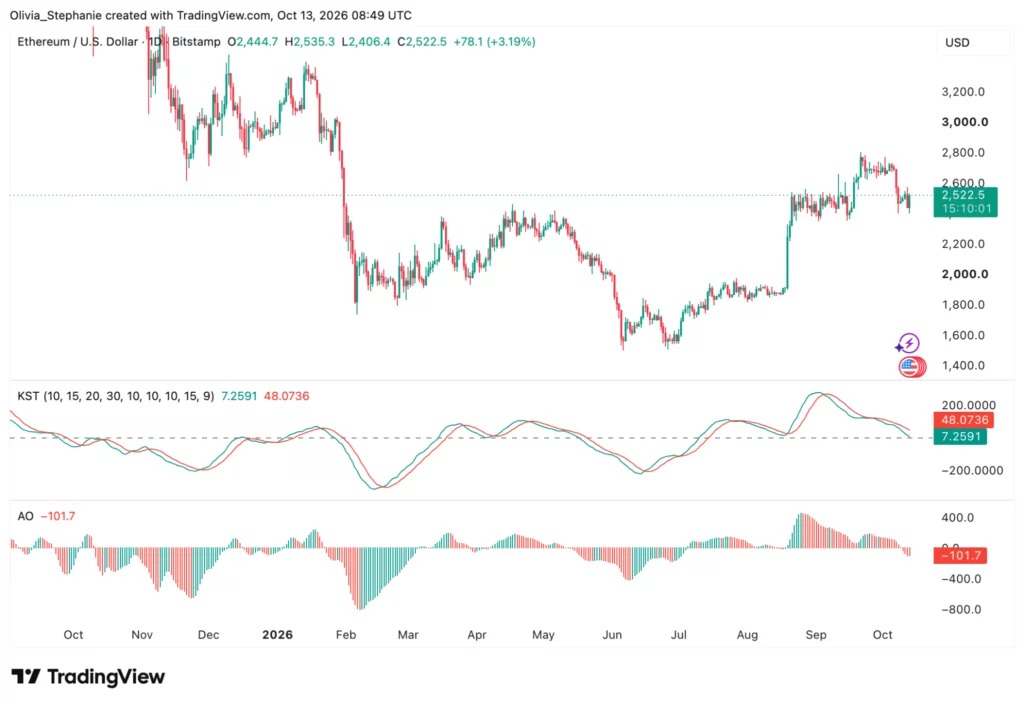
The token has previously rebounded from a low of nearly $1,550 in June, but it is still below the high of around $2,800 in late September. The chart shows that the recent support level is between $2,400 and $2,450, with another potential support level at $2,200.
Resistance levels are still around $2,600, followed by the range of $2,750 to $2,800. If a breakthrough above $2,600 occurs, it will improve the rebound structure depicted on the chart; if the support at $2,400 is lost, Ethereum may test even lower support levels again.
Meanwhile, crypto analyst Iko observed that Ethereum managed to hold above the $2,500 level despite a decline on the previous trading day. The analyst considers $2,550 to be the next price level that requires attention, but noted that a confirmed breakout in the rebound has not yet occurred.
Another analyst, Ash Crypto, stated that Ethereum has been trading within a long-term range for nearly 5 years. He suggested that if ETH breaks through the multi-year resistance level, there could be a significant upward movement, but this judgment does not indicate when such a breakthrough might occur.
BitMine increased its holdings by 12,532 ETH, but the buying pace may have slowed down.
While issuing a warning of potential short-term losses on Lee, Ethereum treasury company BitMine Immersion Technologies disclosed that it purchased an additional 12,532 ETH coins during the week ending October 11. The company stated that its total holdings have reached 6,028,946 ETH coins, which is approximately 4.9% of Ethereum's disclosed supply of 122.1 million coins.
BitMine indicates that approximately 99% of the goal to hold 5% of the Ethereum supply has been achieved. Based on the price of $2,544 per ETH, cited by the company, the value of its cryptocurrency holdings is about $15.3 billion. The company disclosed that as of October 11, its total assets including cryptocurrencies, cash, tradable securities, and other investments amounted to $16.2 billion.
According to the company's update on October 12th, approximately 5.07 million ETH have been pledged, accounting for the majority of their disclosed Ethereum holdings. BitMine describes its treasury strategy as focusing on accumulating ETH and generating income through Ethereum pledging. The balance disclosed by the company includes assets that have already been put into pledging operations.
Management stated that the company 'has essentially completed the purchase of ETH', which means that as it approaches the 5% threshold, the pace of purchases may slow down. This statement does not imply that the purchase of Ethereum with BitMine has been permanently halted; future transactions will still depend on management's decisions.
BitMine Earlier Ethereum accumulation plans set a target of 5% of the supply as the company's main treasury goal. Lee In June, it was stated that once this threshold was reached, there might be no need to continue accumulating further. ETH.
Ethereum indicators show weakening buying momentum
Despite a recent rebound in prices, Ethereum's technical indicators still show weakening momentum. The provided daily chart places the Know Sure Thing indicator at 7.3727, which is below its signal line of 48.0863. The gap between the two indicates that the previous upward momentum has weakened, although both values are still positive.
The reading for Awesome Oscillator is more negative. This indicator stands at -101.7, still below the zero line, indicating that short-term momentum is weaker than the long-term trend as shown by the negative bar chart. This reading is consistent with the selling pressure that occurred during Ethereum's recent decline.
To resume upward movement, the chart identifies $2,550 as the first price level that needs attention, followed by resistance around $2,600. If it can continuously break through this range, the trading range of $2,750 to $2,800 seen in September will come back into focus. These levels are technical reference points in the provided chart and are not guaranteed to be reached.
On the downside, the analysis considers $2,400 to $2,450 as the recent support range. If it continues to fall below $2,400, it will weaken the rebound structure and make $2,200 the next identified support level.
South Korean financial regulators have previously examined the risks associated with leveraged stock investments. Reports in July 2026 indicated that the balance of margin loans reached 38.63 trillion Korean won in June, while investors' total debt exceeded 60 trillion Korean won in May. These figures describe the previous situation in South Korea's leveraged investment market and do not provide evidence of the amount of forced sales that occurred during the trading session on October 13.
Disclosure:This article does not constitute investment advice. The content and materials on this page are for educational purposes only.