

Intraday Outlook for October 13
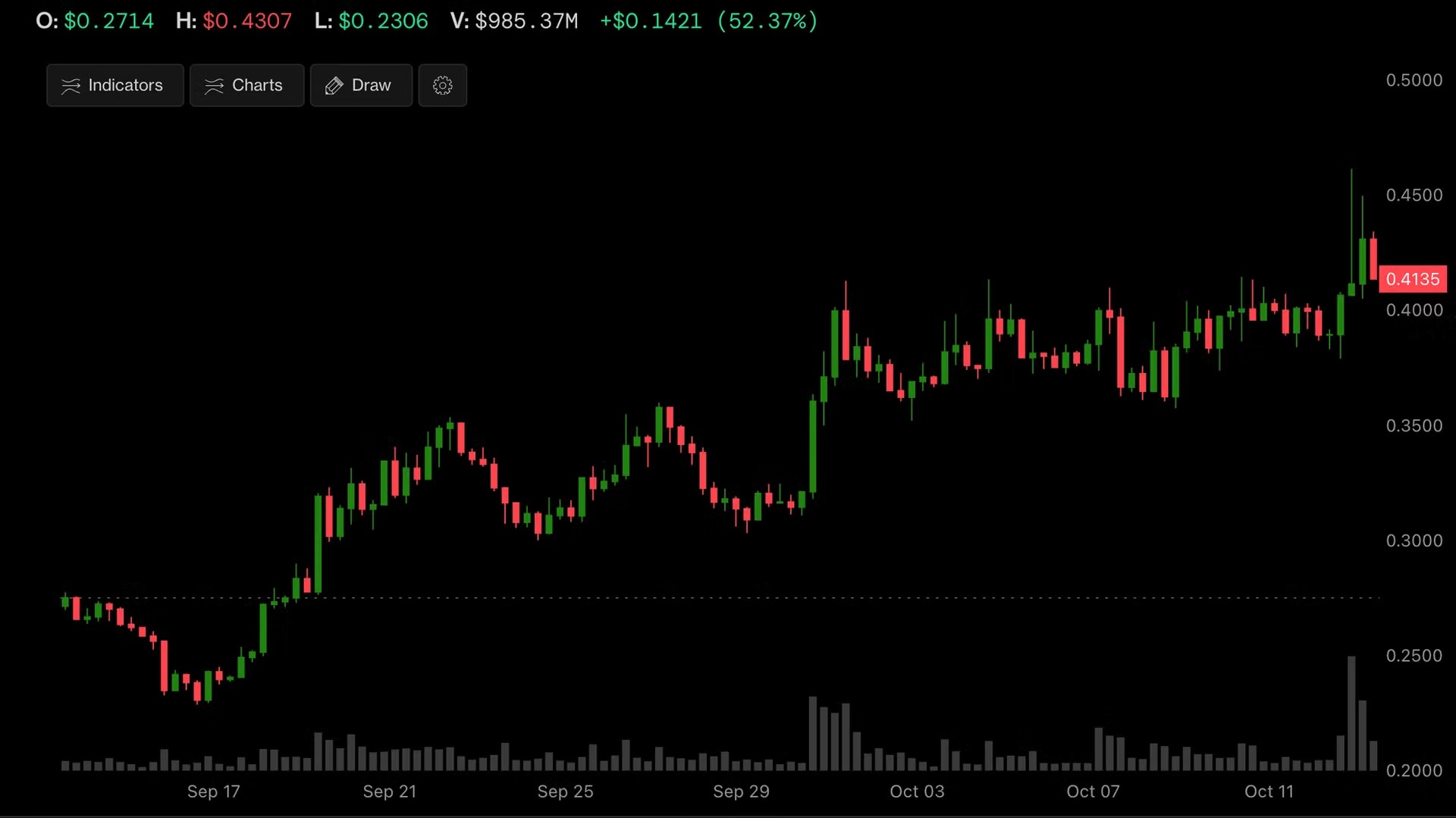
Despite the volatile trends of major cryptocurrencies, STX, the native token of the Bitcoin layer-2 project Stacks, is on the rise. In the past 24 hours, this cryptocurrency has increased by nearly 10%, and over the past week, it has risen by 14%. Its performance has been better than that of Bitcoin at $83,696.96, Ethereum at $2,502.34, XRP ($XRP), and other cryptocurrencies.
This strong performance may reflect investors' interest in the Stacks un-hosted Bitcoin staking architecture. This framework allows holders of BTC to stake directly on the Bitcoin mainchain and earn profits while retaining full control over their private keys. In contrast, traditional frameworks usually require users to package their assets into synthetic tokens (such as wBTC) or transfer funds through cross-chain bridges to obtain additional earnings.
The framework of Stacks relies on a mechanism called “bonding”, which requires participants to lock in assets to ensure network security. “Bonding Period 3” is scheduled for November, and participants holding the native STX are required to lock in an additional proportion of STX—equivalent to approximately 5% of the total value of their BTC—in addition to what they already have locked in BTC in order to successfully obtain the capacity of the protocol stacking.
This creates a positive feedback loop for STX: as more BTC flows into the Stacks ecosystem, more STX will be systematically locked out of the active market. By directly linking Bitcoin liquidity to the scarcity of STX, this architecture clearly favors long-term price increases.
Before Period, Period 1 and Period 2 were used as a preparatory phase to ensure a secure transition for signatories and to provide initial liquidity.
STX is not the only token to experience a significant increase in value within 24 hours. BDX, REDNER, and PYTH also ranked among the top performers with increases of about 6% each. This indicates that liquidity is increasingly shifting towards tokens other than the major cryptocurrencies.
However, the broader context is still closely related to macroeconomic indicators. Analysts are preparing to welcome the release of the U.S. Consumer Price Index ( CPI ) on Wednesday, a figure that could have a significant impact on expectations for the Federal Reserve's upcoming interest rate decisions. Please stay tuned.
Read more:For analysis of today's counterfeit coin and derivative activities, please refer to Crypto Markets Today. For a complete list of events this week, please see “Crypto Week Ahead” in CoinDesk.
Ledger indicates that the "spy" chip in the CryptoBilis Ledger device transmitted the wallet key (CoinDesk) over the mobile network: The embedded Ledger encrypted wallet device's concealed hardware read the user's 24-word recovery phrase and sent it to the attacker via the mobile phone network.
Bitcoin whales that survived the crash in March 2020 transferred $378 million (CoinDesk): A whale that received Bitcoin a few days before the crash in March 2020 triggered by the COVID-19 pandemic and has held it ever since, transferred BTC worth $377.6 million.
As energy prices decline, U.S. Treasury yields fall (CNB): As investors focus on a series of key economic data releases this week, bond yields have moved lower amid falling energy prices in the early session.
Today's Signal
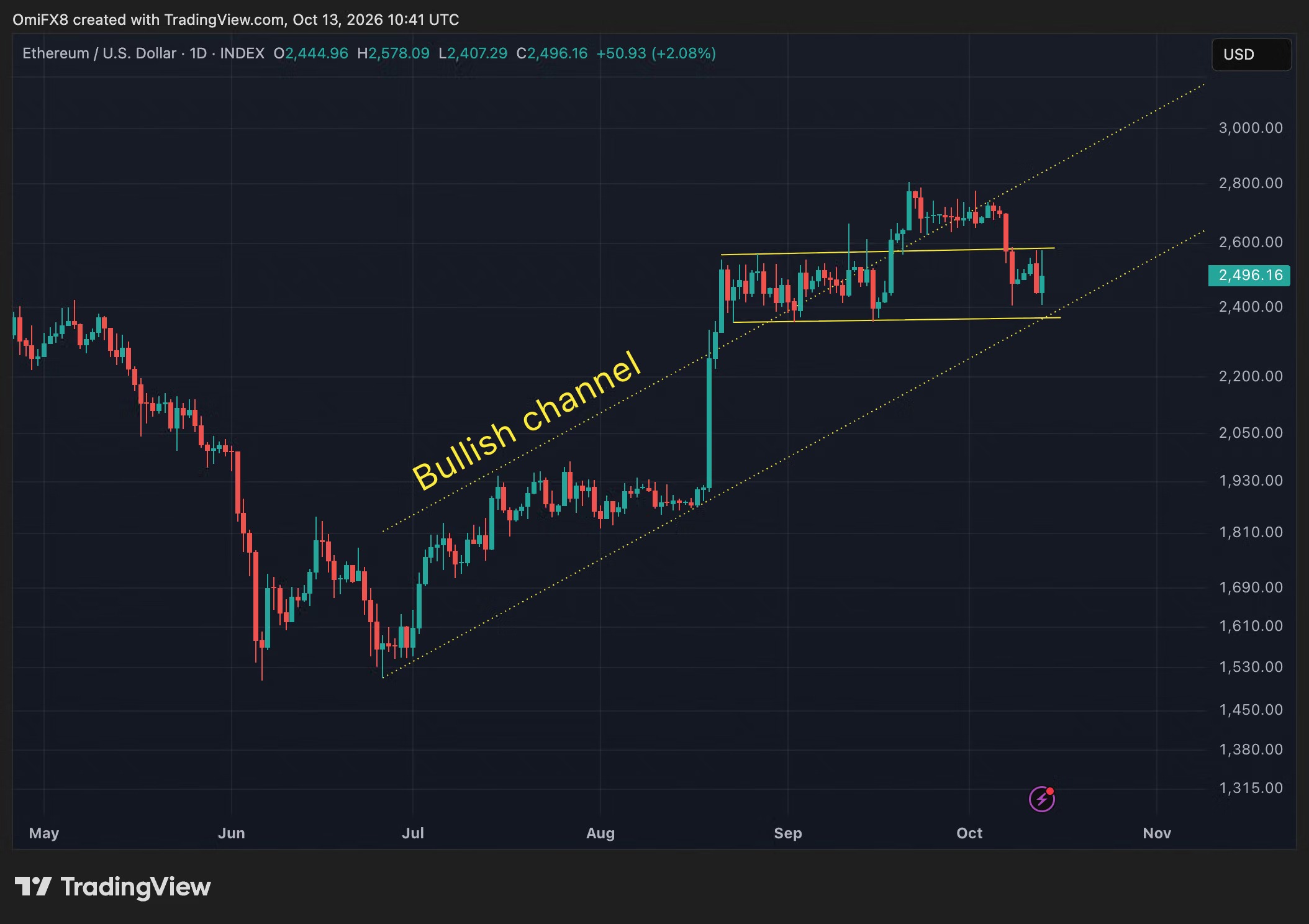
The chart displays the intraday price fluctuations of Ethereum in the form of candlestick charts.
The second-largest cryptocurrency by market capitalization has fallen back into its existing yellow consolidation range and is currently trading closely within that range.
If the price breaks through the upper edge of the consolidation range, the market may retest the recent high of $2,800. If the double support level of $2,400 – which is also the lower edge of the consolidation range and the lower edge of the bullish channel – is lost, it would mean that the rebound since the July low will come to an end.
2 Russia's largest bank Sberbank approved to trade cryptocurrencies 46 minutes ago
3 Real-time updates: Bitcoin fluctuates violently between $81,000 and $84,000; altcoins fall 1 hour ago
4 As concerns over AI deepen, the Kospi index sees a sell-off, while Bitcoin and the South Korean stock market show divergent trends 1 hour ago
5 Ledger indicates that the "spy" chip in the CryptoBilis Ledger device transmitted the wallet keys over the mobile network 2 hours ago.
6 British court ruling increases likelihood of government retaining $5 billion in seized bitcoins 2 hours ago
7 Bitcoin whales that survived the crash in March 2020 transferred $378 million 6 hours ago
8 With the collapse of Asian chip stocks wiping out $800 million, the amount of margin calls on tokenized SanDisk bets exceeded XRP 6 hours ago.
The once-largest Ethereum NFT market Blur will be closed for 7 hours after its trading volume plummeted by 99% 7 hours ago.
10 Bitcoin rebounds above $83,000, decoupled from South Korea's plummeting stock market 7 hours ago
Beyond risk-free rates: Diversified real-world returns in productive stablecoins
Diversification: RWA Stablecoins maintain yields of 5% to 7% through real credit, while the cost of crypto financing has been reduced to around 4%. GENIUS Yields are transferred off-chain; the total potential market size is expected to grow to $4 billion within three years.
Why it's important:Diversification: RWA Stablecoins maintain yields of 5% to 7% through real credit, while the cost of crypto financing has been reduced to around 4%. GENIUS Yields are transferred off-chain; the total potential market size is expected to grow to $4 billion within three years.
Trump's commitments regarding Iran support the rise of cryptocurrencies, and Bitcoin bears face margin call pressure
Bitcoin ETF investors are fleeing in droves, and this is the largest outflow in several months.
What is needed for Bitcoin to break through $87,000?
Russia's largest bank Sberbank approved to trade cryptocurrencies
Real-time update: Bitcoin fluctuates violently between $81,000 and $84,000, while altcoins decline.