The S&P 500 index has repeatedly reached new highs, but the internal divergence in the market, rising financing costs, and the risk of a slowdown in the growth rate of AI capital expenditure are accumulating. Goldman Sachs' senior macro trader Bobby Molavi warns that current U.S. stocks are becoming increasingly dependent on the strong performance of a few large tech companies, while professional investors find it difficult to profit from the rise in the index, and market vulnerability is on the rise.
Molavi pointed out in the latest report that the scale of related assets in the entire AI ecosystem has reached $25 trillion to $30 trillion. Historical experience shows that stock prices usually peak before capital expenditures peak. To determine whether the AI investment cycle is approaching a turning point, three signals can be observed: a divergence between stock prices and actual earnings, a re-pricing of AI borrowers by the credit market, and a actual slowdown in the growth rate of capital expenditures. Currently, the first two signals have already appeared.
Goldman Sachs predicts that the growth rate of capital expenditure for hyperscale cloud service providers may peak in the third quarter of 2026, after which it will decline quarter by quarter. At the same time, the financing costs of AI are rising, equity issuance has cooled down, and the market's scrutiny of investment returns has become more stringent. Although stock repurchases continue to support the U.S. stock market, the highly concentrated market structure means that once there are changes in the investment expectations of AI, adjustments could quickly amplify.
Index hits a new high, yet the market is becoming increasingly fragile internally.
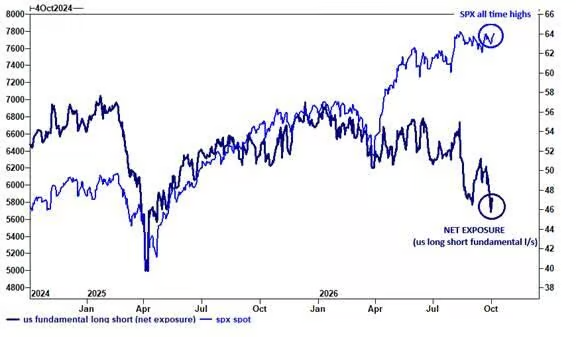
Molavi describes the current U.S. stock market as "running desperately but standing still in place." The S&P 500 index continues to set new highs, yet the net long-short position of U.S. fundamental strategies has dropped to around 46%, near the low levels during the market crash in April 2025, reflecting the difficulty for hedge funds to profit from this round of gains.
Market differentiation is an important factor. The report shows that the difference between the volatility of individual stocks and the volatility of the index over the past three months has expanded to 26 to 28 percentage points, exceeding the historical high of around 20 percentage points in 2009. The intense fluctuations of individual stocks cancel each other out, making the index appear stable on the surface, but this increases the difficulty of trading.
The current market concentration has surpassed the peak of the Internet bubble in 2000. Reports indicate that 10 core AI related stocks currently account for approximately 40% of the total market value of the S&P 500 index. The best-performing AI related stocks within the year saw an average increase of 58%, far exceeding the 13% gain of the S&P 500 index and the 22% increase of the Nasdaq index, while the median performance of S&P 500 constituents actually declined by 15%. Furthermore, the market value of just 5 stocks is equivalent to the total market value of the remaining 434 stocks, highlighting the high dependence of the U.S. stock market on a few large companies.
It is worth noting that liquidity has further deteriorated. The average daily trading volume liquidity in the U.S. stock market has decreased by 21% since 2023, from approximately $14 million to $11 million; the depth of trading corresponding to every one billion dollars in trading volume has also dropped from $162,000 in 2017 to $11,000, a decrease of about 93%. During the same period, the average daily trading volume has increased from about 6.5 billion shares to nearly 19 billion shares. The increase in trading volume while the depth of trading has diminished indicates that the market's ability to handle large transactions has weakened, making individual stocks more prone to significant fluctuations due to sudden news.
AI Capital expenditure approaches a turning point: Changes in stock price, profitability, and financing risks occur simultaneously
Molavi Estimates indicate that the entire AI ecosystem, which encompasses large technology companies, cloud service providers, AI laboratories, as well as chip and computing power infrastructure, has a related asset scale of 25 to 30 trillion US dollars. Its value largely depends on ongoing investments in expanding infrastructure.
Historical experience shows that stock prices usually peak before capital expenditure does. Among the three observation signals proposed by Molavi, the divergence between stock prices and actual earnings, and the re-evaluation of the risks of borrowers in the credit market (AI) have already occurred, while the slowdown in the growth rate of capital expenditure remains to be verified.
Firstly, the forward price-earnings ratio may underestimate the true valuation. Report data shows that in March 2000, the forward price-earnings ratio for the S&P 500 was 25.2 times, but when calculated based on actual realized earnings, it reached 39.3 times, and using the GAAP metric, it was approximately 60 times. In 2007, the forward price-earnings ratio was only 15.1 times, but when calculated based on realized earnings, it reached 31.6 times, and under the GAAP metric, it exceeded 100 times. Molavi Therefore, whether the forward valuation is reasonable ultimately depends on whether the company's earnings can be realized.
Secondly, the financing risks associated with AI are being re-priced. The report indicates that over $500 billion in debt has been issued this year to support the infrastructure construction of AI. The yield on several well-known AI financings has continued to rise, and the credit spreads between investment-grade and high-yield bonds have also widened, suggesting that creditors are raising their pricing of the related financing risks.
Thirdly, the growth rate of capital expenditure may be peaking soon. Goldman Sachs predicts that the growth rate of capital expenditure for hyperscalers in cloud services will reach a peak of 116% year-on-year in the third quarter of 2026 and then drop to just over 20% by the end of 2027. A peak in growth rate does not necessarily mean that the total amount of capital expenditure will decline immediately, but if the market has previously priced in continued acceleration of investment, a slowdown in growth rate could still change investors' expectations for future returns.
Changes in the financing environment have further increased pressure. The number of monthly equity offerings in the United States decreased from 65 in May to 24 in September, and the total quarterly offerings fell from $252 billion in the second quarter to $93 billion in the third quarter. Secondary offerings were weak, and some transactions were forced to be withdrawn. Although Broadcom and SpaceX are still preparing for a new round of financing, high interest rates and increasing uncertainty in investment returns are making buyers more cautious than in the first half of the year.
Repurchases are still supporting the U.S. stock market, while risks in oil prices and the bond market are accumulating simultaneously.
As financing becomes tighter, stock repurchases continue to support the U.S. stock market. The scale of repurchases by S&P 500 constituents in the second quarter increased by 20% year-on-year, and the total repurchase authorization for the year in the United States is expected to reach a record high. However, whether these repurchases will offset market concerns regarding profit realization and the return on investment for AI remains to be seen.
At a macro level, pressures are also accumulating in France's bond market and energy market. Molavi notes that the yield spread between 10-year French and German government bonds has reached 140 basis points, the highest level since 1990, reflecting market concerns about France's fiscal and political risks, and there is a warning that these pressures could spread to other eurozone countries.
In terms of energy, the volatile geopolitical situation, high shipping and insurance costs, as well as constraints on refining capacity, are eroding the market's buffer space. The report indicates that the price of aviation kerosene ranges from $1,100 to $1,400 per ton depending on the contract term, which is significantly higher than the long-term average of around $700. If fuel costs continue to drive up airfare prices, it may increase the burden on consumers and prompt some people to opt for shorter and cheaper trips.
The warning regarding Molavi is not an assertion that investments in AI have peaked, but rather indicates that the market is approaching a critical phase where investment returns will be re-evaluated: there is a divergence between stock prices and actual earnings, the credit market has begun to raise the risk pricing for borrowers of AI, and the growth rate of capital expenditure may also slow down.