


JPMorgan's stock price came under pressure after third-quarter earnings and revenue fell short of analyst expectations, and the market became more cautious about its short-term prospects. Although net profit increased year-over-year, both earnings per share and revenue failed to meet market consensus. The slowdown in its investment banking business also raised doubts about the sustainability of growth. JPMorgan's trading business performed better, but this was not enough to dispel concerns about a slowdown in customer activity. As the stock price approaches a key technical support level, investors are weighing the bank's fundamental resilience against the risk of weaker profit momentum in the coming quarters.
JPMorgan's performance falling short of expectations raises new concerns
An investment of $658 million resulted in losses, putting additional pressure on performance. More importantly, at a time when profits fell short of expectations, some of the bank's strongest businesses also showed signs of slowing down compared to the previous quarter. For investors, the concern is not just that JPMorgan did not meet expectations, but whether the bank will be able to continue to deliver the growth that Wall Street has factored into its stock price, especially against the backdrop of changing market conditions and corporate activities.
Slowing down of trading activities puts pressure on investment banking business
JPMorgan's investment banking fees increased by 14% year-on-year, but decreased by 8% compared to the second quarter. CEO Jamie Dimon stated that customer activity in investment banking and market business has cooled down from the strong levels of the previous quarter. Such a sequential slowdown is important because mergers and acquisitions (M&A) and initial public offerings (IPOs) can bring considerable revenue to large banks. If companies postpone their listing or financing plans, investment banking revenues may face further pressure.
However, JPMorgan Chase's market business provided some support, and driven by volatility, revenue increased by 15% year-on-year. The retail banking business also maintained its resilience, with net interest income growing by 6% to $24.7 billion, and average loans increasing by 10%. Nevertheless, these strong performances cannot eliminate the risk that a weakening investment banking business may drag down overall profit growth. Investors will be watching to see whether this slowdown is merely temporary or the beginning of a broader decline.
JPMorgan Stock Analysis: Can It Hold the 325 Dollar Support Level?
JPMorgan Chase's stock price has significantly fallen from its peak of nearly $370 in August and is currently attempting to stabilize in the range of $334 to $338. The recent rebound has not yet reversed the broader short-term weakness, and the stock price is still below the downward-moving moving average.
The support range of $320 to $325 is the most important level on the chart. This range coincides with a horizontal demand area and an upward trend line, forming a technical zone where buyers may attempt to hold the stock price.
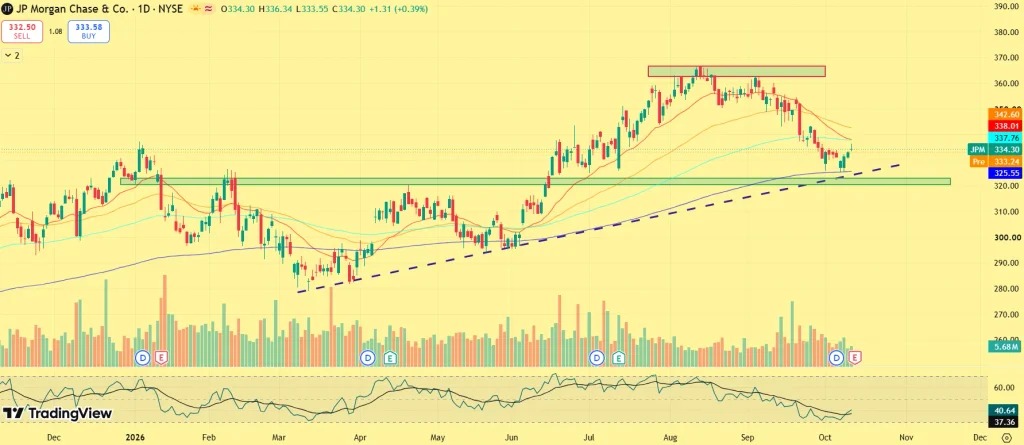
If it effectively falls below $320 to $325, it will weaken the chart structure and put JPM under further downward pressure. If this support level holds, the stock price may attempt to rebound, but first it needs to break through the resistance around $338 to $342. If it manages to stay above this range, the stock price could open up space towards $350, however, a brief intraday rebound alone is not enough to negate the current bearish structure.
Can the seller push the price of JPM below its support level?
After third-quarter performance fell short of Wall Street's expectations and there were signs of cooling in its investment banking business, JPMorgan Chase's stock price is facing a severe test. Higher year-over-year profits and stronger trading revenues provide fundamental support for the stock price, but they have not alleviated market concerns about its growth trajectory. Technical factors also add to the risks: if the price falls below $320 to $325, the correction could deepen; if it manages to rebound above $338 to $342, short-term selling pressure is expected to ease. Until these two levels are clearly broken through, the risk remains on the downside.