


The demand for XRP ETF remains strong, but the activities on the chain show less optimistic signs. According to data from SoSoValue, as of October 12th, XRP ETF had a total net asset of 1.55 billion US dollars, with a cumulative net inflow of 1.8 billion US dollars. This is a considerable amount of capital retained.
However, blockchain data is not so satisfactory: the number of active users has dropped from a peak of 500,000 in August to less than 100,000.
This contrast raises an awkward question: Do investors still maintain their interest, while daily online activities are waning?
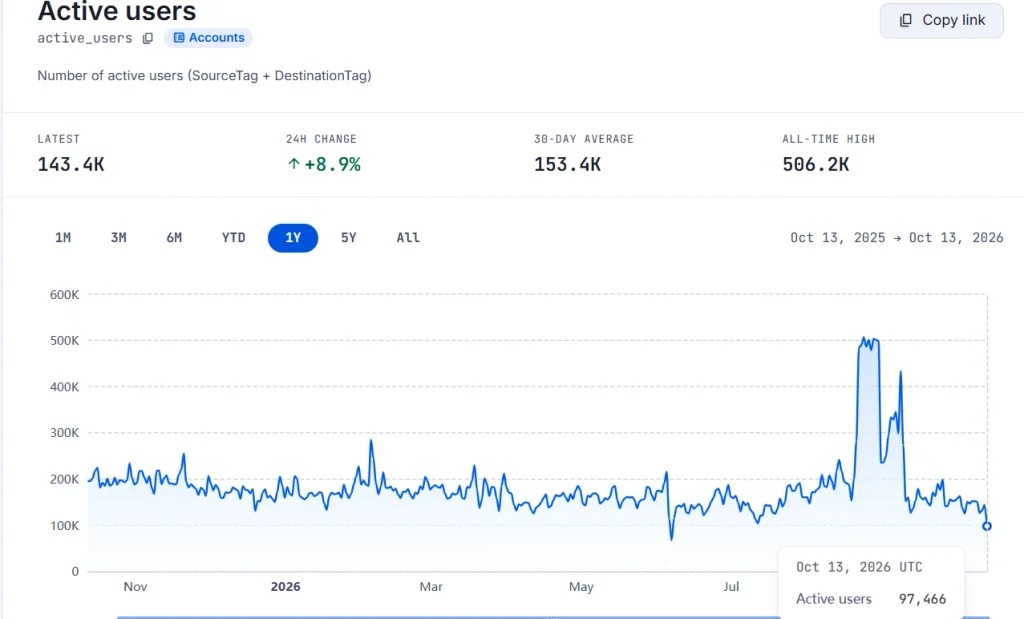
XRP ETF Capital inflows remain stable despite the cooling down of activities
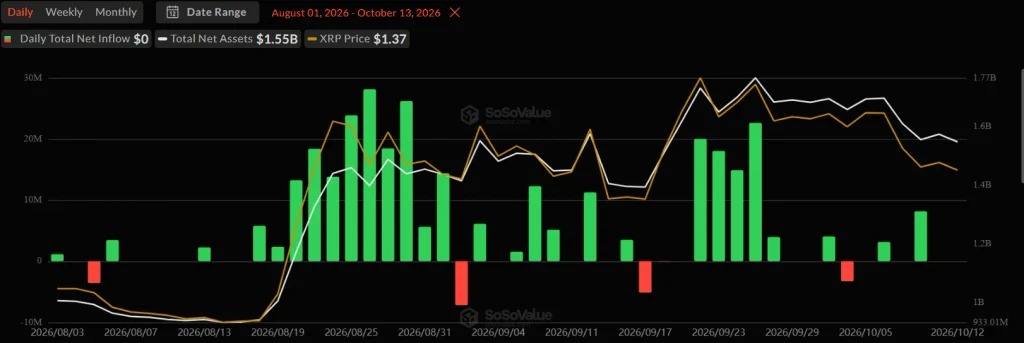
The dashboard data shows that the situation of capital withdrawal is not as severe as that of BTC ETF. However, ETF measures different things: capital inflow and network participation. Strong capital inflow does not necessarily mean that more people are using the network.
XRP Price faces a crucial support test at $1.30
XRP rebounded from $1.00 to $1.70 in August, then encountered resistance and fell back to around $1.30. Since then, the $1.30 range has been repeatedly tested.
This level has now become of paramount importance. If it can be maintained, the recent price trend might just be a retest, rather than a breakdown. However, repeated tests do carry risks; when buying pressure fails to generate new demand, the support level may weaken.
XRP Can it regain $1.50 and $1.70 again?
Whether there can be a rebound depends not only on the ETF headline news. A recovery in demand may also be reflected in an improvement in the number of active users, stronger XRP ETF capital inflows, and more stable token prices.
If the level of $1.30 is held and momentum returns, XRP may retest $1.50 and $1.70, with the potential to move even higher. However, if this support level is lost, $1.00 will become the next downward level worth watching.
For now, the capital inflow for XRP ETF is still encouraging, but the decline in activity is a warning sign. The $1.30 support level is a critical battleground: if it can be held, a rebound is still possible; if it is lost, the market may need to re-evaluate its bullish logic.