US spot XRP exchange-traded funds (ETF) attracted only $740,400 in net inflows on October 14, highlighting a significant slowdown in new institutional demand. Despite this, since the launch of these products in November 2025, the cumulative investment volume has reached approximately $1.8 billion.
According to the tracking data of XRP ETF under SoSoValue, after the trading ended on Wednesday, the cumulative net inflow reached $1.803 billion. On that day, only Bitwise was the issuer that attracted new funds.
The modest inflow on Wednesday stands in sharp contrast to the stronger institutional demand in September.
On September 25th alone, the US spot XRP ETF attracted approximately $22.6 million in capital inflows; on September 24th it was $14.9 million, and on September 23rd it was $18 million.
However, by October 14th, the daily inflow had slowed down to only $740,400, and all of it went into Bitwise XRP ETF.
Since its launch, the fund has accumulated a net inflow of approximately $688 million, making it the most significant contributor among the tracking products. Franklin Templeton follows closely behind with a cumulative amount of about $509 million, while Canary Capital recorded nearly $487 million.
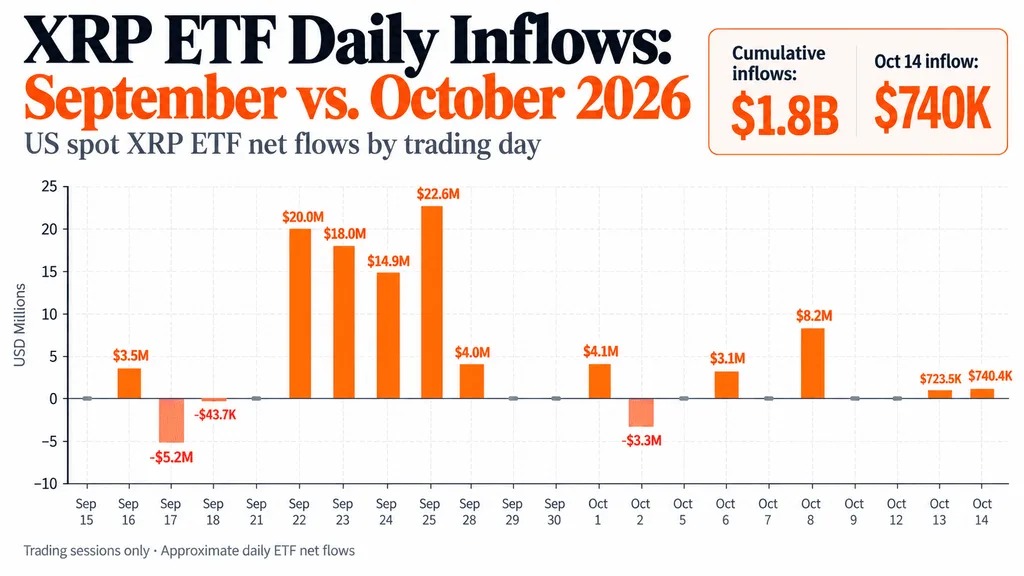
This relatively weak one-day data appears after institutions have maintained demand for XRP for some time. It is reported that even as the price of this cryptocurrency has fallen, these funds have still maintained a net capital inflow for 13 consecutive weeks.
However, a single weak trading day does not necessarily mean that investors are giving up on XRP ETF.
Why is the net asset of XRP ETF lower than the cumulative net inflow?
Another development worth noting is the discrepancy between the funds flowing into the XRP fund and the current market value of its holdings.
As of October 14, XRP ETF has accumulated a net inflow of approximately $1.803 billion, while its total net asset value is only $1.509 billion.
This gap reflects the impact of XRP price fluctuations, and it is also related to the fund's capital flow as well as other factors that affect the scale of asset management.
ETF Net inflow measures the difference between subscriptions and redemptions, while net assets represent the value of the current holdings after adjustments for market fluctuations and at the fund level.
Therefore, if the timing of purchases, the timing of redemptions, and changes in fund assets are not taken into account, this difference should not be interpreted as an accurate measure of investors' losses.
Coinpaper previously reported on how to purchase digital assets using ETF, and explained why the inflow of funds does not directly convert into an equivalent amount of immediate buy orders on spot exchanges.
With prices continuing to be weak, can the demand for XRP ETF recover?
As demand slows down, XRP is still struggling to overcome the impact of the cryptocurrency sell-off in October.
Coinpaper recently reported that from October 5th to 9th, XRP fell by about 7.3%, while during the same period, US spot XRP ETF still attracted approximately $11 million in new investments.
This contrast indicates that the demand in regulated investment channels is not yet sufficient to offset the selling pressure in other areas of the cryptocurrency market.
Marcus Hale
Marcus Hale is a cryptocurrency and financial markets journalist whose coverage includes Bitcoin, Ethereum, digital assets, regulation, ETF, and institutional adoption. His focus is on significant developments that influence the market, investor trends, as well as the broader forces that shape the crypto economy.