Key Points
- Cryptocurrency exchanges can charge a handling fee regardless of which direction the price moves.
- Forced liquidation may lead to additional trading activity.
- A decline in prices does not guarantee higher profits for exchanges.
Imagine this: Bitcoin plunges by 15% in just one afternoon. Traders fall into panic, leveraged positions collapse one after another, and the market value of cryptocurrencies evaporates by billions of dollars. Yet, the exchanges that handle these transactions may still charge higher fees than on calm trading days.
The reason lies in the way cryptocurrency exchanges make money. Unlike investors who profit from the appreciation of assets, the main income for exchanges comes from providing matching services for transactions, whether customers are buying or selling.
This has created an unusual business dynamic: a market collapse may increase transaction revenue in the short term, even though customers themselves suffer significant losses.
Why does a sharp drop in Bitcoin prices increase transaction fees?
Most centralized cryptocurrency exchanges charge commissions when users execute transactions. These fees typically depend on the size of the transaction, the volume of trading, and whether the order is adding to liquidity or consuming liquidity.
When Bitcoin experiences a significant decline, investors may rush to sell, short sellers may close their profitable positions, and other traders may try to buy at lower prices. Each transaction can generate commission revenue for the platform.
The article provides a simplified example: Suppose a cryptocurrency exchange charges an average commission of 0.10% per transaction.
It is also noted in the text that these figures are for illustrative purposes only and do not represent the actual revenues of the exchange. The actual fees will vary depending on the product, users, and type of transaction.
The relationship between trading activities and exchange revenues is also reflected in the 2025 annual report of Coinbase. The company disclosed that its trading revenue amounted to approximately $4.06 billion.
However, higher volatility does not always lead to stronger financial performance. The article points out that during long-term downward phases, decreased participation may suppress income; the transaction revenue of Coinbase in the first quarter of 2026 fell by 40%, which can serve as an example to illustrate this point.
Will crypto exchanges profit from forced liquidations?
During periods of extreme volatility, derivatives trading can provide another potential source of income.
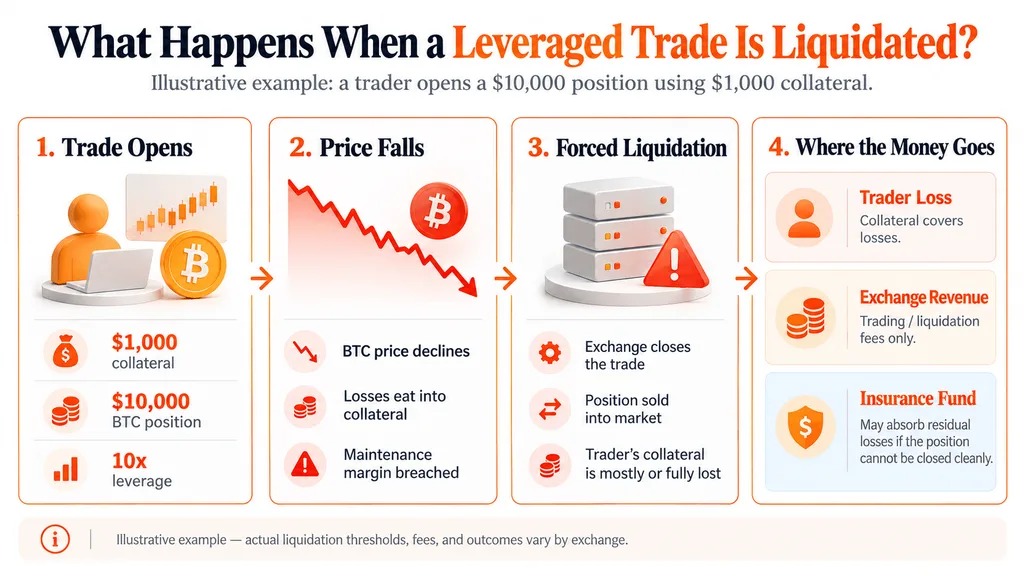
When investors use leverage, the size of the positions they control is greater than the margin they have paid. As long as there is a sufficiently large fluctuation in price in an unfavorable direction, it may trigger an automatic forced liquidation.
These liquidations will increase trading activity, and according to the exchange's derivatives rules, additional fees may be incurred.
In a rapid downward market trend, the nominal value of forced liquidations of Bitcoin could quickly reach several billion dollars, even if the initial margin deposited by traders is much smaller.
But an important difference is that exchanges do not automatically retain the full value of the positions that are forcibly liquidated.
For example, Binance explains that certain forced liquidations will incur settlement fees; at the same time, when a position cannot be closed normally, its insurance fund will help absorb specific losses.
The funding fees for perpetual futures are usually paid back and forth between long and short traders, rather than being collected by the platform as revenue. Binance clearly states that they will not charge a service fee on these funding fees.
Why do exchanges still might lose money during a bear market?
A surge in short-term trading volume does not guarantee long-term profitability.
If Bitcoin continues to decline in value over the long term, it may dampen retail investors' enthusiasm for participation, reduce trading volumes, and decrease the balance of assets that users hold on exchanges. Regardless of the market conditions, platforms still have to bear technical, compliance, security, and operational costs.
The expansion of the encrypted derivatives market has brought more revenue opportunities, but it has also introduced operational and regulatory risks.
In the end, the sudden sharp drop in Bitcoin prices may lead to increased trading activity, which could benefit cryptocurrency exchanges; however, this does not mean that the exchanges themselves will directly benefit from the price decline.
Adrian Cole has been engaged in financial market reporting for over 6 years, with a focus on cryptocurrencies, stocks, and macroeconomic trends. He tracks Bitcoin, major altcoins, the U.S. stock market, interest rates, commodities, and various types of data that drive market fluctuations. Over the years, he has written hundreds of market updates and analysis articles, with an emphasis on price trends, investor sentiment, and the connections between traditional finance and digital assets.