Key Points
- Apple's market value closes above $5 trillion for the first time
- AI Infrastructure stocks tumbled due to financing concerns
- Apple's relatively restrained spending strategy has attracted the attention of investors.
Apple Inc. ( NASDAQ : AAPL ) surpassed a market value of $5 trillion for the first time on October 14, withstandding a broader sell-off in tech stocks. This sell-off caused the market value of artificial intelligence companies to evaporate by billions of dollars and dragged down the Nasdaq Composite Index by nearly 2%.
This comparison raises an unusual question for investors: Is Apple's decision to avoid the most expensive parts of the AI infrastructure race becoming a competitive financial advantage?
Apple's market value reaches $5 trillion, while the Nasdaq falls by nearly 2%
Previously, Apple's stock price had broken through this level during trading, including during the record-breaking rise in September, but it failed to maintain this milestone valuation on multiple occasions at the close of trading.
On Wednesday's close, this record was finally confirmed, bringing Apple's increase from the beginning of the year to date to about 26%, while the S&P 500 index has risen by approximately 13%.
This performance is particularly noteworthy, as the trend in the broader technology sector is clearly the opposite.
The Nasdaq Composite Index fell by about 1.9%, while CoreWeave, Nebius, Oracle, and Dell experienced significant declines. The reason is that investors re-evaluated whether the debt-driven expansion of AI is profitable.
According to Reuters, these four companies lost a total of about $80 billion in market value during the sell-off on Wednesday.
Why Apple's lower AI expenditure could be an advantage
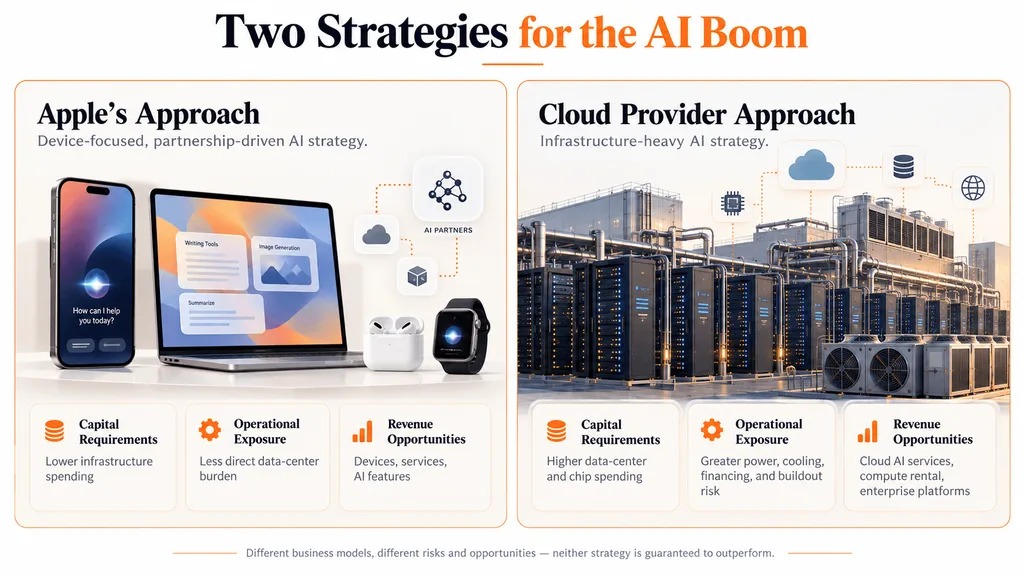
Unlike Microsoft, Meta, and Alphabet, Apple has not committed to investing a similar amount of capital in building a large AI data center network.
Apple's approach relies more on existing hardware, device-side processing, and partnerships, enabling the company to develop AI driver products without necessarily having to own every aspect of the underlying computing infrastructure.
As interest rates rise, this disparity becomes even more significant, as the costs of large-scale expansion also increase.
This financial pressure has already become apparent in the AI debt market, with the default insurance cost for CoreWeave exceeding 1000 basis points, and the credit protection spread for Oracle also rising to record levels.
Apple is facing a different kind of financial challenge. Instead of building its infrastructure through heavy borrowing, the company must prove that its improved devices and services can support consumer spending and protect its profit margins.
Apple is about to launch the iPhone Duo, which is a foldable device with a starting price of $1,999. Pre-orders are expected to begin shortly before its release on October 23rd.
The company is also developing an updated version of Siri experience, utilizing Google's AI technology, which may allow them to expand their capabilities without replicating the infrastructure investments of their main competitors.
However, spending less money does not automatically mean that Apple will achieve better long-term returns. A deeper dependence on external AI providers may pose strategic risks; whereas competitors that control their own infrastructure may be able to capture more value as demand grows.
Nvidia and AI chip manufacturers face different financial challenges
Apple's resilience does not necessarily mean that the broader AI investment boom is coming to an end.
However, chip manufacturers are facing increasing pressure to prove that their valuations are based on expectations of exceptional growth in the coming years.
In recent times, the sell-off in the semiconductor sector has wiped out approximately $1.64 trillion in market value over six trading days, indicating that even though underlying demand remains strong, investors' expectations can change rapidly as well.
Apple's valuation is also not without risks. A slowdown in smartphone upgrades, high prices for new products, and intensified competition from AI could all challenge its profit prospects.
For now, the milestone of $5 trillion highlights a divergence between two types of technology companies: one group is actively investing in future computing power, while the other is generating revenue through mature consumer businesses.
Whether Apple's more restrained strategy will ultimately prove to be better will depend on profitability, product demand, and how much consumers are willing to pay for the AI feature.
Author Information
Ethan Mercer is a financial journalist who covers cryptocurrency, stocks, and the global economy. He studied economics and finance before turning to market reporting, with a particular focus on Bitcoin, stocks, monetary policy, and investor sentiment. His work focuses on explaining daily market fluctuations as well as the broader trends behind them.