CBN News 2026-10-16 06:58:52
Author: Chu Chu Editor-in-Chief: Ge Weier
*The three major U.S. stock indices closed higher, with the Dow Jones rising by more than 1%;
*Medical and consumer stocks strengthened, while the Philadelphia Semiconductor Index fell for the seventh consecutive trading day;
International oil prices fluctuated, with U.S. crude rising by more than 3%, and gold and silver rebounded.
On Thursday (the 15th), the three major U.S. stock indices closed higher. In September, U.S. producer prices rose more than expected, but U.S. Treasury yields fell. Investors shifted their focus to sectors such as healthcare and consumer goods. The Dow Jones Industrial Average led the gains, while technology stocks showed mixed performance.
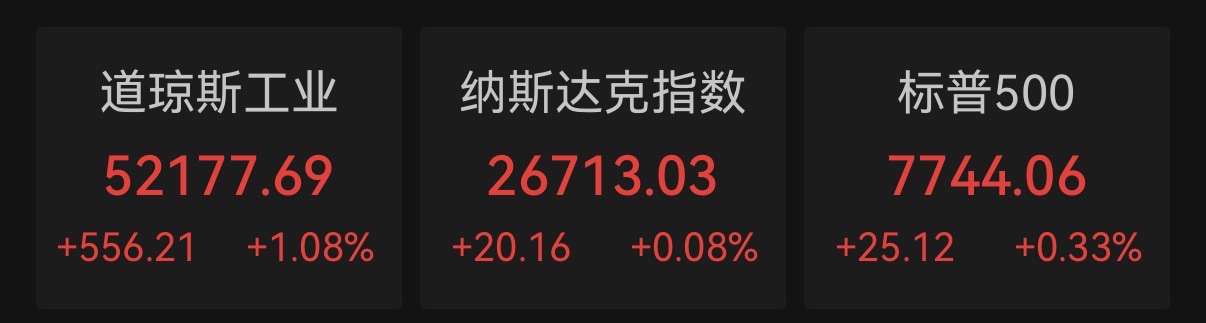
As of the close, the Dow Jones Industrial Average rose by 556.21 points, or 1.08%, to 52,177.69 points; the Nasdaq Composite Index increased by 20.16 points, or 0.08%, to 26,713.03 points; and the S&P 500 Index gained 25.12 points, or 0.33%, to 7,744.06 points.
【Popular Stocks Performance】
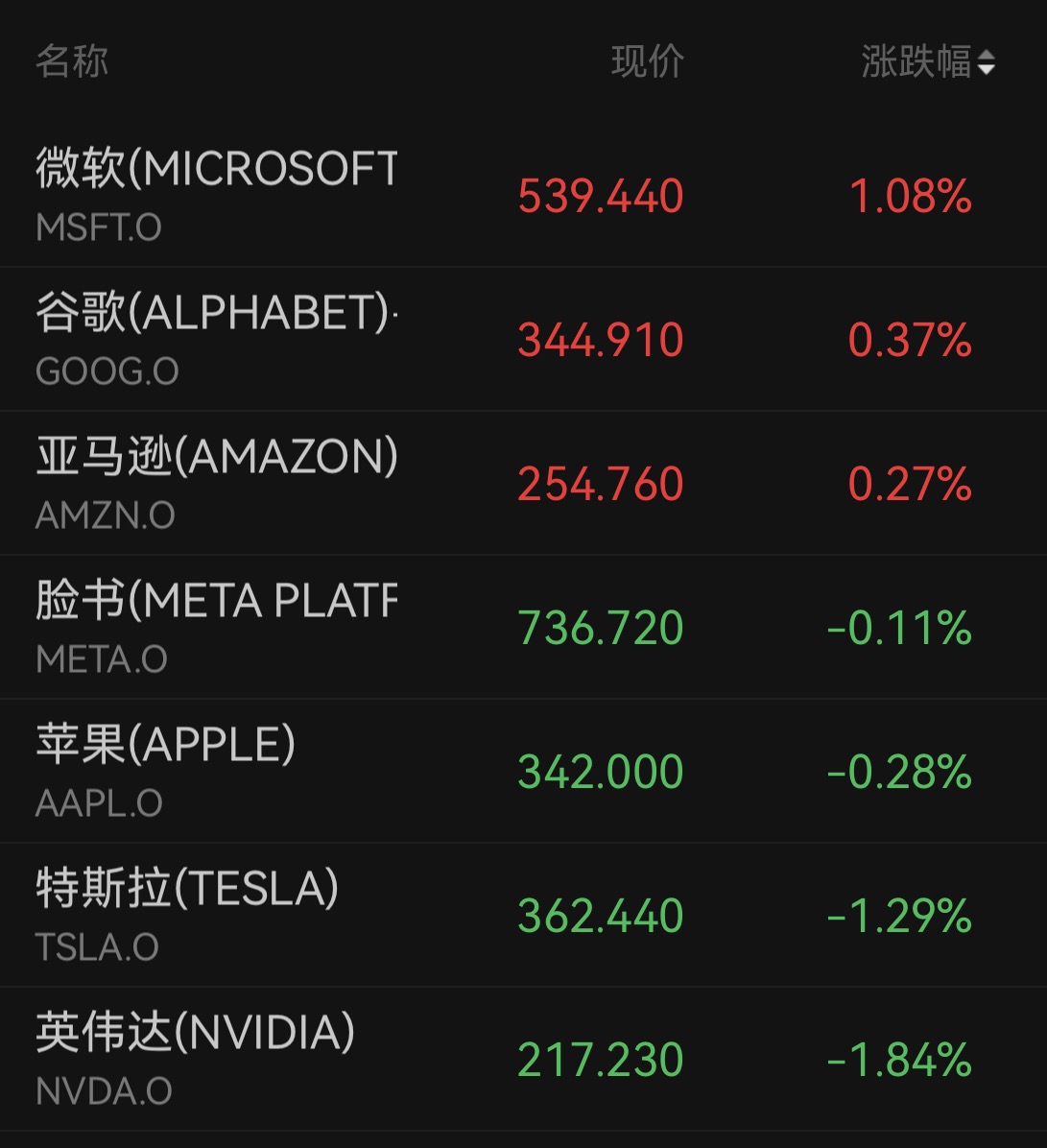
Leading tech stocks showed mixed movements. Microsoft rose by 1.08%, Google by 0.37%, and Amazon by 0.27%; Meta fell by 0.11%, Apple by 0.28%, Tesla by 1.29%, and NVIDIA by 1.84%.
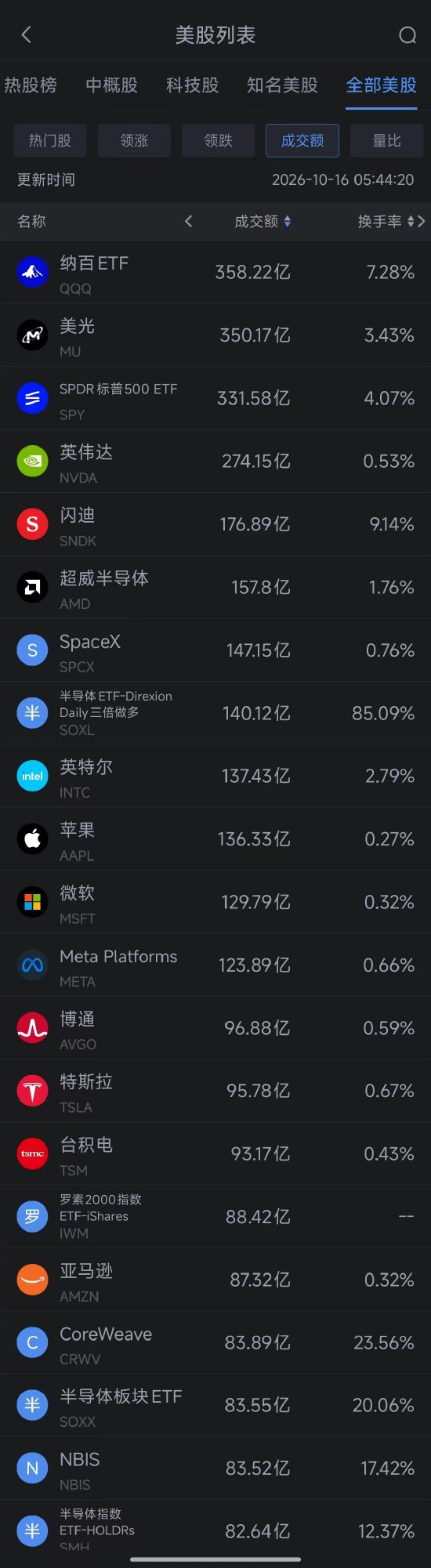
Chip stocks continue to face pressure, with the Philadelphia Semiconductor Index falling by 0.88%. Intel fell by 2.80%, TSMC ADR fell by 1.80%, and AMD fell by 1.50%; Micron, however, rose by 1.87% against the trend.
Optical communication stocks weakened, with Coherent Corporation falling by 4.83% and Lumentum dropping by 2.99%.
Medical and consumer stocks performed prominently. Nike rose by 5.21%, Home Depot by 4.31%, Eli Lilly by 3.55%, and UnitedHealth by 2.79%.
Most popular Chinese concept stocks rose, with the NASDAQ Golden Dragon China Index increasing by 1.96%. NetEase rose by 2.73%, Ctrip rose by 2.70%, JD.com rose by 2.66%, and NIO rose by 2.64%; Alibaba fell slightly by 0.04%.
【Market Overview】
After the sell-off of tech stocks on the previous trading day, there was a rotation of sectors in the market. Among the 11 sectors of the S&P 500 index, 8 closed higher, with the healthcare and materials sectors leading the way. The debt burden and financing costs of companies related to artificial intelligence continue to be a concern, and the semiconductor sector failed to rebound along with the broader market.
Joe Saluzzi, co-head of stock trading at Smith Trading Company ( Themis Trading ), stated that there has been a certain degree of rotation among large-cap stocks. Similar situations have occurred before, and concerns about investments related to artificial intelligence re-emerge almost every few months.
Economic data released on the same day showed a situation where inflation was rising, consumption continued to grow, and the scale of layoffs was relatively low. On one hand, investors are assessing the transmission of energy costs to the prices of goods and services, while on the other hand, they are concerned about whether consumers can withstand the ongoing pressure of rising prices.
The U.S. Bureau of Labor Statistics announced that in September, the Producer Price Index for Final Demand ( PPI ) rose 1.3% month-on-month, exceeding market expectations of 0.5%, marking the largest single-month increase since March 2022; it also rose 6.3% year-on-year, the largest increase since December 2022. The month-on-month increase in August was revised upward from 0.4% to 0.5%.
Looking at each item separately, the final demand commodity prices rose by 2.6% month-on-month, with energy prices increasing by 10.8% and gasoline prices rising by 20.3%, which contributed half of the increase in commodity prices. Service prices rose by 0.8%. Excluding food, energy, and trade services, the index rose by 0.5% month-on-month and by 5.0% year-on-year, indicating that price pressures are not limited to the energy sector.
David Russell, the head of global market strategy at an online brokerage trading platform ( TradeStation ), stated that the latest data confirms that, against the backdrop of persistently high energy prices, the inflation situation is worsening, and price pressures are spreading to other sectors of the economic system, particularly evident in the transportation and materials industries.
Consumption data is also affected by oil prices. According to the U.S. Census Bureau, retail and food service sales in September, after seasonal adjustment, amounted to $745 billion, representing a month-on-month increase of 0.8% and a year-on-year increase of 6.3%; the month-on-month growth rate for August was revised upward from 1.1% to 1.3%.
Among them, the sales volume of gas stations increased by 6.4% month-on-month and 28.1% year-on-year; excluding gas stations, retail sales only increased by 0.2% month-on-month. Retail sales data is not adjusted for inflation, and the rise in fuel prices has pushed up nominal sales volumes. The overall increase does not indicate a comprehensive acceleration in consumer spending on goods.
By industry, automobile sales increased by 0.2% month-on-month, furniture sales grew by 1.3%, catering sales increased by 1.1%, and sales of building materials and gardening supplies decreased by 0.6%. Retail sales, excluding automobiles, gasoline, building materials, and catering services, only increased by 0.1% month-on-month, which is lower than the 1.2% in August.
In terms of the labor market, the U.S. Department of Labor reported that as of the week ending October 10, the number of people filing for unemployment benefits for the first time was 199,000, an increase of 1,000 from the revised previous figure; the four-week moving average was 198,500. As of the week ending October 3, the number of people continuing to receive unemployment benefits was 1.71 million, with an unemployment rate of 1.1%.
Chris Osmond ( Chris Osmond ), the Chief Investment Officer of 53 Wealth Advisors ( Fifth Third Wealth Advisors ), believes that these data reflect interwoven economic signals: inflation is heating up, consumers are still spending, but the underlying momentum is weakening, and the labor market is closer to stagnation than to a clear deterioration. He stated that there is still reason for the Federal Reserve to continue to wait and see, but if inflation does not subside, the cost of waiting will increase.
U.S. Treasury yields fell on the same day. The end-of-day constant maturity yields released by the U.S. Treasury Department showed that the yield for 2-year Treasurys was 4.77%, down 5 basis points from the previous trading day; the yield for 10-year Treasurys was 5.10%, down 9 basis points; and the yield for 30-year Treasurys was 5.43%, also down 9 basis points. The decline in long-term yields was greater than that of short-term yields, leading to a flattening of the yield curve.
Regarding the subsequent interest rate path, the market is still weighing the prospects of inflation and economic growth. According to the Federal Reserve observation tool provided by the Chicago Mercantile Exchange ( CME ), traders are pricing a probability of another interest rate hike at the December meeting at around 67%, up from 62% on Wednesday. The next Federal Reserve interest rate meeting is scheduled for October 27th to 28th.
Regarding the situation in the Middle East, according to Xinhua News Agency, on the 15th, the Iranian Navy reported that its monitoring team detected a oil tanker on fire in the eastern waters of the Strait of Hormuz that day. The Iranian side stated that the oil tanker had turned off its tracking system and attempted to pass through a "forbidden zone."
【Large-Cap Performance】
International oil prices have seen both increases and decreases. On WTI, the settlement price of November crude oil futures rose by $2.88, an increase of 3.03%, to $97.97 per barrel; the settlement price of December Brent crude oil futures fell by $0.14, a decrease of 0.13%, to $105.92 per barrel. U.S. crude oil inventories have decreased significantly, providing support for U.S. oil prices, while the market continues to pay attention to supply and shipping risks in the Middle East.
Precious metals rebound. COMEX In December, the settlement price of gold futures rose by 1.51% to $4,170.10 per ounce; COMEX In December, the settlement price of silver futures rose by 2.29% to $57.156 per ounce. A weaker dollar and declining U.S. Treasury yields provided support for gold prices.