Key Points
- Google's Willow processor reduces certain quantum errors by 40 times
- New research has further advanced the development of fault-tolerant quantum computing.
- The cryptographic defenses of Bitcoin are still secure on current machines.
Google claims that by using its Willow processor, it has reduced quantum computing errors by 40 times, marking an important step towards machines that will be capable of performing computations and may ultimately pose a threat to Bitcoin cryptography.
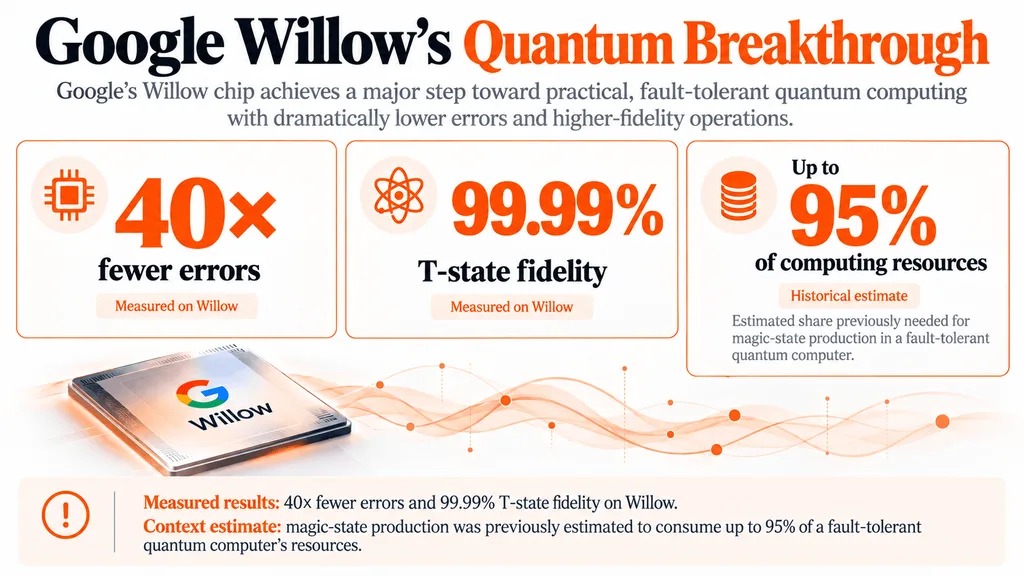
On October 15, Google announced this breakthrough, stating that it had achieved a logical fidelity of 99.99% for the specially prepared quantum states. This achievement has overcome a major technical obstacle that has long restricted the development of powerful, error-correcting quantum computers.
However, this result does not mean that Google will be able to crack Bitcoin encryption today. On the contrary, it raises a question: how fast will researchers be able to overcome the remaining obstacles before what is known as Q-Day arrives? Q-Day refers to the point in time when sufficiently advanced quantum computers may pose a threat to widely used public key cryptography.
How Google's Willow chip reduces quantum errors by 40 times
According to Google's official research announcement, the company has successfully demonstrated a technology named magic state cultivation on a Willow quantum processor.
Quantum computers rely on extremely fragile quantum states, which are prone to errors during the computing process. Correcting these errors requires additional computational resources, making it difficult for the systems to be scaled beyond experimental applications.
Google's new technology targets the particularly expensive part of this process: creating high-quality quantum states required for complex quantum computations.
Previous estimates indicated that generating these quantum states could consume up to 95% of the capacity of a fault-tolerant quantum computer, leaving relatively limited hardware for actual computations.
Google claims that Willow has reduced the error rate in the prepared quantum states by approximately 40 times compared to the untrained baseline, with a reported fidelity of 99.99%.
This does not mean that the overall computing performance has increased by 40 times. The experiment also shows that only about 8% of the preparation attempts were successful, indicating that the engineering challenges remain very severe.
Will Google's breakthrough bring Bitcoin's Q-Day one step closer?
Comparing this progress with another study by Google on the resources required to attack blockchain cryptography, the implications for Bitcoin become clearer.
In a research paper from 2026, Google researchers estimated that theoretically, cracking 256-bit elliptic curve cryptography might require less than 1200 logical quantum bits and 90 million Toffoli gates, using one of the proposed circuit designs.
Another design requires less than 1,450 logical qubits and 70 million of such gates. These are theoretical resource estimates, not demonstrations of a successful attack on Bitcoin.
Nevertheless, the decline in resource demand estimates has intensified discussions regarding the long-term security of Bitcoin.
Project Eleven Previously, a Q-Day forecast was provided, with the baseline set for the year 2033. It also listed earlier and later scenarios ranging from 2030 to 2042.
What if quantum computing makes faster progress? What would happen to Bitcoin?
Bitcoin uses elliptic curve digital signatures to authorize transactions. If quantum computers are powerful enough and run the Shor algorithm, it is theoretically possible to derive the private key from the public key.
This possibility has prompted external discussions about freezing vulnerable Bitcoin and introducing quantum-resistant signature systems.
This debate also extended to the dormant holdings related to early Bitcoin users. Zhao Changpeng, the founder of Binance, has also discussed protecting old wallets through a potential migration process.
None of these proposals imply that existing Bitcoin wallets will currently be able to be cracked by Google's Willow processors.
The more direct question is, whether Bitcoin developers can reach an agreement on a feasible security transition plan before quantum technology achieves capabilities related to cryptography.
Author
Ethan Mercer is a financial journalist who covers cryptocurrency, stocks, and the global economy. He studied economics and finance before turning to market reporting, with a particular focus on Bitcoin, stocks, monetary policy, and investor sentiment. His work focuses on explaining daily market fluctuations and the broader trends behind them.