Key Points
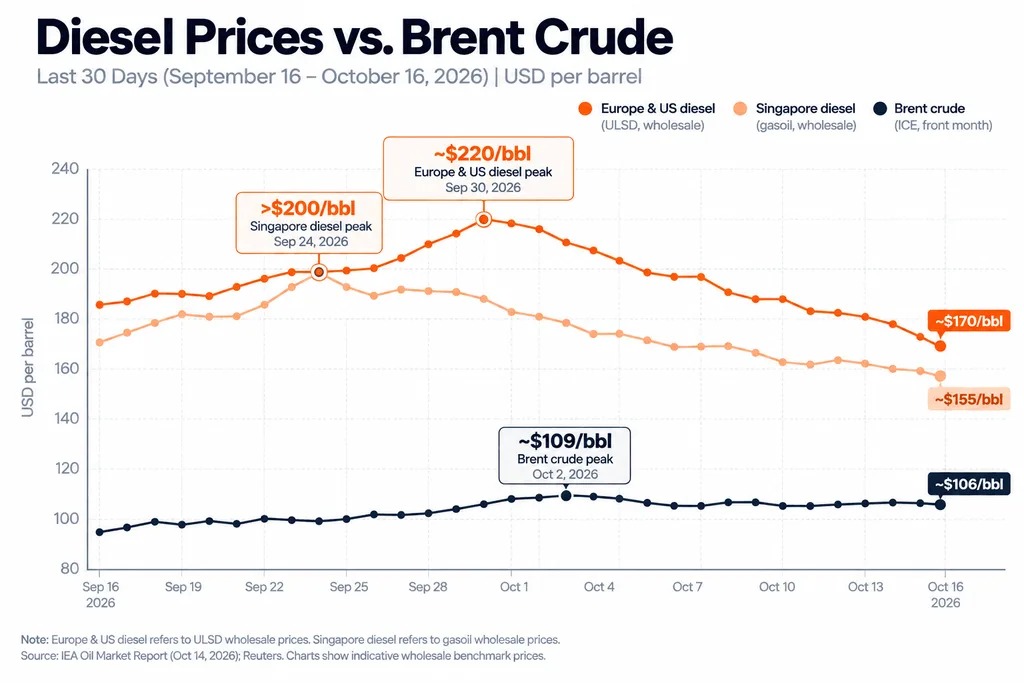
- Diesel prices broke through $200 per barrel in September.
- Global diesel exports decrease by 700,000 barrels per day
- IEA Accelerates the release of over 20 million barrels of diesel from emergency reserves
Global diesel prices soared above $200 per barrel in September, with a increase far exceeding that of crude oil. Outages at refineries and a contraction in fuel exports have led to a shortage of supply, a situation that may continue until 2027.
The International Energy Agency ( IEA ) reported that the wholesale price of diesel in Singapore has exceeded $200 per barrel, while in Europe and the United States it is around $220 per barrel. Although prices have since fallen from these highs, diesel remains exceptionally expensive compared to crude oil.
This supply crisis prompted IEA to take new intervention measures on October 15th, announcing plans to accelerate the release of emergency reserves, which include over 20 million barrels of diesel.
Why is the price of diesel much higher than that of crude oil?
The difference between crude oil and refined fuel largely explains the price divergence.
According to the IEA October "Oil Market Report," Russia and the Middle East's combined diesel net exports decreased by 1.3 million barrels per day in September, representing a drop of over 60% compared to a year ago.
Increased exports from the United States and China partially offset the aforementioned losses. However, global shipments of diesel and light diesel still decreased by about 700,000 barrels per day year-on-year.
It is worth noting that despite the weakening of global oil consumption, the shortage of diesel has become particularly evident. IEA predicts that global oil demand will decline by 2.6 million barrels per day in 2026, yet limited fuel production is still supporting high diesel prices.
In Europe, diesel refining margins once approached $100 per barrel before declining, and then fell to around $60 in early October due to rising freight and raw material costs. Meanwhile, U.S. refineries benefited from relatively cheaper crude oil supplies.
These differentiated economic conditions explain why an increase in diesel prices does not necessarily mean that every refinery will achieve higher profits.
IEA Accelerates the Release of 20 Million Barrels of Diesel
The statement on October 15th, as confirmed by IEA, confirmed that member countries had released approximately 330 million barrels of emergency oil reserves under the intervention measures taken in March.
An additional approximately 100 million barrels are to be released as planned, and governments of various countries have agreed to accelerate the delivery process. The unfinished portion includes over 20 million barrels of diesel, aimed at alleviating the current fuel shortage.
This decision continues the emergency reserve measures previously taken to stabilize the energy market following disruptions in the surrounding areas of the Strait of Hormuz.
However, this announcement does not imply the addition of a new commitment of 100 million barrels in total. It is mainly aimed at accelerating the release pace that was previously agreed upon, although IEA indicates that the total delivery volume will exceed the initial target of 4 million barrels.
Will diesel prices remain high until 2027?
IEA It is expected that global refinery processing capacity will recover around the end of 2026, and diesel supply may improve in early 2027.
However, it may take longer to replenish the depleted inventory. The inventories of diesel and light diesel at the Organization for Economic Co-operation and Development (OECD) OECD had dropped to about 565 million barrels in July, which is approximately 5% lower than the level before the conflict.
This makes the fuel market still vulnerable to additional refinery shutdowns, disruptions in shipping, and increases in seasonal demand.
The impact is not limited to commodity traders. Higher diesel costs will affect freight transportation, agriculture, and industrial production, exacerbating the inflationary pressures that the global economy is already facing.
To ensure a sustained decline in diesel prices, relying solely on the recovery of crude oil production may not be sufficient. The export of refined fuel, the operational capacity of refineries, and inventory levels also need to be improved.
Until these conditions change, even if the broader upward trend in crude oil loses momentum, diesel prices may still remain significantly higher than those of crude oil.
Maya Bennett
Maya Bennett is a financial journalist who has reported on cryptocurrencies, stocks, and broader market trends. Her areas of focus include Bitcoin, major digital assets, the stock market, monetary policy, and economic developments that influence investor sentiment. She is adept at transforming rapidly changing market news into clear and concise reports.