Key Points
- Despite an overall increase in capital inflows, technology funds still saw outflows of $4.75 billion.
- In one week, global equity funds attracted $20 billion in capital inflows.
- Analysts still expect profits in the tech industry to grow by 46.9%
As concerns about spending on artificial intelligence in the market intensify, global tech funds faced redemptions of $4.75 billion by investors; at the same time, investors still poured over $20 billion into global equity funds.
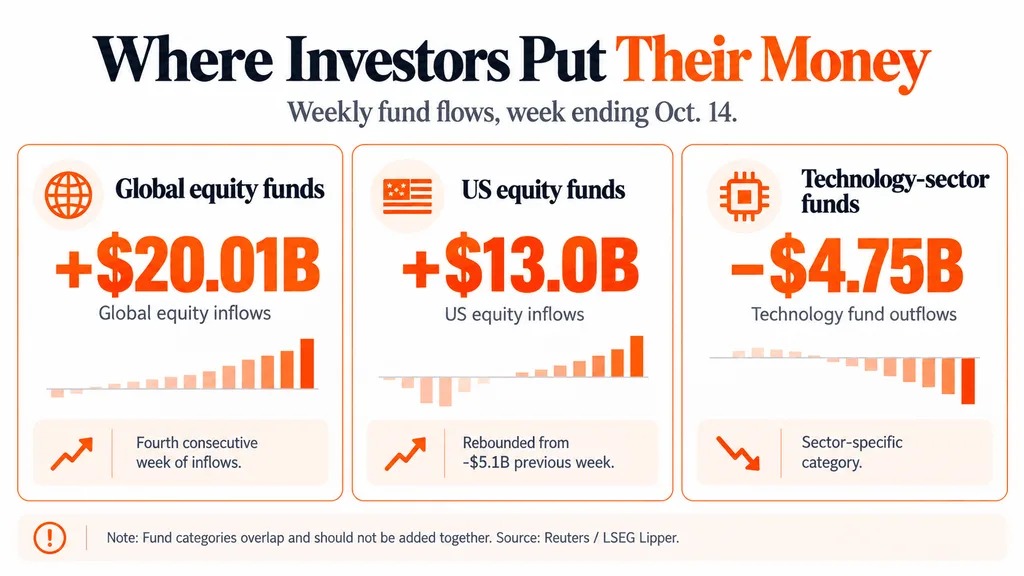
LSEG Lipper data shows that as of the week of October 14, global equity funds attracted $20.01 billion in capital inflows, compared to only $1.59 billion the previous week.
$4.75 billion in tech funds flowed out, while global equity fund inflows accelerated
Supported by strong corporate profit expectations and declining government bond yields, global equity funds have recorded net inflows for the fourth consecutive week.
U.S. equity funds led the recovery, attracting approximately $13 billion in capital inflows, compared to $5.1 billion outflows the previous week. Asian funds saw $2.93 billion in inflows, while European funds received an additional $1.5 billion.
However, the trends of stock funds focusing on specific sectors are the opposite.
Technology funds recorded an outflow of $4.75 billion, industrial funds saw an outflow of $1.86 billion, and financial sector funds had another outflow of $1.43 billion.
The total net outflow of sector funds reached $6.14 billion.
This contrast is noteworthy, as broad-based stock funds encompass technology companies, banks, healthcare enterprises, and other industries.
The inflow of funds does not prove that every sector except technology has attracted capital, nor does it indicate that the funds withdrawn from the technology sector were directly transferred into other stock funds.
However, these data indeed show that during the week in which concerns about the valuation of AI in the market intensified, investors' preferences changed.
Why are investors still selling AI stocks despite strong profit expectations?
Despite the market expecting a significant increase in profits across the tech industry, funds are still withdrawing.
However, strong profit expectations were not enough to protect semiconductor stocks from selling pressure.
Coinpaper Previous reports stated that the market value of AI chip stocks evaporated by approximately $1.64 trillion within six trading days, with NVIDIA, AMD, and Micron all being affected.
Investors are increasingly questioning whether the substantial capital invested in the infrastructure for AI will yield sufficiently attractive returns.
This issue is particularly evident in those companies that have taken on large amounts of debt to purchase GPU and build data centers.
The default insurance cost for CoreWeave has recently exceeded 1,000 basis points, indicating that market concerns regarding credit risks in the infrastructure sector of AI are on the rise.
Even though the demand for computing power remains strong, higher financing costs may lead to a decline in future expansion profitability.
Can lower U.S. Treasury yields support the stock market?
One factor supporting the broader demand for stocks is the recent rebound in the government bond market.
The yield on 10-year U.S. Treasury bonds rose to 5.3645% last week, reaching a level not seen in about 24 and a half years, before then falling by about 26 basis points.
A decline in bond yields can alleviate the pressure on stock valuations, especially for growth companies whose expected profits are more likely to be realized in the future.
Global bond funds once again attracted $7.79 billion in inflows during the week under review, indicating that demand for fixed-income investments remains strong.
At the same time, investors withdrew $46.73 billion from money market funds, partially reversing the large-scale inflows of the previous week.
Maya Bennett
Maya Bennett is a financial journalist with experience reporting on cryptocurrency, stocks, and broader market trends. Her coverage focuses on Bitcoin, major digital assets, the stock market, monetary policy, as well as economic developments that influence investor sentiment. She is adept at transforming rapidly changing market events into clear and concise reports.