


Netflix ( NFLX ) The stock price is facing additional selling pressure ahead of the upcoming financial report release, with investors assessing changes in leadership, layoffs, and growth prospects. NFLX The stock price closed at $70.53 on Friday, drawing attention to this streaming giant before its earnings report on October 20. Although advertising revenue and subscription pricing may still be drivers of growth, concerns about user engagement and intensifying competition are weighing on market sentiment.
The following three factors may determine whether Netflix will stabilize or continue to decline.
1. Changes in the leadership team raise strategic questions
Netflix will replace the Chief Content Officer Bela Bajaria with former Disney executive Peter Rice, who is expected to take over on October 26th. This transition occurs as the company is attempting to maintain user engagement and strengthen its programming strategy.
The challenge is not just about releasing more movies and TV series. Netflix needs to produce content that can attract viewers, sustain subscriptions, and create opportunities for advertising revenue. Investors will be watching to see if this change in leadership can improve program performance without simultaneously increasing costs.
This handover does not necessarily mean a deterioration of business, but at a time when investors are hoping to see clearer evidence of sustainable growth, it adds to uncertainty.
2. Layoffs make cost discipline a focus
Netflix plans to cut approximately 1,000 positions, which accounts for about 6% of its total workforce. This round of layoffs involves multiple functional departments including product, technology, legal, and human resources.
This move highlights the company's emphasis on resource allocation at a time when competition for viewers is intensifying. Although restructuring can improve operational efficiency, investors would like to see whether the savings in costs can be translated into stronger profitability without weakening the company's ability to develop products and provide attractive content.
Merely layoffs alone do not prove that the business of Netflix is deteriorating. The bigger question is whether management will be able to control expenses while continuing to invest in programs, advertising, and new forms of entertainment.
3. Slowing growth has increased the importance of financial reports
The financial report to be released on October 20th by Netflix may provide the clearest indication as to whether its growth trajectory remains intact. The market expects its revenue to be around $12.87 billion, a year-on-year increase of about 12%; earnings per share are expected to be around $0.82. The anticipated revenue growth rate will be lower than the 17% increase seen in the same period last year. With the slowdown in growth, advertising performance, subscription pricing, and user engagement have become particularly important.
Strong financial reports and positive performance guidance may alleviate concerns. On the contrary, if the results fall short of expectations or the comments are cautious, it could further pressure stock prices.
Netflix Stock Price Analysis: Can NFLX Return Above $72?
Netflix The stock price closed at $70.53 on Friday, down by about 2.9%. The area around $70 is an important short-term psychological barrier. If the stock price rebounds above $72.60, it could improve short-term momentum and create room for a broader rebound attempt. However, if it clearly falls below $70, the stock price may face further declines, and the range of $64 to $65 could become a potential area worth watching.
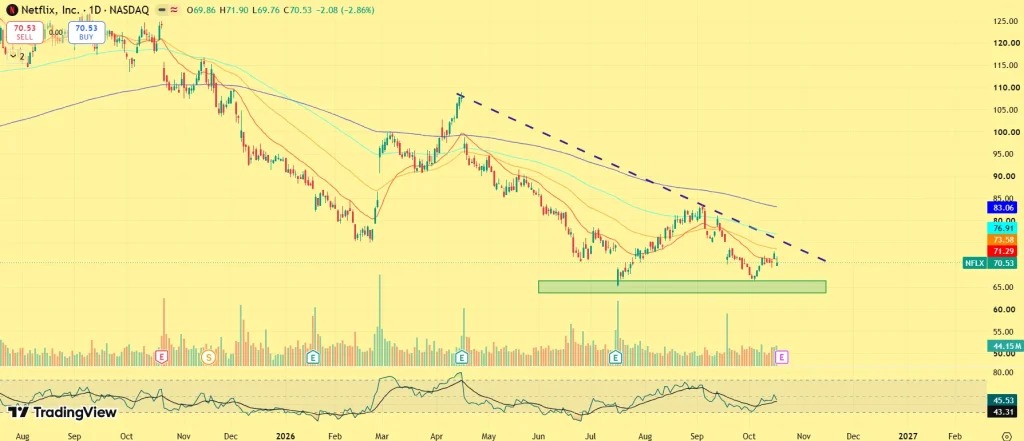
This financial report could trigger significant two-way fluctuations in stock prices. The key factors will be revenue growth, profitability, management's guidance, and comments on user engagement.
Netflix What will happen to the stock price next?
Netflix faces three direct challenges: proving that its content strategy can continue to attract audiences, demonstrating that layoffs can improve efficiency, and maintaining growth in the face of increasing competition in entertainment spending.