Key Points
- Federal judge upheld the $5 million settlement reached between Gemini and CFTC.
- Although the regulatory agency that initially prosecuted Gemini supported its appeal to overturn the original judgment, the court still did not accept it.
- Even though the enforcement stance of CFTC has changed, the permanent ban remains in effect.
Cryptocurrency exchange Gemini failed in its attempt to overturn a $5 million regulatory settlement, despite being supported by the same U.S. regulatory agency that initially sued the company.
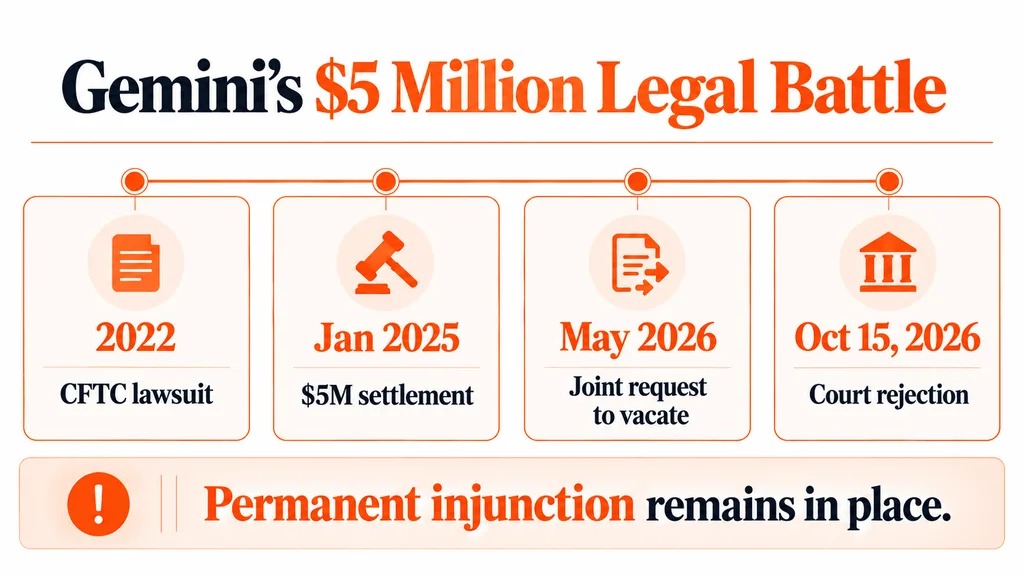
A judge in the U.S. region, Alvin Hellerstein, rejected a joint request filed by Gemini and the Commodity Futures Trading Commission (CFTC) of the United States (CFTC), which aimed to revoke an order issued in January 2025.
This ruling means that the $5 million fine already paid by Gemini remains in force, and at the same time, the permanent ban on Gemini from making false or misleading statements to regulatory authorities will also be maintained.
Judge dismisses Gemini's attempt to revoke a $5 million settlement
This dispute can be traced back to June 2022. At that time, CFTC filed a lawsuit against Gemini regarding the statements made during the review of a proposed Bitcoin futures contract in 2017.
Regulators alleged at the time that Gemini provided misleading information regarding its trading operations, including matters related to assessing whether the proposed futures products could be manipulated.
Gemini defended against these accusations for nearly three years, and then reached a settlement not long before the scheduled trial in January 2025.
According to the agreement, Gemini is required to pay a civil fine of 5 million US dollars and accept a permanent ban; meanwhile, Gemini has neither acknowledged nor denied the relevant allegations.
However, by 2026, there had been a significant change in regulatory stance.
In May this year, CFTC stated that an internal review determined that, according to the institution's current enforcement standards, the original lawsuit against Gemini should not have been filed in the first place.
Thereafter, Gemini joined forces with that regulatory agency to attempt, rather unusually, to overturn the existing judgment.
According to the ruling of Hellerstein, neither party was able to provide sufficient reasons to reinstate this settlement.
The court emphasized that new information regarding events that existed prior to the judgment being rendered does not automatically constitute a significant change in circumstances.
The judge also pointed out that Gemini has actively responded to the lawsuits over the years, and it was only after careful consideration that they chose to settle the matter.
Why does CFTC switch to supporting Gemini after filing a lawsuit?
This reversal by regulatory authorities comes against the backdrop of a broader re-evaluation of cryptocurrency enforcement during the Trump administration.
According to the official statement of CFTC, serious concerns have been raised regarding their review of the investigation process, the credibility of key whistleblowers, and the litigation methods employed against Gemini.
The institution stated that Gemini itself was also a victim of fraudulent activities, and that some of the evidence supporting the original allegations was not reliable.
CFTC also questioned whether the law enforcement officers had improperly restricted Gemini from obtaining the information needed for their defense.
However, these are merely determinations and accusations made by regulatory authorities, and they do not constitute new judicial rulings by the courts, nor do they imply that Gemini has been declared innocent.
Therefore, CFTC has incorporated the request of Gemini to remove the obligations that remain in effect under the consent order, especially the permanent ban.
It is worth noting that both parties had previously agreed that even if the court approves their request, Gemini will not get back the $5 million that has already been paid.
This case is different from another lawsuit between Gemini and the U.S. Securities and Exchange Commission (SEC). The latter was dismissed earlier in 2026, at a time when clients had already recovered assets related to their lending projects with that exchange Earn.
What does this ruling mean for crypto regulation?
This decision demonstrates that there are limitations to the regulatory authorities' ability to reverse previous law enforcement actions.
Regulatory agencies can reconsider their priorities, withdraw ongoing charges, or decide not to pursue certain cases any further. However, a federal court judgment that has already been rendered will not be automatically overturned just because the regulatory agency changes its stance.
For those cryptocurrency companies that wish to break free from the reconciliation obligations negotiated during the tenure of previous governments, this distinction is particularly important.
For Gemini, this ruling means that even though the exchange is expanding its business in regulated financial products, the relevant bans will continue to be in effect.
The company has previously obtained a CFTC clearing institution license, which enables it to develop clearing infrastructure for derivatives and predictive markets.
Maya Bennett
Maya Bennett is a financial journalist whose reporting covers cryptocurrency, stocks, and a broader range of market trends. Her areas of focus include Bitcoin, major digital assets, the stock market, monetary policy, as well as economic developments that influence investor sentiment. She is adept at transforming rapidly changing market events into clear and concise reports.