As competition in the smart ring market intensifies, Oura is launching two new features to help users gain a deeper understanding of their workouts and the impact of these exercises on their bodies. The company announced on Tuesday that it will introduce Cardio Effort and VO as well as max indicators, expanding exercise tracking from simply recording workout duration and heart rate zones to more detailed analysis.
Although Oura has dominated the smart ring market in recent years, competitors such as RingConn and Ultrahuman are rising to try to take their place, which also brings continuous innovation pressure on Oura. Oura is trying to differentiate itself from its competitors by launching more advanced sports metrics.
With the help of Cardio Effort, users can see the amount of strain that a particular exercise puts on their cardiovascular system. This metric is summarized on a weekly basis relative to each user's personal baseline, providing more insights. Oura indicates that this metric shifts users' focus from "how many minutes did I exercise?" to "am I maintaining my fitness, improving it, or am I overexercising?"
Since Cardio Effort takes into account both intensity and duration, a shorter training session with higher intensity may yield similar results to a longer training session with lower intensity, as indicated by Oura.
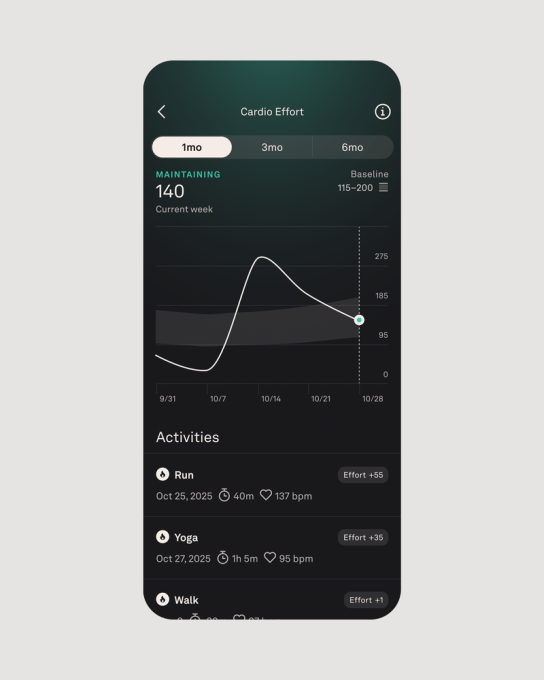
Oura points out that this indicator consists of two parts: Workout Cardio Effort and Weekly Cardio Effort. The former assesses the impact of a single exercise, while the latter summarizes the level of effort into a weekly total, which is then categorized into five levels: “Light”, “Fair”, “Maintaining”, “Building”, or “Reaching”.
Oura calculates by measuring the change in the elevated heart rate relative to a member's long-term resting heart rate, avoiding fluctuations that may arise from estimates based on the maximum heart rate. The weekly effort level is determined using personalized zones based on recent activity patterns.
Cardio Effort will be pushed to Oura Ring Gen3 and updated models.
As for VO 2 max, this indicator shows how exercise helps to improve long-term physical fitness. It measures the efficiency with which the heart, lungs, and muscles work together to transport and utilize oxygen during exercise. Previously, measuring VO 2 max usually required laboratory tests or a six-minute walk test. Now, Oura can estimate this value passively through exercises that support GPS.
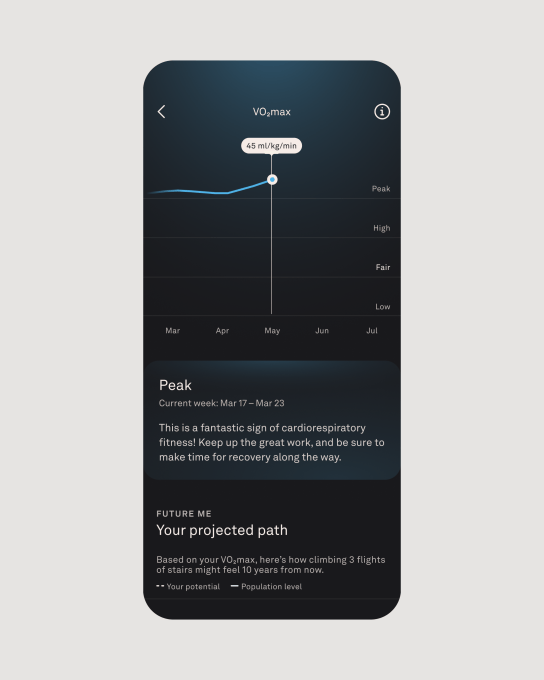
After completing five eligible activities, users will receive an initial estimate of VO 2 max. Within My Health Heart Hub, users can view the current estimate (in units of ml / kg / min), the physical fitness category ( Low , Fair , High or Peak ), the change in the estimate over time, as well as the last update time. Users will also receive a notification indicating whether there has been a significant change in their estimate ( VO 2 max ), or a prompt that their estimate remains stable.
VO and max will be launched on Oura Labs, which is a special area for experimental features of the company, available to members equipped with Gen3 and later versions of Oura Ring.
Oura indicates that these two new features are designed to work together to show users how hard they have trained, and how this effort has accumulated over time.