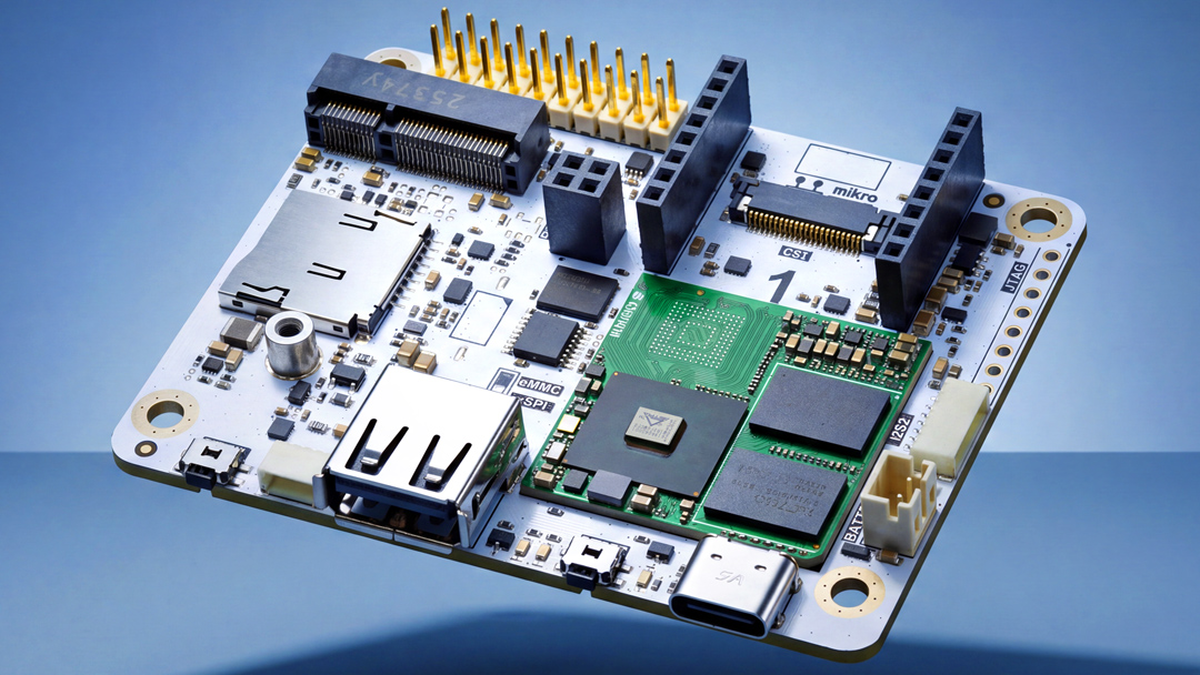


A major challenge on the client side with AI in the past was not whether a small model could be run, but rather whether developers could stably deploy and debug the model after obtaining the actual hardware, and then hand it over to the product team for mass production. On October 20th, Synaptics announced that a new version of Coralboard SL began to be sold through DigiKey, and at the same time, a new Coralboard SR based on the Astra SR200 series was launched, along with an expansion of support for the Torq compiler. Google Research introduced the progress of the Coral NPU architecture and open toolchain. Unlike previous releases that only showcased performance scores, this announcement covered chips, development boards, distribution, and software paths all on the same day; however, "SL that is now available for purchase" and "the newly released SR" are still two different states, and it should not be mistakenly assumed that all devices have been shipped in large quantities.
According to official information from Synaptics, Coralboard SL was jointly developed by Coralboard SL and Google Research. It is equipped with Astra SL2619 and integrates the Torq / Coral NPU of TOPS. The company stated that a limited initial batch was previously released, and now the new version is available for global online sales through DigiKey. Another Coralboard SR is designed for higher computing power and multi-modal applications, based on the Astra SR200 series xMCU; its development board specification sheet uses SR250 and lists options such as Arm Cortex - M85 and M52, 400 GOPS of Torq / Coral NPU, up to 8MB of integrated SRAM, and up to 256MB of customized DRAM. The specifications mentioned here are as stated by the suppliers and do not guarantee that each application will achieve the peak throughput.
Why is it worth writing about the sales channels of development boards as well? Because the engineering teams working on edge devices need to reduce friction in purchasing, replicating, and delivering these components. It’s one thing for a model to work at a press conference, for dozens of engineers to be able to purchase hardware with the same specifications from the same supply chain, replicate the same tool environment, and transform a prototype into a maintainable product. Development boards are not the final consumer products, but they determine whether a chip manufacturer can make it onto engineers’ test benches. The significance of development board sales channels lies in lowering the entry barrier, and they should not be exaggerated as if “AI glasses and industrial cameras have been fully adopted” by everyone.
From 1 TOPS to 400 GOPS, the focus is not just on the numerical size.
Synaptics refers to the new series as xMCU, attempting to find a market niche between traditional microcontrollers and application processors that run Linux. Traditional MCU are inexpensive and power-efficient, making them suitable for long-term online sensing and control; however, when visual, voice, and graphics need to operate simultaneously, memory and computing resources are often insufficient. Application processors are more powerful but may exceed the power consumption, startup time, and material cost constraints of wearable devices. Therefore, the SR200 series emphasizes heterogeneous computing, tiered memory, audio-video interfaces, and low-power domains. This is a set of engineering trade-offs, as there is no single metric that can determine success.
The company has categorized SR210, SR230, and SR250 as compatible product lines, targeting continuous voice and sensing, mainstream multi-modal devices, as well as dual-channel vision and display requirements respectively. The official specifications for the AI engine state that its peak performance is 200, 300, and 400 GOPS respectively. While these peak figures help to illustrate the differences between the models, they do not directly reflect the actual product's endurance, latency, or recognition accuracy; factors such as model architecture, quantization methods, memory handling, and system power consumption when both the camera and microphone are active can all affect the results. Reports should not misinterpret "reaching 400 GOPS" as meaning that all models can process 400 billion valid tasks per second.
Another layer of cooperation between Google and Synaptics lies in the software. Google Developers Blog mentions that Coral NPU's open architecture works well with the IREE / MLIR toolchain. The Synaptics compiler and runtime provide a more consistent development experience for SL and SR. For application teams, this means they can first verify their models on available development boards before considering different levels of computing power. However, the "unified toolchain" still needs to be tested in real frameworks, operators, and model versions; just because one demonstration example works does not mean that all production models will not require adaptation.
Synaptics lists optimized Gemma, Liquid AI in the Chinese announcement, as well as examples of visual models, and provides generation speeds under specific quantitative conditions. Such figures should be regarded as configuration examples provided by the manufacturer, rather than general performance commitments across devices and models. On the client side, AI, what is particularly easy to overlook is memory: model weights, camera frames, and context caches all take up space; even if the NPU computing power is sufficient, if data transfer slows down the system or depletes the battery, users will not feel a "smarter" experience. The claimed scalable customization of DRAM is precisely to address this limitation, yet its cost and power consumption effects still need to be verified by mass-produced devices.
An open architecture must pass the tests of mass production and ecosystem development.
The first challenge is mass production. Development boards place the camera, display, interfaces, and debugging channels on the desktop for engineers to test easily; however, actual glasses, doorbells, or industrial cameras have to address issues such as heat dissipation, size, wireless connectivity, long-term supply, and safety regulations. Supplier announcements mention applications like wearable devices, earbuds, smart home appliances, and industrial control as target scenarios, but this does not mean that there are already large-scale orders in these fields. The company's collaboration with Google to showcase chips cannot replace the specific customer's acceptance of functionality, privacy, and reliability.
The second challenge is the software ecosystem. An open NPU design and compiler can reduce the lock-in associated with closed toolchains, allowing developers to have a clearer understanding of how models are mapped to hardware; however, whether a project is easy to maintain depends on documentation, examples, error diagnosis, operator overwriting, version compatibility, and community contributions. For small teams, purchasing a single board only solves the initial problem. If they have to rewrite the underlying code with each model upgrade, the value of open hardware is diminished. Synaptics claims that Torq is compatible with mainstream machine learning frameworks, but this still needs to be continuously verified through developer practice.
End-side inference is not a complete substitute for cloud-based inference either. Processing voice and images locally on the device can reduce the amount of data that needs to be sent to the cloud and the time required for network waits, making it suitable for scenarios that require low latency or offline operations; however, complex inference, model updates, and cross-device collaboration may still necessitate the use of the cloud. Engineers must decide which data to retain locally, which requests to send to the server, and how to downgrade functionality in case of network interruptions. When promoting “privacy protection,” one must also consider the actual design of logs, telemetry, updates, and third-party services, and cannot draw conclusions solely based on the fact that certain components (such as NPU) are located within the device.
The highlights of this release are that the AI on the client side has evolved from a theoretical framework in papers to a development tool that can be purchased, as well as a wider range of chip families. The channel sales of SL are already a reality, while SR and SR200 are product lines that have just been launched and are awaiting further real-machine verification. What is worth observing next is not another peak in computing power, but whether developers can deploy applications repeatedly using a unified toolchain, whether OEM can turn prototypes into reliable products, and the speed, battery life, and privacy benefits that end-users will ultimately receive. Only when all these aspects are in place can the so-called “AI leaving the cloud” become more than just a slogan on the demonstration stage.
Source: Synaptics Official Announcement https :// www.synaptics.com / cn / company / news / synaptics-and-google-research-expand-the-coralboard-ecosystem ; Synaptics Investor Announcement https :// investor.synaptics.com / news-releases / news-release-details / synaptics-launches-xmcutm-era-astrar-sr200-series-multimodal ; Google Developers Blog https :// developers.googleblog.com / unifying-edge-ai-how-coral-npus-open-standard-brings-portable-energy-viable-intelligence-from-model-to-silicon /