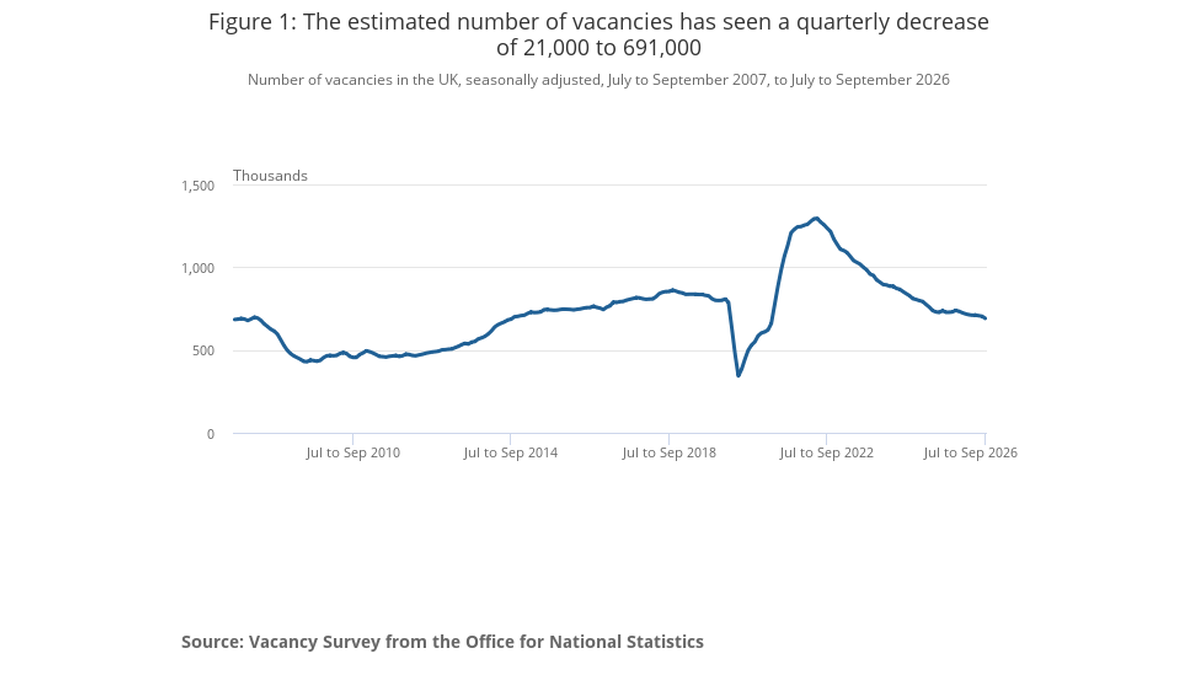


The labor market data released by the UK on October 20th cannot be simply summarized as "strong employment" or "weak employment." According to the Office for National Statistics (ONS), the unemployment rate from June to August 2026 was 4.7%, which is 0.1 percentage points lower than in the same period of the previous year and the quarter before. During the same time, the employment rate rose to 75.3%. On the other hand, from July to September, there were only an estimated 691,000 job vacancies in companies, which is 21,000 fewer than in the previous quarter, representing a decrease of 2.9%. The number of people receiving unemployment benefits also increased to around 1.701 million in September. These seemingly contradictory signals stem from differences in statistical methods, time frames, and employers' willingness to hire.
The details of this report are more important than the headlines. The employment and unemployment rates are primarily derived from labor force surveys, which observe the average situation over three months; job vacancies are based on business surveys covering the period from July to September; real-time information on payroll taxes in September provides a more timely but preliminary estimate of the number of employees. These figures from different sources do not represent readings from the same dashboard at the same moment. To argue that the “decrease in unemployment rates from June to August” contradicts the “reduction in job vacancies from July to September” is like using the average speed of the previous quarter to deny that traffic is now heavier at this intersection—these two statements are not mutually exclusive.
The Office for National Statistics in the UK describes the overall labor market as “generally stable” in 2026, rather than experiencing a sudden acceleration. The economic inactivity rate from June to August was 20.9%, which is 0.1 percentage points lower than the previous month. During the same period, the number of employees recorded in the payroll system was 37,000 fewer than in the previous quarter and 92,000 fewer than in the previous year. The preliminary estimate for September indicates that there are about 30.3 million employees in the payroll system, an increase of 13,000 compared to August. Officials also noted that this estimate may be revised next month with the addition of administrative data. It is not sufficient to assert that job markets have rebounded based on this initial figure of just over 13,000 more employees.
The improvement in unemployment rates cannot conceal the slowdown in recruitment demand.
The decline in the number of job vacancies is the more forward-looking aspect of today's data. From July to September, there were 691,000 vacancies, which is 21,000 fewer than in the previous quarter, representing one of the largest quarterly declines since the beginning of the year; compared to the same period last year, there were 37,000 fewer vacancies, a decrease of 5.1%. However, the Office for National Statistics also provided a confidence interval for the quarterly change of about 32,000, and the estimated decrease of 21,000 falls within this range, so a single change cannot be considered a precisely confirmed sharp drop in recruitment. The UK Office for National Statistics noted that, outside of the pandemic period, the last time the number of job vacancies was not higher than this level was in a similar quarter of 2014. This comparison suggests that companies' reserves for "how many people they want to hire" are dwindling, but it does not prove that all positions have been eliminated; vacancies refer to those that have not yet been filled and for which companies are currently recruiting, and they do not equate to the current number of jobs available.
Statistics Bureau survey feedback shows that some small businesses have reduced recruitment due to rising labor costs. This is based on corporate statements and survey findings, and it cannot be directly attributed as the sole cause of a nationwide decline in job vacancies. Industry structure, employment efficiency, growth expectations, and adjustments to existing employees' working hours can all affect recruitment plans. Many companies choose to freeze new hiring positions when demand is uncertain rather than lay off employees immediately, which is why the unemployment rate may remain stable or even temporarily decrease. If this situation continues, future graduates and those looking for new jobs may first notice a reduction in job opportunities before it is reflected in the unemployment rate.
Another easily confused indicator is the number of claims. The Bureau of Statistics estimates that the number of claims related to unemployment benefits in September was 1.701 million, which is an increase from the previous month and the same period last year. It is also noted that the latest monthly data is still a temporary estimate and may be affected by subsequent revisions to administrative records. The number of claims does not correspond to the internationally defined number of unemployed people: whether one is eligible to claim benefits, the welfare system in place, and whether a person is actively looking for work can all lead to differences. It is not appropriate to simply use the increase in the number of claims to “prove” that the official unemployment rate is incorrect, nor can a slight decline in the unemployment rate be used to deny the pressures faced by those claiming benefits.
Wage growth rate and data quality determine the boundaries of macroeconomic interpretation.
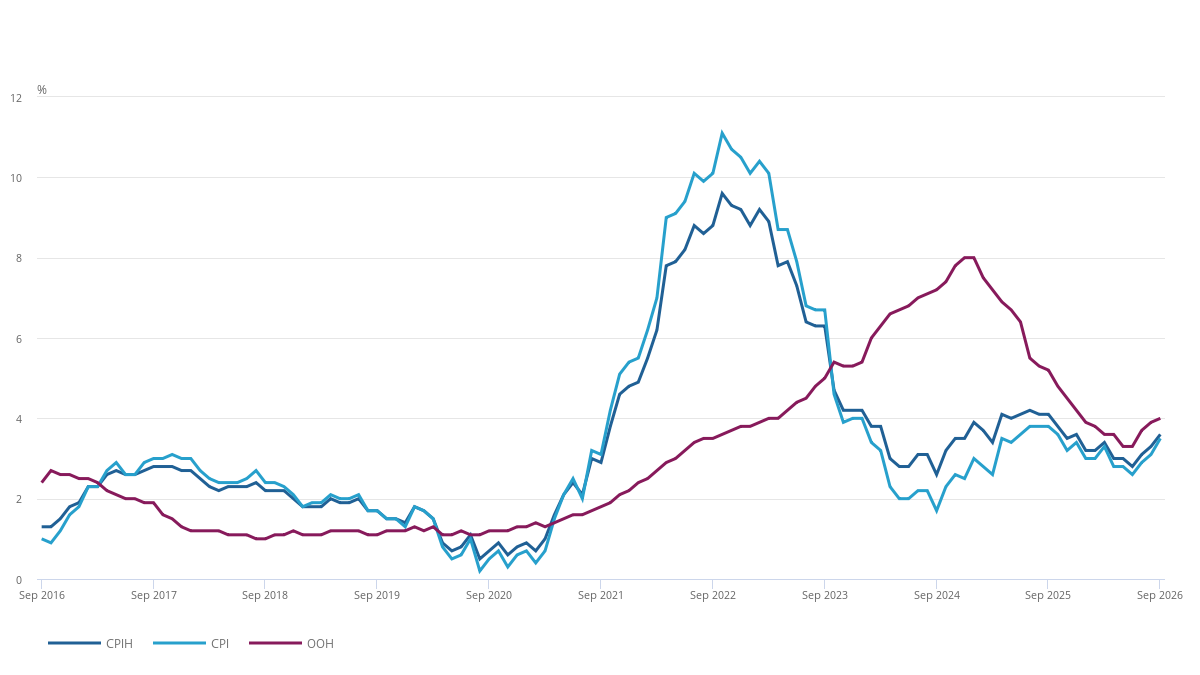
There is no single direction indicated for the revenue side either. From June to August, the average weekly salary excluding bonuses increased by 3.7% year-on-year, and the statistical bureau stated that this growth rate has been relatively stable over the past six to three-month periods; the total salary including bonuses also increased by 3.7% year-on-year, which is lower than the previous period's 3.9%. After adjusting for the cost of owning a home (represented by CPIH), the actual regular salary increased by 0.6% year-on-year, while the total salary increased by 0.7%. Although salaries are still rising, the improvement in actual purchasing power is relatively limited. The average salary will also be affected by changes in the composition of high- and low-paying positions, so it does not mean that every employee received a 3.7% raise.
The regular wage growth rate in the public sector is 6.3%, while in the private sector it is 3.0%. This does not mean that all positions in the public sector are consistently leading; the statistical bureau reminds us that the timing of salary incentives in the public sector this year affects the year-on-year figures. When comparing the two sectors, it is essential to consider the base and payment timing; mistaking a one-time adjustment for a permanent wage trend can lead to overestimating subsequent inflationary pressures. The impact of the labor market on prices and central bank policies also depends on productivity, the transmission of corporate costs, and whether future recruitment will continue to weaken. It is not possible to draw conclusions about interest rates based solely on this month's wage figures.
There have also been discussions about the quality of the UK Labour Force Survey in recent years. In this report, the Office for National Statistics includes a special update on quality, indicating that sample responses and methods still need to be continuously monitored. Administrative salary data covers a wide range but only involves salaried employees; the Labour Force Survey includes a more complete group of people such as self-employed individuals, yet it is based on sampling estimates. When there are differences between the two sets of data, the correct approach is to check the definitions and timing, rather than choosing the one that fits one's own views. Especially since the preliminary salary figures for September may be revised, reports must retain the word "preliminary."
What is most worth monitoring in the coming months is whether the decline in job vacancies will further translate into changes in the number of employees, working hours, and unemployment rates, as well as whether real wages can continue to grow in a slower hiring environment. If companies simply reduce new recruitments, the labor market may cool down moderately; however, if layoffs and unemployment increase significantly, the narrative will change. At this stage, official data supports the statement that "the surveyed unemployment rate has fallen slightly, while job vacancies and some administrative indicators suggest weak hiring." Presenting both scenarios is more useful than labeling the market as undergoing a sharp turn.
Source: Office for National Statistics, UK, “Labour market overview , UK : October 2026”, October 20, 2026. https :// www.ons.gov.uk / employmentandlabourmarket / peopleinwork / employmentandemployeetypes / bulletins / uklabourmarket / october2026