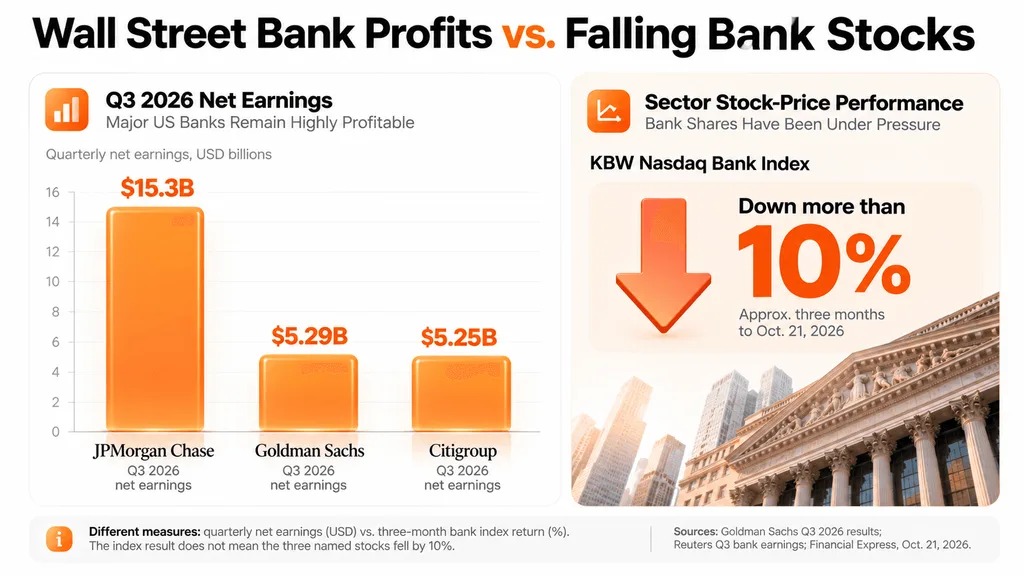
Despite another profitable financial reporting quarter, Bank of America's stock is still declining, revealing an increasingly widening gap between Wall Street's financial performance and investors' confidence in this sector.
According to market reports on October 21st, the KBW NASDAQ Bank Index has fallen by more than 10% in the past three months, while the Dow Jones U.S. Banks Index has dropped by over 7%. Some individual bank stocks have seen even greater declines.
However, large lending institutions are still continuing to generate billions of dollars in profits, supported by robust consumer spending, loan demand, and stock trading operations. The issue is that rising yields on U.S. Treasury bonds are causing investors to become increasingly concerned about what might happen next.
JPMorgan Chase and Goldman Sachs recorded billions of dollars in profits
Its stock trading revenue increased by 72% to $6.44 billion, indicating that even as the overall financial environment deteriorates, market volatility may still benefit investment banks.
At the same time, Bank of America faced more direct factors of disappointing performance, including regulatory-related expenses of $1.2 billion, as well as a weaker bond trading business.
Why the Rise in U.S. Treasury Yields Hits Bank Stocks?
The biggest concern comes from the bond market. The yield on the benchmark 10-year U.S. Treasury note has recently risen to around 5.35%, the highest level since 2002.
Banks hold a large amount of government bonds and other fixed-income securities. When interest rates rise, the market value of existing bonds declines, which may result in unrealized losses.
Therefore, the recent rise in U.S. Treasury yields has put pressure on balance sheets. However, whether these losses will immediately affect reported profits still depends on the accounting treatment methods used.
Higher interest rates could also benefit banks by increasing loan returns. However, these benefits depend on how quickly banks need to raise the costs they pay to depositors and other providers of funds.
If the cost of funds rises faster than the growth of lending income, the competition to attract customer deposits may squeeze profit margins.
Wall Street fears that the slowdown in the banking industry will last longer.
JPMorgan Chase's fixed-income trading revenue declined by 4%, and the costs of its investment banking business fell by 8% compared to the previous quarter. Among the major lending institutions on Wall Street, bond trading revenue generally weakened as rising yields curbed financing activities.
This represents a reversal from the situation earlier on; at that time, strong investment banking activities had helped to support the profits of the financial sector.
However, the demand for loans has not collapsed. A recent report by PNC indicates that loan growth amounted to 14.2%, highlighting the differences between regional commercial banks and Wall Street's trading businesses.
Ethan Mercer
Ethan Mercer is a financial journalist who covers cryptocurrency, stocks, and the global economy. He has studied economics and finance before entering the field of market reporting, with a particular focus on Bitcoin, stocks, monetary policy, and investor sentiment. His work focuses on explaining daily market fluctuations and the broader trends behind them.