Key Points
- French 10-year government bond yield rises to 5%, the highest level since 2002
- The borrowing premium of France relative to Germany is close to the levels during the crisis period.
- Budget uncertainties have heightened market concerns about broader financial stability in the eurozone.
On Wednesday, October 21st, the yield on 10-year French government bonds rose above 5%, reaching the highest level since 2002. Investors are demanding higher compensation when lending to Europe's second-largest economy.
The benchmark yield reached 5.002% at 09:14 Greenwich Mean Time, rising by about 8 basis points during the day. This move has exacerbated market concerns regarding the potential deterioration of France's public finances, political instability, and broader pressures on the European bond market.
According to Reuters, the premium that investors are willing to pay for French government bonds over German government bonds has expanded to about 157 basis points, approaching the levels seen during the eurozone debt crisis in 2011.
France's debt problem has pushed borrowing costs to a 24-year high
France's public debt has reached approximately 3.6 trillion euros, which is about 119% of its gross domestic product. Its budget deficit is still significantly higher than the EU's 3% threshold, putting policymakers in a difficult position when making decisions regarding spending and taxation.
When maturing bonds must be refinanced at a higher interest rate, the cost of managing France's debt burden also rises accordingly.
An increase in bond yields means that the prices of already issued bonds fall, which could result in losses for investors holding French government bonds.
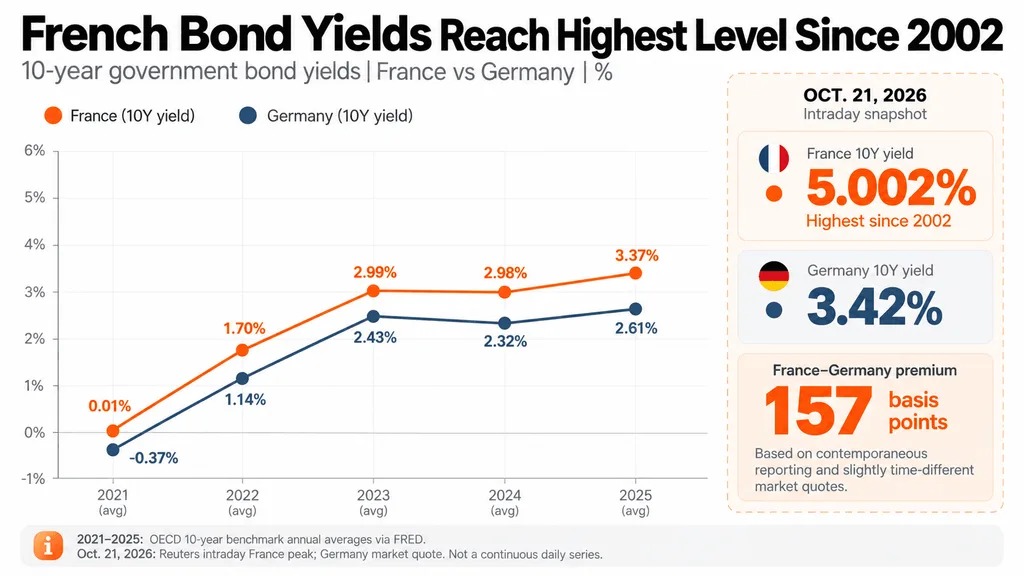
This round of pressure also occurred after a broader sell-off in global bonds, partly due to high energy prices, persistent inflation, and an increase in sovereign borrowing demand.
However, the rapid increase in borrowing costs in France exceeds that of many comparable economies, indicating that investors are factoring in additional domestic risks associated with France.
Why is the interest rate spread of 157 basis points with Germany important?
The widening gap between the yields of French and German government bonds more clearly reflects the growing concerns of investors.
German government bonds are generally regarded as the benchmark for sovereign bonds in the eurozone. When France has to offer significantly higher yields, it indicates that investors are demanding higher compensation due to fiscal and political uncertainties.
The recent weakening of the euro has already reflected changes in the market's expectations regarding European economic growth, interest rates, and government fiscal conditions.
European bank stocks are particularly vulnerable to disruptions in the sovereign bond market, as banks hold government bonds and rely on a stable financing environment.
The difficulties faced by France have also driven the demand for traditional safe-haven assets, contributing to the strengthening of the Swiss franc against the euro.
Will France trigger another debt crisis in the eurozone?
A sharp rise in borrowing costs does not mean that France is on the verge of immediate default, nor does it indicate that another eurozone crisis has begun.
However, higher yields will gradually increase government interest expenditures, as well as the financing costs for households and businesses.
This situation is similar to the broader risk of government refinancing: as older debts with lower costs in the past mature, the existing debt obligations become more expensive.
Maya Bennett
Maya Bennett is a financial journalist who has reported on cryptocurrencies, stocks, and broader market trends. Her areas of focus include Bitcoin, major digital assets, the stock market, monetary policy, as well as economic developments that influence investor sentiment. She is adept at transforming rapidly changing market events into clear and concise reports.