Starknet The community supported the research of an independent, quantum-resistant blockchain layer. After a seven-day governance vote, 93.52% of the voting rights supported this proposal.
The seven-day governance vote, Starknet, concluded on October 22nd, with 93.52% of the voting rights in favor of exploring an independent layer-1 blockchain.
This non-binding vote recorded approximately 3,200 votes in total, and did not authorize its departure from Ethereum.
StarkWare and Starknet Foundation will study an independent, quantum-resistant network before the next round of governance decisions.
STRK will continue to serve as a native token, and there are no plans to replace it with another token; the existing Ethereum bridge is expected to remain open.
StarkWare plans to release a draft white paper in November, outlining the technical issues involved in potential transformations.
According to the official governance proposal, this non-binding vote concluded on October 22nd and attracted approximately 3,200 votes, providing community support for the proposed transformations of StarkWare and Starknet Foundation. However, it did not authorize them to decouple from Ethereum.
This result is the first official response from the community to the proposal put forward on October 8th by StarkWare regarding whether Starknet should operate as an independent blockchain.
StarkWare indicates that this vote has set a new record for the highest level of participation in the history of network governance. The company has not participated in the vote, leaving the decision to the owners of STRK and the participating representatives to decide whether to continue advancing the research.
The vote offered three options: to support further research, to oppose, or to remain neutral until more information is available. Approval means that developers can prepare technical proposals for future deliberation.
As reported by crypto.news when the voting commenced, the original ballots clearly distinguished between "supporting the research" and "approving the actual migration."
Starknet currently operates as a layer-2 network on Ethereum, utilizing its own transaction processing infrastructure while also relying on Ethereum for settlement and data availability.
Any decision to establish an independent network requires another round of governance processes. This proposal does not provide a binding migration timeline, a final architecture, nor does it require users to transfer their assets.
Ethereum's reliance has driven the advancement of post-quantum proposals.
Security concerns have prompted StarkWare to explore different network structures. Although Starknet has already used hash-based STARK proofs, other components still rely on the cryptographic systems maintained by Ethereum.
In its subsequent quantum security roadmap, StarkWare lists Ethereum's bridging message infrastructure and data availability based on blob as two remaining dependencies that need to be resolved.
Independent blockchain allows Starknet to have greater control over security upgrades, without having to follow Ethereum's timeline for certain components.
However, independence also brings other requirements. Starknet needs to determine how validators can ensure consensus, maintain data availability, and protect transaction security without relying on Ethereum's existing infrastructure.
Community discussions have raised questions regarding the responsibilities of verifiers, their resistance to censorship, and the economic security provided by staking STRK. A complete alternative security model has not yet been announced.
StarkWare Preparing the November white paper to discuss potential transformations
After the favorable voting results, StarkWare and Starknet Foundation have established a working group to assess the technical and operational requirements for an independent blockchain.
A draft white paper is planned to be released in November in order to examine the proposed architecture before any binding decisions are made.
Discussions on the governance forum have confirmed that regardless of the arrangement adopted, STRK will continue to serve as the native cryptocurrency of the network. This proposal does not require a change of token.
The existing bridges connecting Starknet to Ethereum are expected to remain available, however, the team has not yet announced the detailed procedures for maintaining these connections under an independent architecture.
StarkWare has set a goal for 2027 to enable Starknet with quantum-resistant capabilities. Its current roadmap divides the work into three phases, covering new initiatives, existing smart contracts, and infrastructure that relies on Ethereum.
In the first phase, certain Pedersen hash components will be replaced with alternatives based on BLAKE2. In the second phase, the storage and migration requirements for existing contracts will be addressed.
The third phase focuses on the infrastructure that currently relies on Ethereum's cryptographic upgrades, including the availability of bridging messages and data.
The quantum security work of Starknet is still being advanced on Ethereum.
This proposal for an independence study follows several advancements in the existing security plan of StarkWare.
In August, StarkWare demonstrated quantum-safe Bitcoin transactions on the Bitcoin mainnet, but further review and improvement are still needed before broader implementation.
Starknet and DeFi have also introduced privacy features, including Shadow Accounts, allowing supported applications to use addresses that will not be publicly linked to the user's main wallet.
These tools operate within the current two-layer network and do not rely on an independent blockchain proposal as a prerequisite.
The quantum research project of StarkWare has demonstrated post-quantum account technology on the real-time network of Starknet, however, this experimental implementation has not yet undergone a security audit.
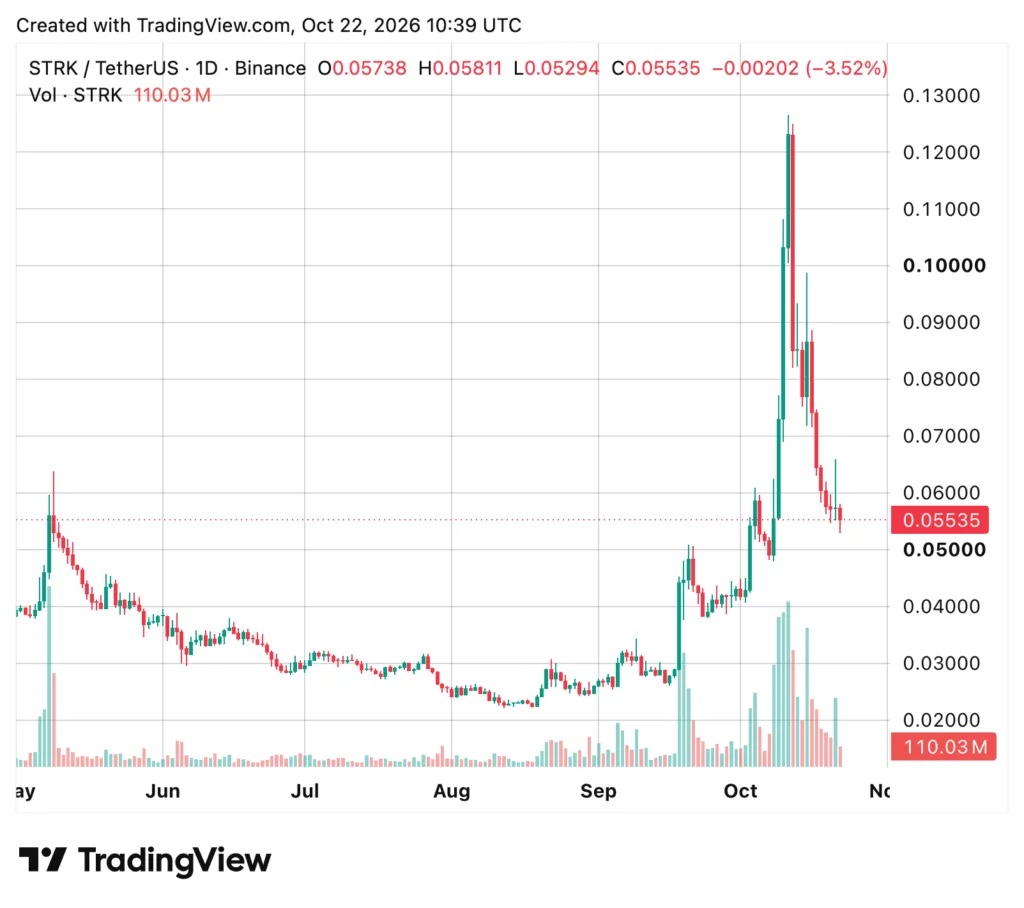
Meanwhile, as of press time, the trading price of STRK is close to $0.055, with a 1.24% decline over 24 hours and a 32.46% drop in the past seven days. The daily trading volume is approximately $162.5 million.
The circulating supply is approximately 7.6 billion tokens, corresponding to a market value of about 414.3 million US dollars.