Before purchasing a box of eggs, a television, or any other household necessity, millions of Costco customers made an unusual financial commitment: they paid to this retailer first in exchange for the right to shop.
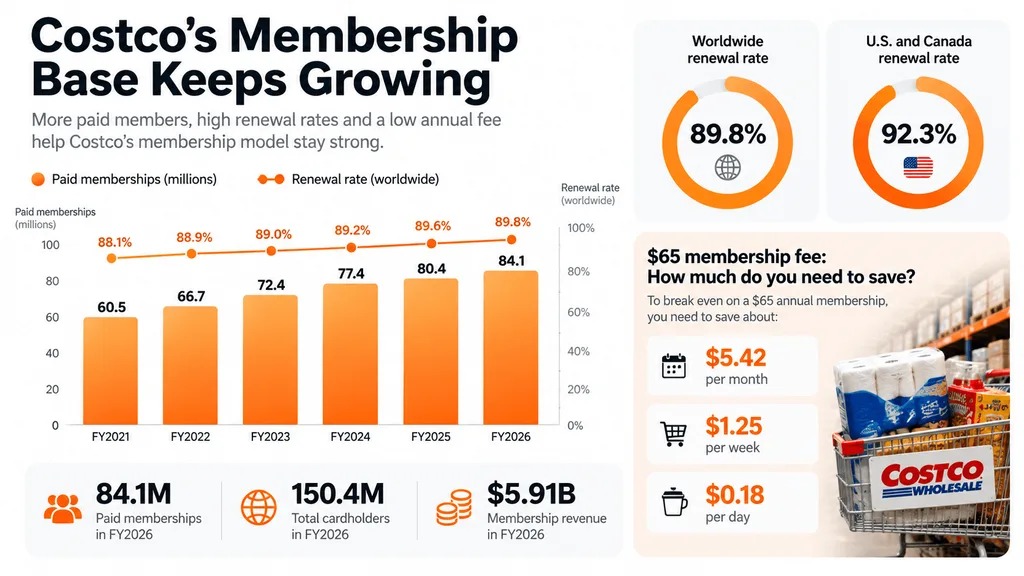
According to the 2026 fiscal year performance of Costco, this arrangement resulted in $5.91 billion in membership fee revenue; as of August, the company had a total of 84.1 million paid members and 150.4 million cardholders.
What is more notable is the customer retention rate. The global member renewal rate of Costco reaches 89.8%, with 92.3% in the United States and Canada.
Why are 84 million Costco members willing to continue paying every year?
According to the 2026 annual report of Costco, member revenue increased by 11% compared to the $5.32 billion in fiscal year 2025. The growth was driven by new member registrations, an increase in membership fees, and upgrades in membership levels for Executive members.
In the United States, the regular annual membership fee is $65, while the Executive membership fee is $130, and members are eligible for a 2% rebate on qualifying purchases, although there is an annual cap on this rebate.
Therefore, customers will be motivated to assess how much money they can save throughout the year, rather than just looking at a single shopping experience.
If someone pays $65 per year, then to offset this cost, they would need to save about $5.42 per month compared to alternative options. This calculation is for illustrative purposes only; the actual amount saved depends on the products purchased, local prices, and shopping habits.
Bulk purchasing, discounted fuel, and the company's own brand Kirkland Signature further enhance this attractiveness.
Costco has decided to return a large portion of the $184 million in tariff refunds to customers through price reductions, which also reflects how management is attempting to maintain this value proposition.
Costco earns billions of dollars before customers even reach the checkout counter
Most retailers rely heavily on the difference between the cost of goods and their selling price.
The gross profit margin of Costco products is exceptionally low. In the company's fiscal year 2026, the gross profit margin for these products was 11.09%, while the annual sales volume reached 297.25 billion US dollars.
However, the member-driven economic model allows the company to have recurring revenue in addition to these sales.
Member fees account for approximately 64% of Costco $9.23 billion in annual net profit. This comparison does not imply that member fees contribute 64% of the profit, as revenue and net profit are different accounting indicators.
Unlike retailers that rely entirely on a single transaction, Costco has a type of customer relationship that persists between two purchases.
Its model is also different from that of digital subscription companies like Spotify; the latter's regular payments must cover a large amount of ongoing copyright costs.
The membership fees for Costco are not cost-free income, but customers still need to purchase products separately. Therefore, the member income can complement the company's retail earnings.
Costco The Business Risks Behind the Success of Members
This model depends on whether customers continue to consider this access qualification worth paying for.
If prices rise, product choices worsen, or service quality declines, this perception may be weakened, especially when families are more cautious about their spending.
This pressure has already become apparent in the discount retail industry, with some smaller grocery chain stores facing challenges due to competition and high operating costs.
Costco is also exploring other reasons to encourage customers to continue retaining their membership, including a proposal for a medical service collaboration targeting elderly Americans.
Frequent payments can also trigger scrutiny; Amazon's settlement regarding subscription registration and cancellation practices is an example of this. Prime
Adrian Cole
Adrian Cole has been engaged in financial market reporting for over 6 years, with a focus on cryptocurrencies, stocks, and macroeconomic trends. He tracks Bitcoin, major altcoins, the U.S. stock market, interest rates, commodities, as well as data that drives market changes. Over the years, he has written hundreds of market updates and analysis articles, with an emphasis on price trends, investor sentiment, and the connections between traditional finance and digital assets.