Barclays plans to cut around 5,000 jobs in 2026, despite the bank reporting a 12% increase in profits for the third quarter, which makes this British bank one of the most prominent examples of how automation is reshaping employment in the banking industry.
The company announced pre-tax profits of £2.3 billion for the third quarter, with revenue growing by 3% to £7.4 billion. Nevertheless, management confirmed that the restructuring will affect approximately 5% of the workforce, with significant cuts to be made in technical and support positions.
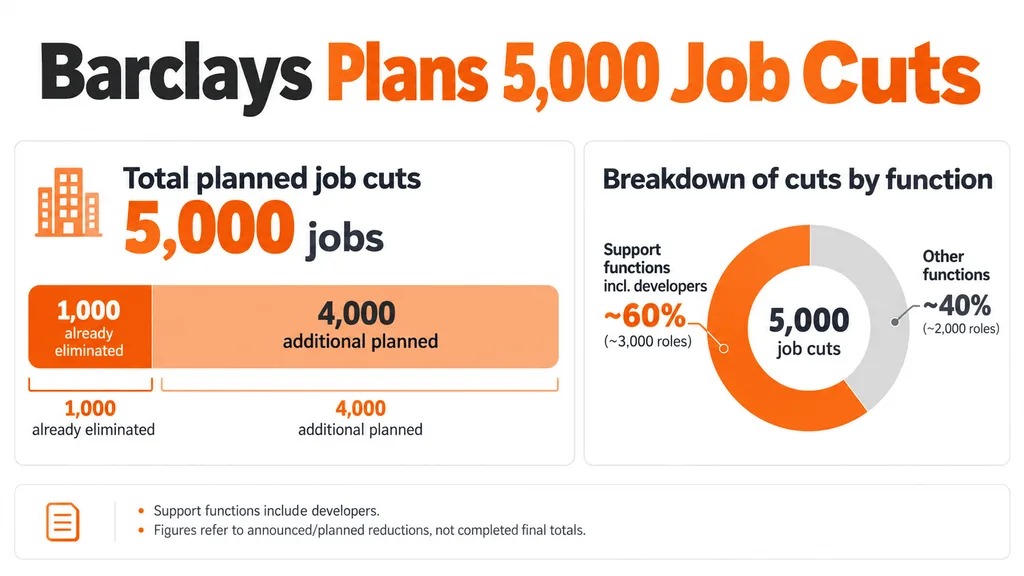
According to Reuters, approximately 1,000 positions have been cut, and another 4,000 positions are expected to disappear by the end of the year.
Barclays targets 5,000 positions as artificial intelligence reshapes bank operations
Chief Financial Officer Anna Cross ( Anna Cross ) stated that approximately 60% of the positions to be cut will affect support functions, including software developers.
This means that approximately 3,000 positions in the support operations department will be affected, although Barclays has not disclosed how many developers will lose their jobs.
These layoffs are part of a broader reorganization strategy aimed at streamlining operations and making greater use of technology.
In its official quarterly results, Barclays disclosed that structural cost actions in the third quarter amounted to 201 million pounds, compared to 93 million pounds in the same period last year.
However, Barclays does not attribute each round of layoffs directly to artificial intelligence. Its reorganization also reflects an investment in system modernization and the simplification of existing processes.
Despite weaker bond trading, Barclays' profits still increased by 12%
Barclays' financial results show why, despite an overall improvement in profits, management continues to cut costs.
However, revenue from fixed-income, foreign exchange, and commodity trading decreased by 19% year-on-year, offsetting some of the strong performance from other businesses of investment banks.
Stock trading performance was significantly better, with revenue growing by 47% following previous investments in financing and derivatives.
These comparison results help to explain why, even though the profits of Toutiao have improved, investors remain cautious about the profitability of banks.
Similar concerns are also present in the European banking market. Previously, the sell-offs by Deutsche Bank and Union Credit (UniCredit) indicated that even though the lending business is still profitable, higher bond yields will put pressure on financial stocks.
AI Layoffs Raise Questions About the Future Staff Structure of Banks
Barclays' reorganization reflects a broader shift in resource allocation among large financial institutions.
Banks are investing in automated customer support, software development tools, and more efficient internal systems, while also attempting to reduce recurring labor costs.
Barclays expects that despite continued investment in technology, the group's total costs will be approximately £18.5 billion in 2026 and around £18.4 billion in 2027.
Maya Bennett ( Maya Bennett )
Maya Bennett is a financial journalist with experience covering cryptocurrencies, stocks, and broader market trends. Her work focuses on Bitcoin, major digital assets, the stock market, monetary policy, and economic developments that influence investor sentiment. She is adept at transforming rapidly changing market news into clear and concise reports.