Key Points
- HSBC pointed out that the pressure to add margin caused by the decline in the stock market may force investors to sell gold to raise cash, leading to a simultaneous decline in gold prices and stock prices.
- Rising U.S. Treasury yields and a stronger dollar will also put pressure on gold prices.
- Although gold still benefits from concerns about debt and inflation and has long-term investment value, it cannot withstand all market shocks, and investors should not regard it as a "panacea."
The hedging properties of gold are being put to the test. Although concerns about debt and inflation still provide long-term support for gold prices, in a market environment where stock markets are declining and bond yields are rising, gold may also be sold off as investors rush to raise cash, making it difficult for gold to play its role as a short-term hedge.
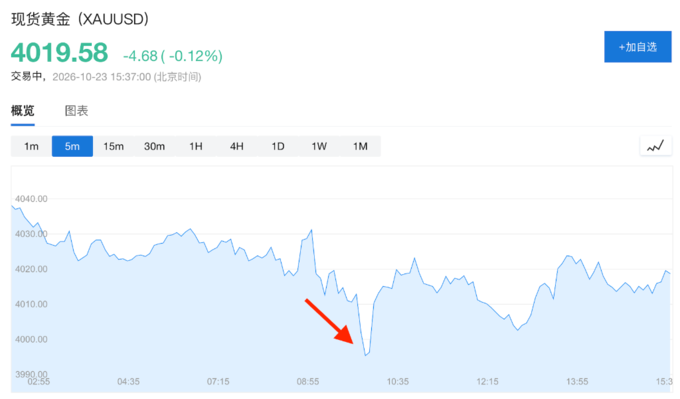
On October 23, spot gold briefly fell below the $4,000 per ounce mark. Previously, this year gold prices had broken through $5,000 per ounce, setting a new historical high, but then the upward trend slowed down, prices declined, and market volatility increased.
HSBC Asset Management strategists pointed out in their latest report that high oil prices, rising interest rates, and soaring bond yields are putting pressure on gold. However, factors such as the fragmentation of the geopolitical landscape and the diversification of central bank reserves are still supporting demand for gold, and its long-term investment value has not disappeared as a result.
Gold has recently fallen in tandem with U.S. stocks, and the key factor is the pressure on market liquidity, rather than a complete disappearance of the demand for hedging. HSBC warns that leveraged funds hold a concentrated position in gold. Once a stock market decline triggers margin calls, investors may be forced to sell gold to raise cash, leading to simultaneous pressure on both gold and stocks. The bank emphasizes that no single asset can withstand all types of market shocks, and investors should not regard gold as a universal hedging tool.
Why is gold falling along with U.S. stocks? Liquidity pressures weaken its short-term hedging effect
HSBC asset management strategists believe that the recent decline in gold prices does not mean that the logic behind so-called 'debasification trading' (Debasement Trade) has become invalid. The core of this trading strategy is that investors, concerned about government debt expansion, declining purchasing power of money, and inflation risks, shift some of their funds to physical assets such as gold.
"As long as concerns about debt and inflation persist, this transaction can continue," said the strategist.
However, the validity of long-term configuration logic does not mean that gold will rise in every market turmoil. When a decline in the stock market leads to margin pressure, investors holding leveraged positions may need to sell more liquid assets to replenish cash, and as a result, gold becomes an asset that is sold off. At this time, gold may not be able to hedge against the decline in stocks; it could even fall in tandem with stocks.
HSBC’s Global Chief Investment Officer Willem Sels and the Head of Global Wealth Insights Lucia Ku also pointed out in a report in July that gold did not significantly rise during the Middle East conflict, and its trend was basically in sync with stocks. The two believe that the yield on U.S. Treasury bonds is an important factor affecting gold prices: since gold itself does not generate interest, rising yields increase the opportunity cost of holding gold, thereby putting pressure on gold prices.
This also explains the limitations of gold's hedging properties: while gold can counteract some long-term monetary and credit risks, it may not necessarily protect a portfolio during short-term liquidity shocks. When investors generally need cash, the liquidity of these assets may instead make them a priority for liquidation.
Short-term pressure does not change the medium-term configuration logic, but gold is not a 'panacea'.
HSBC expects that high actual yields and a stronger US dollar may cause gold prices to remain within a range of fluctuations in the short term, but the need for portfolio diversification, central banks' continued gold purchases, and ETF capital inflows will still provide support for gold prices. "We expect gold prices to rise further before the end of the year," Sels and Ku stated.
Regarding the reasons for the significant pullback in gold prices earlier on, James Steel, the chief analyst of HSBC Precious Metals, pointed out in May that after gold prices reached a high of around $5,400 per ounce at the end of January this year, they fell back. Part of the reason was that the market's long positions were too concentrated, and profit-taking exacerbated price volatility.
Steel believes that the poor performance of gold during the Middle East conflicts does not mean that its hedging function has failed. When oil prices rise, bond yields strengthen, and stock markets decline, investors may sell gold to raise cash. "Gold is like an insurance policy, and this insurance policy is now being cashed in."