Key Points
- HSBC launches the regulated Hong Kong dollar stablecoin RedCoin through PayMe.
- Over 3.3 million users have gained access to potential stablecoin usage.
- Merchant payments and tokenized investments will become the directions for future expansion.
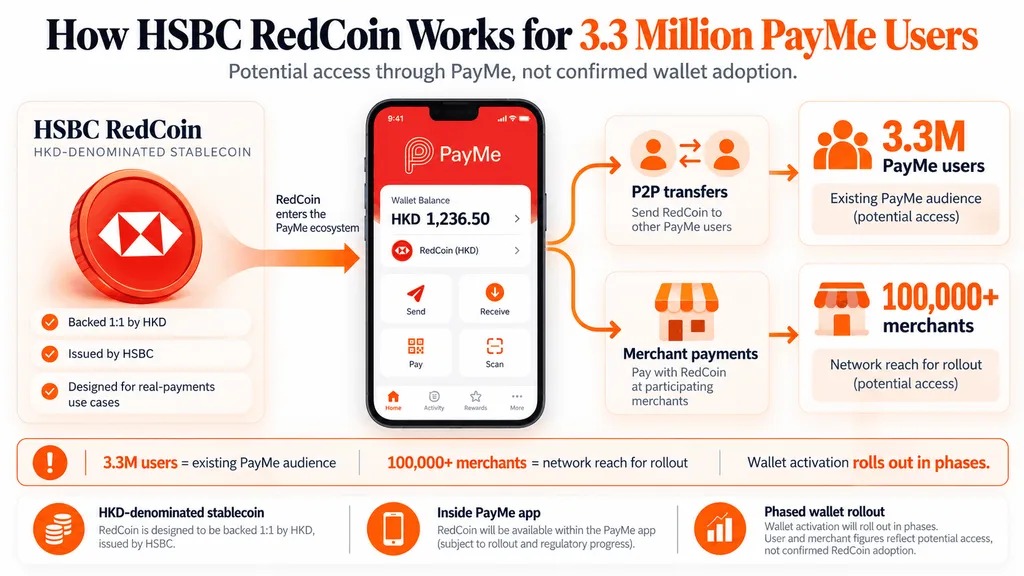
HSBC has launched its first regulated stablecoin in Hong Kong, bringing digital currency payments to its PayMe platform. This platform has over 3.3 million users and supports transactions with more than 100,000 merchants.
The new token, denominated in Hong Kong dollars as HSBC RedCoin ( RCHKD ), was officially launched on October 23rd. According to the bank's announcement, customers will be able to activate their stablecoin wallets within PayMe in the coming days.
However, the number 3.3 million refers to the total number of existing users of PayMe, not the number of customers who have already activated the RedCoin wallet.
HSBC brings stablecoin payments to 100,000 merchants
RedCoin is licensed and regulated by the Hong Kong Monetary Authority in accordance with Hong Kong's "Stablecoin Regulations." These regulations establish a dedicated framework for fiat-backed digital assets.
HSBC obtained one of the first stablecoin licenses in Hong Kong in April. During the same period, Anchorpoint Financial also received a license, as did a consortium involving Standard Chartered Bank, Hong Kong Telecom, and Animoca Brands.
The launch in October means that this regulatory approval has been transformed into a retail payment product that can be actually put into operation.
PayMe Users will be able to transfer funds to relatives and friends RedCoin without leaving the application, as well as make payments to participating merchants. This stablecoin is designed to maintain a 1:1 value to the Hong Kong dollar and is backed by isolated reserve assets.
HSBC Digital Assets Custody will provide the hosting infrastructure, while that team will continue to be responsible for compliance and transaction control.
This approach is different from traditional cryptocurrency wallets; in the latter, users usually need to manage their blockchain addresses on their own and transfer assets between separate platforms.
This also echoes the broader trend of stablecoin payments expanding, as financial companies are increasingly integrating digital currencies into applications that consumers are familiar with.
HSBC's stablecoin strategy is not limited to payments
This plan aims to expand RedCoin to tokenized investment scenarios through its mobile banking app in Hong Kong.
HSBC currently operates institution-level tokenization infrastructure through HSBC Orion, and also provides Gold Token as well as wholesale tokenized deposit services.
Its participation in Hong Kong's tokenization fund projects indicates that financial institutions are attempting to connect blockchain-based settlements with regulated investment products.
Earlier this month, SoFi expanded its bank-issued stablecoin model, demonstrating how mature financial companies are utilizing digital currencies in their existing payment services.
Can stablecoins issued by banks challenge USDT and USDC?
RedCoin Entering a global stablecoin market dominated by assets denominated in US dollars, which includes Tether's USDT and Circle's USDC.
Its initial advantage lies in its distribution channels, rather than the proven transaction demand. HSBC already has millions of potential customers and a mature network of business relationships.
This strategy is similar to the directions of Visa and Mastercard; both companies are integrating stablecoins into their existing payment infrastructure.
However, HSBC has not yet disclosed how many PayMe users will activate the RedCoin wallet, nor has it revealed how much trading volume this launch will generate.
Author: Emir Abyazov