Key points:
- The Brazilian stock market tumbled significantly after President Lula's unexpected re-election
- Lula's victory has sparked concerns in the market about increased government spending, rising public debt, and economic uncertainty.
- Analysts warn that volatility may further increase as investors await Lula's statements on economic plans and fiscal policies.
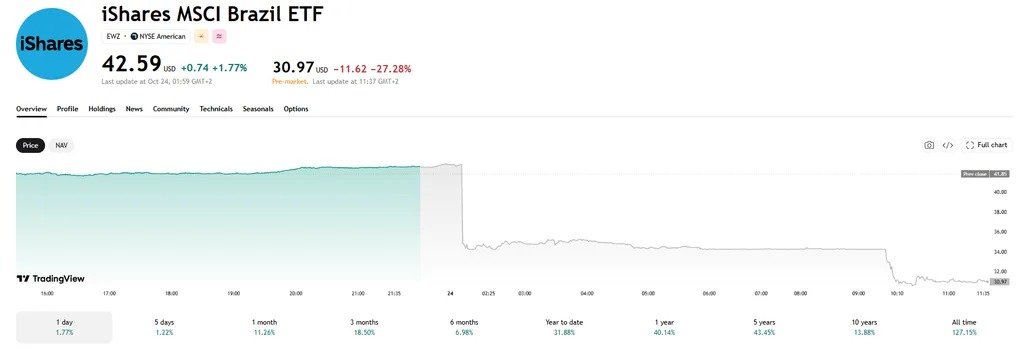
After Brazilian President Luiz Inácio Lula da Silva ( Luiz In à cio Lula da Silva ) unexpectedly won re-election on Sunday, the Brazilian stock market tumbled significantly. As investors abandoned their bets on a more business-friendly government, there was a sharp sell-off in the market.
This intense market reaction stems from Lula's unexpected reversal of the situation, as he defeated the right-wing senator Jair Bolsonaro ( Fl á vio Bolsonaro ). Bolsonaro's strong performance in the first round of voting had once filled investors with optimism.
Why did the Brazilian stock market plummet after the election?
Lula won about 51.8% of the votes in the presidential runoff on Sunday, defeating Bolsonaro who received about 48.2% of the votes. This victory has granted this 80-year-old president an unprecedented fourth term in office.
After Jair Bolsonaro unexpectedly took the lead in the first round of voting, Brazil's benchmark Ibovespa index rose by 7.7% on October 5th, reaching a closing record high of 206,911.89 points. By last Friday, the Brazilian stock market was still nearly 7% higher than its pre-election level, and the real currency appreciated by nearly 5% against the US dollar.
Lula's victory quickly reversed these expectations and caused Brazilian assets to plummet in international trading.
Brazil's debt problem exacerbates investors' concerns
In addition to the surprising election results, investors are still concerned about Brazil's deteriorating public finances. The country's public debt has exceeded 82% of its gross domestic product ( GDP ), which has raised doubts about the government's ability to strike a balance between spending commitments and fiscal stability.
Although Lula's government aims to achieve a primary budget surplus of approximately GDP 1.3% by 2030, investors remain skeptical due to the lack of a detailed expenditure reduction plan.
The financial market is also watching whether Lula will appoint a finance minister who can reassure investors and negotiate fiscal reforms with a congress inclined towards the opposition parties.
Will the Brazilian stock market continue to fall further?
The overnight sharp decline has now sparked concerns in the market about potential further volatility in Brazil's domestic stock market after it opens on Monday. Political uncertainty has increased with Jair Bolsonaro refusing to accept his defeat and calling for the election results to be declared invalid.
Investors will now be focusing on Lula's economic policy statements, especially his approach to government spending, public debt, and the budget for 2027.
Danielle Walgenbach
Danielle is a journalist who covers cryptocurrency and financial markets. With over four years of reporting experience, she is adept at breaking down complex financial and economic topics into clear and solid news stories.