

As the Vice President of Technology at Solana extends an invitation to migrate to the “dying blockchain,” the support rate for Proposal 346 among holders of $AKT has become overwhelmingly leading.
Akash Network is a decentralized cloud computing platform that has received overwhelming support and plans to migrate from its sovereign blockchain based on Cosmos to Solana.
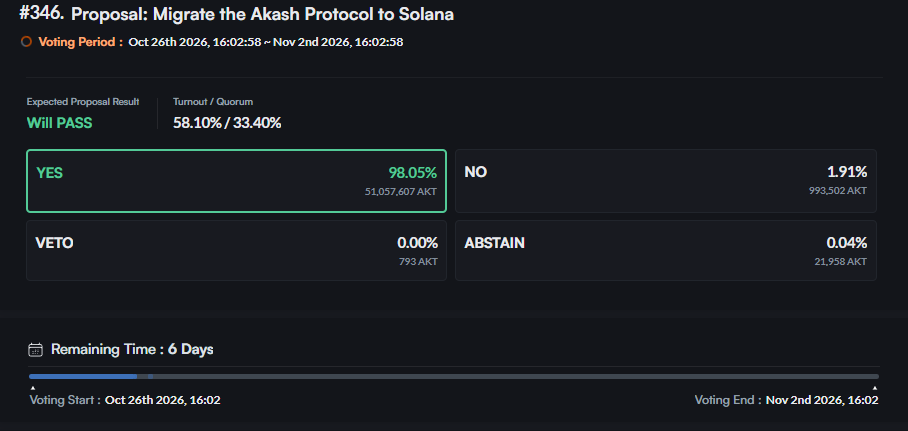
Proposal 346, titled "Migrating the Akash Protocol to Solana," has received 98.05% of the votes in favor, which is approximately equivalent to 51.06 million $AKT. Opposing votes account for 1.91%, while abstentions and vetoes make up 0.04% and 0% respectively.
Voting will begin on October 26 and will last until November 2. The required quorum is 33.4%. Currently, with a participation rate of 58.10%, we have already exceeded this threshold. Since the number of "yes" votes has reached 98.05%, even if all remaining votes are cast against the proposal, it is mathematically guaranteed to pass.
Akash Why choose Solana
Akash began looking for a new blockchain in October 2025. At that time, the founder Greg Osuri announced plans to gradually phase out the project's own Cosmos SDK chain. The team stated that they would evaluate each network based on security, liquidity, community strength, and growth potential.
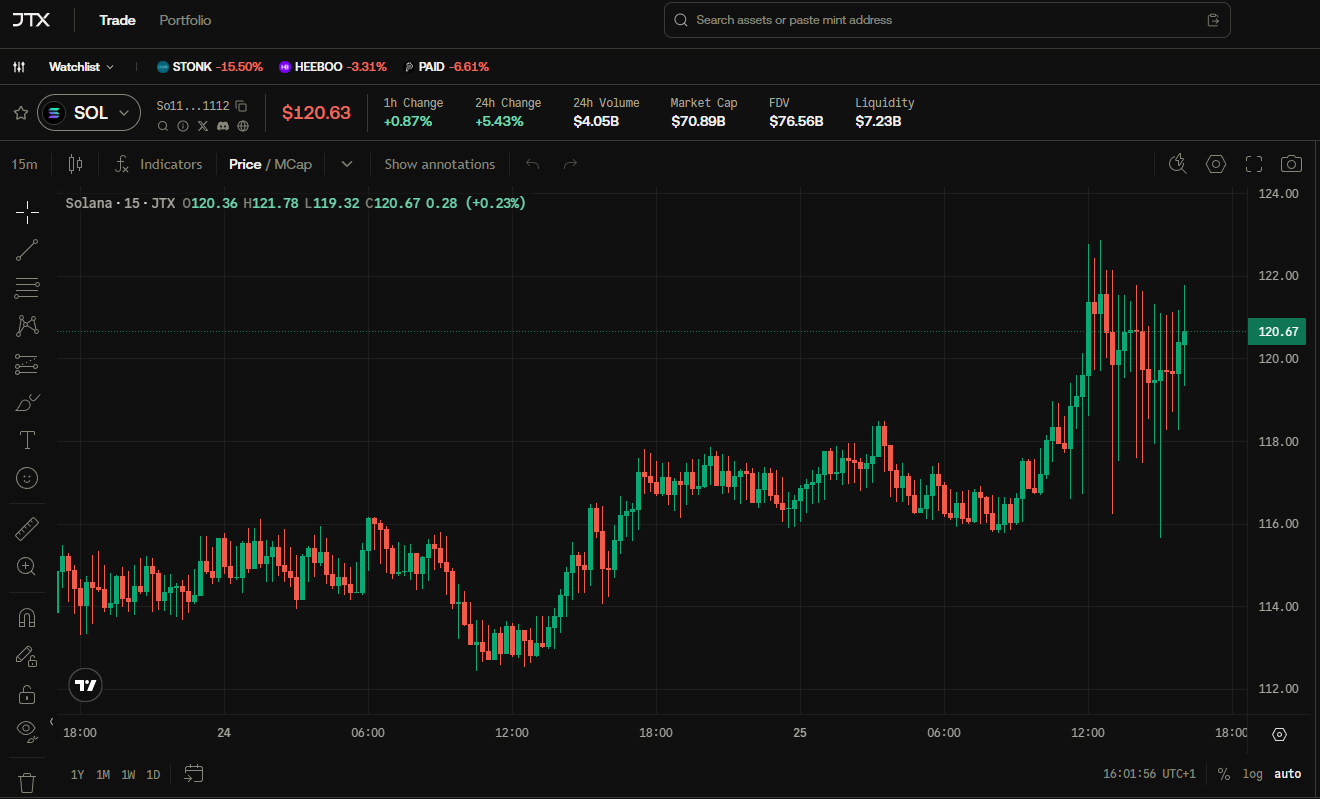
In a blog post, the Akash team explained the reasons for choosing Solana. Akash currently relies on about 100 validators to ensure the security of its blockchain and maintains its own versions of Cosmos SDK, CometBFT, and gogoproto. The team believes that migrating to Solana will reduce infrastructure and maintenance costs by eliminating the need for an independent consensus layer. The team estimates that the transaction fees for the entire market on Solana are approximately 0.075 SOL per day, which is about 7.5 US dollars at current prices.
The team also mentioned the growth potential of Solana. Akash estimates that its market processes about 15,000 transactions per day, while Solana reports a daily user transaction volume of 112 million.
One of the reasons for this migration is the established DePIN ecosystem. Helium, Render, io.net, Hivemapper, and Nosana are already running on that network. Taking Akash and the migration in Helium in 2023, as well as the token conversion of Render as examples, it can be seen that existing projects have migrated their infrastructure or tokens to Solana.
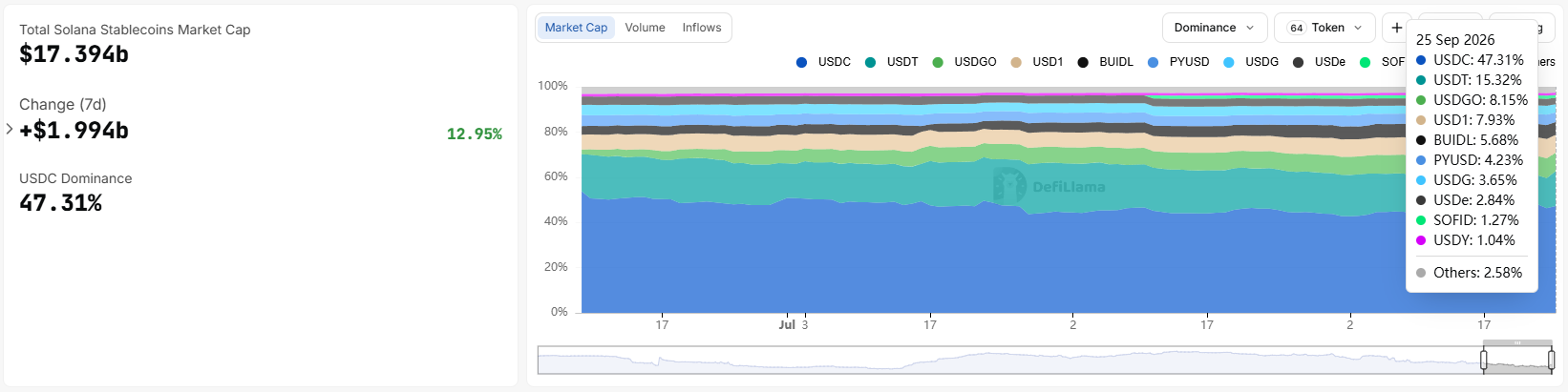
Finally, Akash emphasized the liquidity and user base of Solana, stating that its stablecoin supply is approximately 15 billion US dollars, with around 2.2 million paying users daily, and it holds a leading position in the weekly trading volume of decentralized exchanges. The team believes that this ecosystem can expose their decentralized computing market to more on-chain users. The team also mentioned the integration of the Cosmos ecosystem, including the exit of Noble in March 2026, as part of a constantly changing landscape.
How will the $ AKT migration be carried out?
According to Proposal 346, $ AKT will be issued in the form of SPL tokens. Holders who destroy 1 $ AKT on the Cosmos chain will receive 1 $ SPL version of $ AKT. The team expects to launch this token about 2 weeks after the proposal is approved, provided that both the token and the migration portal pass two independent audits. This one-way exchange portal will remain open for 2 years after its launch.
Self-hosted holders will connect their Cosmos wallets and select the Solana address. The proposal states that they do not need to hold $SOL to complete the exchange. Balances held by Console will be automatically migrated, and the exchange will arrange the migration schedule on its own. Holders of Osmosis or other users who have $AKT on the chain connected through cross-chain communication (IBC) must first transfer the tokens back to the native chain of Akash.
The pledged $ AKT will follow a separate process. First, the unlocking and collection of outstanding rewards will be carried out, and then it will queue up for conversion after the 21-day unlocking period ends.
What happens to providers, tenants, and staking?
Market migration will take place later, provided that the audit and migration drills are completed. Another separate governance vote will determine the switch date. Providers need to upgrade their software and complete registration on Solana. Tenants can retain their deployment configuration files, namely the SDL files, and the existing leases will continue to be valid during the transition period.
Solana Will it continue to absorb the "dying blockchain"?
In the past two years, there has been a broader trend of integration in the crypto industry, with more and more projects abandoning their own blockchains in favor of migrating to Solana. Akash is the latest example of this trend. Previously, Zeta Network decided to abandon its dedicated Layer-1 in September 2026, and that blockchain had been in operation since 2023.
The governance proposal of Zeta received 99.4% support, facilitating the migration of its flagship application Anuma AI and over 300,000 connected users to Solana. The project stated that the emerging AI infrastructure of Solana, which includes the Agent Registry and x402 payment layers, was a key reason for this migration.
The proposal from Akash also received a direct invitation from Jacob Creech, the Vice President of Technology at Solana Foundation. Creech has called on Layer-1, Layer-2 and applications that are running on “dying blockchains” to consider migrating to Solana. He believes that Solana has already handled a large amount of network traffic, continuously expanded its capacity, and demonstrated the security suitable for institutional use.
As more and more projects re-evaluate the costs and benefits of maintaining independent chains, the liquidity, infrastructure, and user base that have been established by Solana may make it an increasingly attractive destination for migration.