News from the IT family on October 28th: Visa has released its annual report for the fiscal year 2026 (from October 1, 2025, to September 30, 2026), as well as the report for the fourth quarter of 2026 (from July 1, 2026, to September 30, 2026), today.
For the fiscal year 2026, Visa achieved total operating revenue of $45.903 billion, a year-on-year increase of 15%; gross profit of $28.11 billion, a year-on-year increase of 17.15%; gross margin of 61.24%, an increase of 1.25 percentage points year-on-year; net profit attributable to the parent company of $23.504 billion, a year-on-year increase of 17%; operating cash flow of $23.728 billion; basic earnings per share of $12.32; diluted earnings per share of $12.32, a year-on-year increase of 21%; and a debt-to-asset ratio of 61.75%.
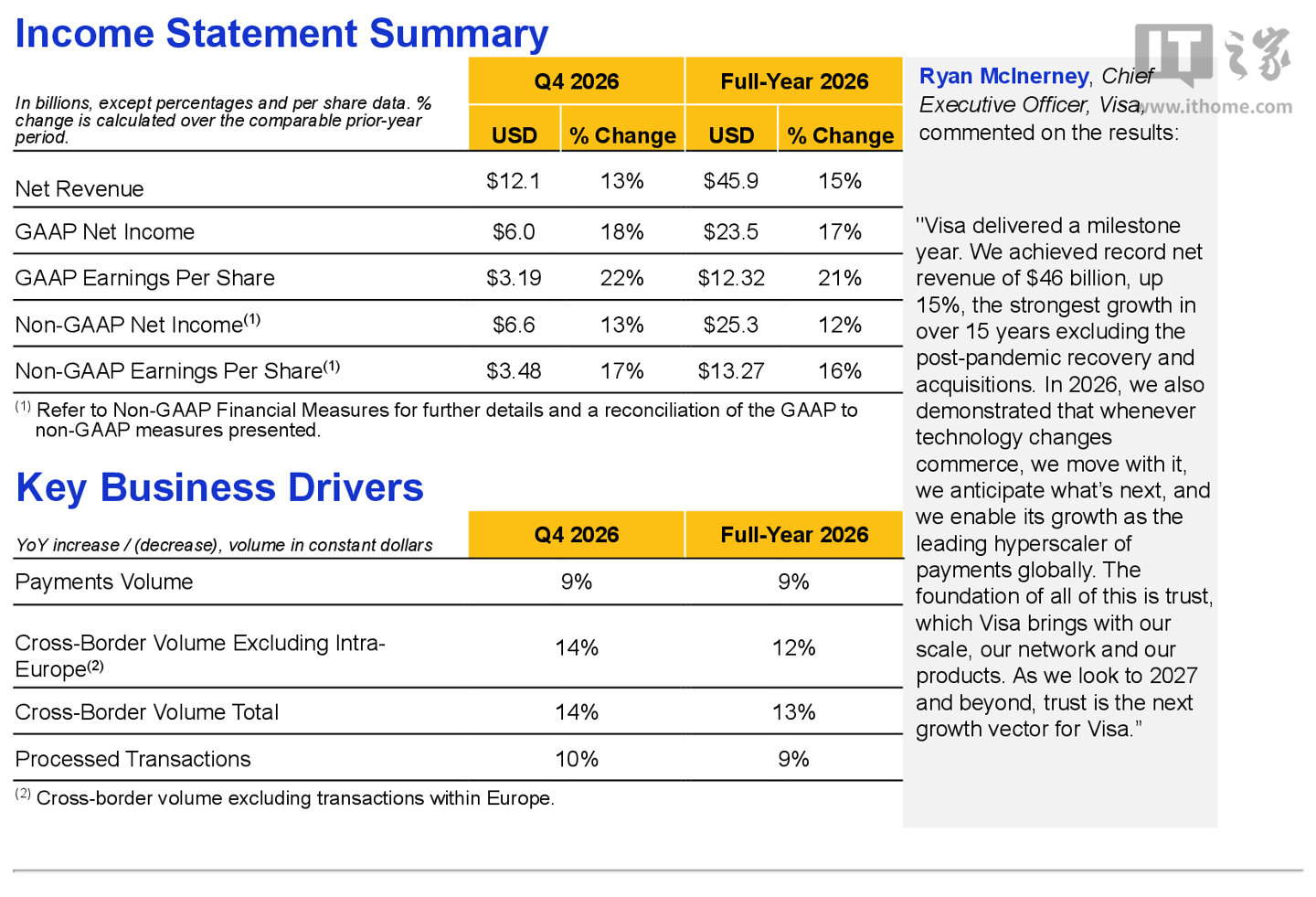
In the fourth fiscal quarter, Visa achieved total operating revenue of $12.139 billion, a year-on-year increase of 13% and a quarter-on-quarter increase of 4.35%; gross profit was $7.262 billion, up 18.12% year-on-year; gross margin stood at 59.83%, an increase of 2.5 percentage points year-on-year; net profit attributable to the parent company was $6.002 billion, up 18% year-on-year and 6.65% quarter-on-quarter; basic earnings per share were $3.19, up 22% year-on-year; diluted earnings per share were also $3.19, with a 22% year-on-year increase; and the debt-to-asset ratio was 61.75%.
The article states that according to the interpretation of AI, the core indicators of this financial report as a whole exceeded market expectations. Net revenue, GAAP net profit, and non-GAAP profitability all surpassed analysts' forecasts, continuing the trend of exceeding expectations for eight consecutive quarters.
In terms of the company's main business and key performance highlights, Visa is a leading enterprise in the global digital payment sector, providing transaction settlement networks covering over 200 countries and regions for consumers, merchants, financial institutions, and government agencies. Its core revenues come from service fees, data processing fees, cross-border transaction fees, and other segments.
In the fourth fiscal quarter of 2026, net revenue reached $12.139 billion, a year-on-year increase of 13%; GAAP net profit was $6.002 billion, a year-on-year increase of 18%. Non-GAAP net profit was $6.552 billion, a year-on-year increase of 13%. For the full fiscal year of 2026, net revenue amounted to $45.903 billion, a year-on-year increase of 15%; GAAP net profit was $23.504 billion, a year-on-year increase of 17%. Non-GAAP net profit was $25.314 billion, a year-on-year increase of 12%.
At the operational level, in the fourth fiscal quarter of 2026, payment amounts, cross-border transaction volumes, and the number of transactions processed all continued to grow, with year-over-year increases of 9%, 14%, and 10% respectively when measured in constant US dollars; for the full year, the corresponding indicators also saw year-over-year increases of 9%, 13%, and 9% respectively.
In terms of future prospects and strategic actions, the company signed a final agreement in August 2026 to acquire the behavioral multi-signal anti-fraud service provider BioCatch for $2.4 billion in cash. The transaction is expected to be completed in the second fiscal quarter of 2027, further enhancing the company's payment security and risk control capabilities.
In terms of shareholder returns, during the fourth fiscal quarter of fiscal year 2026, repurchases and dividends totaled 5.2 billion US dollars, with an annual total of 25.6 billion US dollars; the board of directors announced an increase in the quarterly cash dividend by 16% to 0.78 US dollars per share.
It is also mentioned in the text that Visa currently holds an oligopolistic position in the global payment network, with strong business growth resilience and stable cash flows. Coupled with ongoing shareholder repurchase and dividend policies, it possesses long-term defensive investment value. The article also warns that in the future, attention should be paid to the potential impact of litigation provisions and rising operating costs on profit margins.