

A new report examines the retirement prospects of four generations of workers
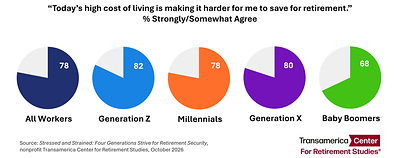
Los Angeles, October 28, 2026 / PRNewswire / -- A new report, "Stress and Burden: How Four Generations Fight for Retirement Security" (Stressed and Strained : Four Generations Strive for), jointly released by the non-profit Trans-American Retirement Research Center (Transamerica Center for Retirement Studies , abbreviated as TCRS ) and the Trans-American Institute (Transamerica Institute ), has been released. A study by Retirement Security shows that the majority of American workers (78%) agree that the current high cost of living is making it more difficult for them to save for retirement.
Cross-America Research Institute and TCRS CEO and President Catherine Collinson stated: "The retirement system in the United States is evolving, and today it requires workers to bear more responsibility for financing their retirement than previous generations. Currently, uncertainties about the future of social security, ongoing inflation, competing priorities, and potential employment disruptions make it more difficult for workers to save, plan, and prepare for retirement." She said, "This is a perfect storm."
The survey results show that nearly two-thirds of workers (65%) agree with the statement: "I may work until retirement, but I still won't be able to save enough money to meet my own needs." 73% of the respondents are concerned that by the time they are ready to retire, social security benefits may not be able to provide them with support. At the same time, 41% of people list "living longer than their savings and investments will allow" as one of their biggest worries regarding retirement.
"Pressure and Burden: How Four Generations Strive for Retirement Security" is a research report based on surveys that examines in depth the retirement preparedness of workers from different generations, including Generation Z, Millennials, Generation X, and Baby Boomers. The report provides insights into their health and well-being, employment, personal finances, and retirement prospects.
Generation Z (born between 1997 and 2012)
Collinson indicates that Generation Z workers are starting their careers during a period of unprecedented transformation in the labor market. For them, this is a critical time to establish a solid foundation and build a financial base, so that their long-term retirement savings and investments can experience compound growth over the coming decades. However, many of them also have to balance work with family responsibilities, which may hinder their progress.
Among Generation Z workers who are 18 years of age or older, the survey found that:
- Half of Generation Z workers (50%) struggle to maintain a balanced income and expenses. 28% have more than one job, and 52% engage in side hustles.
- The current financial priorities of Generation Z workers include: repaying debts (56%), building an emergency savings fund (47%), saving for major purchases or life events (47%), saving for retirement (40%), and merely covering basic living expenses (40%). Among them, 25% indicate that supporting their parents is also a priority.
- One-third of Generation Z workers (34%) are currently acting as caregivers, or have provided care for relatives or friends at some point in their careers. Among these individuals, 90% have made adjustments to their work situations due to taking on the role of caregiver, ranging from taking time off, reducing working hours, to giving up promotion opportunities, and even quitting their jobs altogether.
- The median savings in the retirement accounts of Generation Z workers' families is estimated to be $37,000. One-fifth (22%) have utilized their retirement savings, including making difficult withdrawals and/or early withdrawals from 401(k) or similar plans, or IRA.
Millennials (born between 1981 and 1996)
Collinson indicates that: "Most members of the millennial generation are now in their mid-30s to mid-40s, with many being part of the 'sandwich generation' – working while raising children and taking care of elderly parents. With so many competing priorities, it can be difficult for them to find time for retirement planning. However, even small steps taken today can lead to substantial changes in the long run."
The investigation found:
- Nearly 60% of millennial workers (58%) say that debt is preventing them from saving for retirement; 44% indicate that they prefer to wait until closer to their retirement date before considering or worrying about retirement investments.
- Current financial priorities for millennials include: repaying debts (61%), saving for retirement (54%), building an emergency fund (47%), supporting children (45%), and saving for major purchases or life events (40%). Among them, 16% indicate that supporting parents is also a financial priority.
- 37% of millennial workers are currently caregivers and/or have previously served as caregivers. Among these individuals, 90% have adjusted their employment arrangements due to caregiving responsibilities.
- The median savings in the retirement accounts of millennial workers' families is estimated to be $73,000. One-fifth (20%) have made difficult withdrawals and/or early withdrawals from 401(k) or similar plans, or from IRA.
Generation X (born between 1965 and 1980)
Collinson indicates that the "X generation is approaching the age of 60 and is close to retirement. Many people are already behind in terms of savings, which is particularly concerning against the backdrop of ongoing inflation. They plan to work longer and retire at a later age to make up for the savings gap, but whether they will be successful depends not only on their financial plans but also on their ability to maintain their health and employability."
The investigation found:
- 18% of Generation X workers are "very confident" that they can retire in comfort, and 25% strongly agree that they are building up a sufficient retirement savings.
- More than one-third (36%) of Generation X workers are expected to retire at the age of 70 or later, or they simply do not plan to retire at all; 53% intend to continue working after retirement.
- Nearly half of Generation X workers (49%) expect that their main source of retirement income will come from self-funded savings, including 401(k) and 403(b) plans, as well as IRA (38%), or other savings and investments (11%). 27% expect to rely mainly on social security, 11% expect to depend on income from continued work, and 5% expect to rely on company-sponsored pension plans.
- The median savings in the retirement accounts of Generation X workers' families is estimated to be $113,000. 17% have made difficult withdrawals or early withdrawals from 401(k) or similar plans, or from IRA, thereby utilizing their retirement savings.
Baby boomers (born between 1946 and 1964)
Collinson indicates that "the youngest members of the baby boom generation are now over 60 years old, and the oldest will turn 80 this year. Among those who remain in the labor market, the baby boomers are continuing to push back the age of retirement. They are more susceptible to health and employment issues, therefore, emergency plans are needed to prevent them from being forced to retire unexpectedly."
The investigation found:
- More than half of the Baby Boomer workers (55%) are expected to retire at the age of 70 or later, or they do not intend to retire at all.
- The median savings in the retirement accounts of Baby Boomer workers is estimated to be $263,000. 11% have made difficult withdrawals or early withdrawals from 401(k) plans or similar programs, or from IRA.
- 28% of Baby Boomer workers have developed written retirement financial strategies, and 15% frequently discuss retirement savings, investments, and planning with family and close friends.
Strengthen retirement security
Collinson indicates that "retirement security is a responsibility shared by policymakers, employers, and individuals. A strong retirement system in the United States requires a stable economy, a vibrant labor market, accessibility to workplace retirement plans, and affordable living costs. Everyone should have the ability to retire with dignity. Success depends on workers' ability to earn income, support their families, and save for the future, as well as on the stability of social security and medical insurance ( Medicare ), both of which face long-term funding challenges."
"Pressure and Burden: How Four Generations Strive for Retirement Security" is part of the 26th Annual Retirement Survey. This survey is one of the largest and longest-running of its kind, providing recommendations for workers, employers, and policymakers. The report can be downloaded at www.transamericainstitute.org. The organization also operates accounts on LinkedIn, Facebook, as well as on social media platforms @TI_insights and @TCRStudies.
About the Cross-American Retirement Research Center
The Cross-America Retirement Research Center (TCRS) is a department under the Cross-America Institute, which is a non-profit, privately operated foundation. (TCRS) conducts one of the largest and longest-running annual retirement surveys of its kind. The information provided in this text is for educational purposes only and should not be interpreted as insurance, securities, (ERISA), tax, investment, legal, medical, or financial advice or guidance. For specific questions, please consult independent professionals. Website: (www.transamericainstitute.org)
Regarding the 26th Cross-America Retirement Survey
The analysis in “Pressure and Burden: How Four Generations Strive for Retirement Security” was conducted by the Cross-America Institute and the research team of TCRS. This study was carried out by Harris Poll ( The Harris Poll ) on behalf of the Cross-America Institute and TCRS among 6,153 workers employed in for-profit companies with at least one employee. The survey period was from September 16 to October 17, 2025. The data was weighted as necessary according to age, gender, race/ethnicity, region, education level, marital status, family size, household income, and smoking status to align it with their actual proportions in the overall population. Respondents were selected from those who agreed to participate in the survey. The sampling accuracy of Harris Online polls is measured using Bayesian confidence intervals. For this study, at a 95% confidence level, the margin of error for the sample data is plus or minus 1.8 percentage points. For sub-samples within the surveyed population, this interval is wider. All sample surveys and polls, whether using probability sampling or not, are also affected by various other sources of error, which are typically impossible to quantify or estimate. These include, but are not limited to, coverage errors, non-response-related errors, errors related to the wording of questions and answer options, as well as post-survey weighting and adjustments.
Media contact: Kyle Moschen [ email protected ]