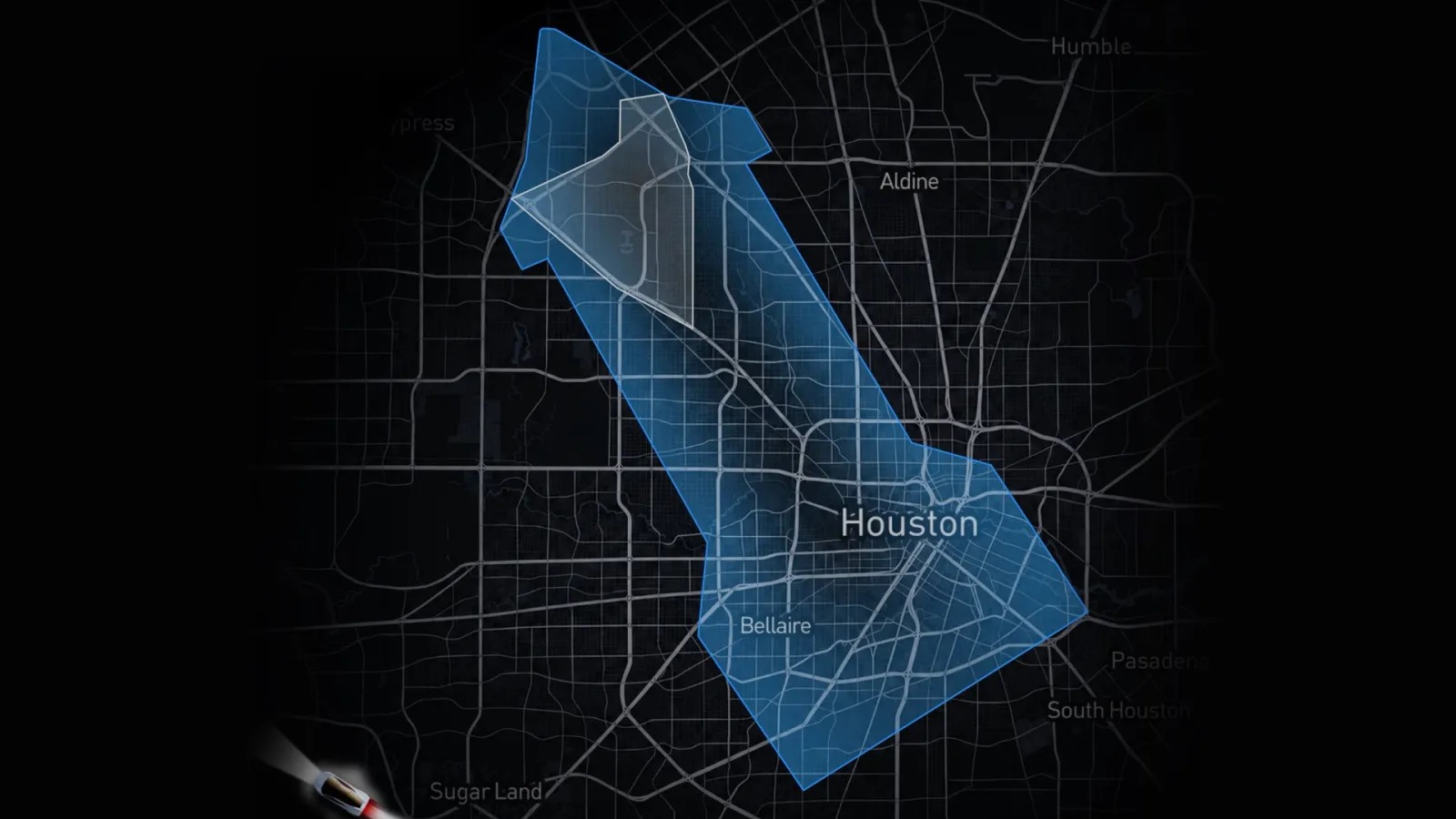
According to Robotaxi Tracker, the creator and former Tesla employee Ethan McKanna, Tesla's newly launched rocket-shaped Robotaxi service area in Houston includes some areas of the city center, but the service actually will not pick you up there.
McKanna tried out this service after the expansion on Monday and described Houston as "by far the most absurd 'fake' autonomous driving service area" he has ever seen. He also mentioned that once, a travel quote showed that taking a Robotaxi across two streets would take about 40 minutes.
On Monday, Tesla expanded the geographical fence of its Robotaxi location in Houston into a rocket shape. The company extended the small launch area, which was originally located in the northwest of Harris County, all the way to the city center and Bellaire, accompanied by the caption “Houston, we have liftoff.”
McKanna operates the crowdsourcing website Robotaxi Tracker, which is used to track Tesla's Robotaxi fleet and service areas; he also worked at Tesla this summer, so his understanding of this project is deeper than that of most people. He went to Houston to experience it firsthand and released the following information last night:
The video shows that the Robotaxi app pinned a pick-up location in downtown Houston, which was completely within the polygon area announced by Tesla. However, the app rejected this request: “Location not available Move the map to select a different location.”
It takes 40 minutes to walk two blocks.
The day before, he posted a travel quote showing what passengers would see:
The quote provided by the application shows that pick-up is at 2:05 PM on the east side of the city center, and delivery is at 2:48 PM to the headquarters of the Houston Police Department at Travis Street. The two locations are only a few blocks apart. However, instead of going straight through the city center, the planned route took a detour south, passing by Midtown and Museum District, then headed towards the area of Texas Medical Center, before turning back north.
The judgment of McKanna is that Robotaxi seems to be avoiding the railway crossing in the city center; he stated that this also fits with 'some other strange route planning in Houston.' He expects Tesla to fix this issue.
However, he did not completely reject this service. He wrote that, aside from this issue, the experience in Houston “felt really good,” with reasonable waiting times, and the “driving performance was clearly better than that of the Waymo I took recently.”
The map of Waymo is not perfect either.
Tesla is not the only one. On Tuesday, Robotaxi Tracker reported that Waymo reduced its service area in Orlando by 10 square miles to 109 square miles, a decrease of 8.4%. McKanna explained the reasons:
Orlando Airport was originally within the map range published on Waymo, but after a check using the McKanna application, it was found that passengers could not set the airport as a drop-off point at this time. As a result, Tracker removed it from the map. The airport service mentioned in Waymo may be launched soon, and some people updated their maps before the official announcement.
That's an airport on the edge of the map. In Houston, however, the vacant area appears right in the middle of the city center.
Views of Electrek
Every autonomous driving operator has gaps in their maps, and Waymo is no exception. However, Waymo's gap in Orlando is located at an airport on the edge of the map, and it's very likely that this area will be added to service soon; whereas Tesla's gap in Houston is in the city center. They first draw a rocket shape, and then decide where the vehicles can actually go after that.
Services and products should always take precedence over marketing, but Tesla's Robotaxi clearly does not reflect this principle. People rely on these maps to determine whether Tesla provides services in their area. It is utterly foolish to forge maps just to achieve a rocket-shaped appearance; better efforts could have been made.
If you're considering using an electric vehicle for commuting in the city, instead of waiting for Robotaxi, combining it with home solar power supply can bring the fuel costs down close to zero. Last year, electricity prices rose by nearly 10%, and it is expected to continue to rise. Installing solar panels is one of the best ways to offset these increasing costs. Through leasing and PPA programs, you can even start with zero down payment and start saving money immediately. If you want to find the best option, you can check out EnergySage. This is a free service, and hundreds of selected installers will compete for your order, so you can usually save 20% to 30% compared to searching on your own. There will be no sales calls before you choose an installer. Click here to get a free quote.
FTC: We use automated affiliate links that can generate income. For more information.