Key Points
Standard Chartered Bank announced on Wednesday, October 28th, that its pre-tax profit for the third quarter increased by 27%. The international bank stated that stronger performance in wealth management and financial market transactions helped its results exceed analysts' expectations.
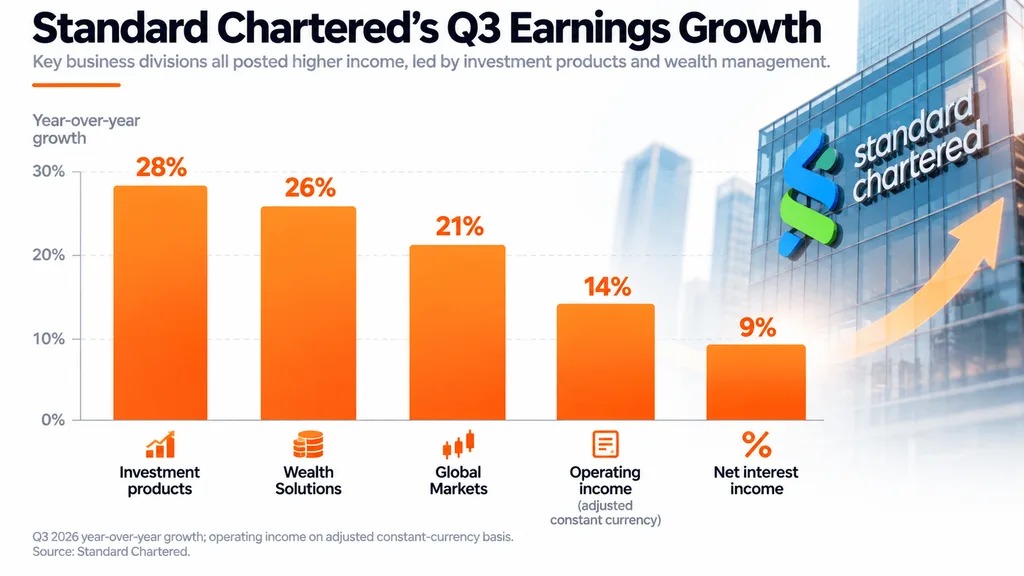
According to the official financial results for this period, pre-tax profit reached $2.25 billion, compared to $1.77 billion in the same period last year, and the market's consensus expectation was $1.99 billion. Calculated using an adjusted fixed exchange rate, revenue increased by 14% to approximately $5.8 billion.
Standard Chartered Wealth's business revenue grew by 26%, with an additional $20 billion in funds from wealthy clients
The wealth solutions business reported revenue of $1.12 billion for the quarter, a year-on-year increase of 26%, and set a new high for the third consecutive quarter.
Among them, investment product revenue increased by 28%, and bancassurance business revenue increased by 18%, reflecting a stronger market demand for entrusted investments and insurance products.
More importantly, wealthy clients saw a record net increase of $20 billion in funds for that quarter.
The company has also accelerated its long-term wealth management business expansion goals, with plans to attract a total of $200 billion in net new funds between 2025 and 2028, which is one year ahead of the original schedule.
This diversified layout has also supported the bank's expansion into the digital finance sector. Standard Chartered previously launched an institutional service with Circle and expanded its cooperation with Coinbase to support international fund transfers.
However, these measures are separate from the growth in wealth solutions disclosed by the company this time, and the revenue contributions brought by each related business have not been disclosed.
Transaction revenue increased by 21%, and credit impairment losses decreased.
Global market business revenue increased by 21%, benefiting from the strong performance of foreign exchange, commodities, and other trading products.
Non-interest income totaled 19% growth to approximately $2.8 billion, exceeding analysts' expectations of $2.68 billion; net interest income increased by 9% to $3 billion.
Credit impairment expenses were reduced from $188 million to $90 million, further enhancing profitability.
However, some consumer loan businesses are still under pressure. Calculated at a fixed exchange rate, income from credit cards, personal loans, and other unsecured loans has decreased by 13%.
Standard Chartered's institutional business strategy has also expanded beyond traditional markets, including conducting Bitcoin transactions with Wintermute, as well as providing RLUSD custody services for eligible customers.
Its venture capital department also proposed to establish a digital asset fund of $250 million, but none of these developments indicate how much contribution the cryptocurrency business made to profits in the third quarter.
Banks raise their outlook targets for 2026; profitability expected to improve
Standard Chartered currently expects that the annual revenue growth will exceed 7%, compared to the previous guidance of 5% to 7%.
Management has also raised the target for return on tangible equity from 'above 12%' to 'above 14%', and the bank's return for that quarter has already reached 15.7%.
However, Standard Chartered's profitability still lags behind that of its competitor HSBC by about 17%, which highlights the challenges the bank faces in improving efficiency while pursuing investment growth.
The article states that Standard Chartered's plan to advance its encrypted principal brokerage business also reflects its broader ambitions for institutional services. However, based on this quarter's performance, wealth management and trading businesses remain the direct drivers of current profits.
Ethan Mercer
Ethan Mercer is a financial journalist who covers cryptocurrency, stocks, and the global economy. He studied economics and finance before turning to market news reporting, with a particular focus on Bitcoin, stocks, monetary policy, and investor sentiment. His reporting focuses on explaining daily market fluctuations and the broader trends behind them.