Anthropic has always focused on keeping corporate users on its platform. On Wednesday, the company announced the launch of a new reporting tool designed to enable customers to gain a more detailed understanding of the value they obtain from their token expenditures.
With the help of internal analysis and employee surveys, managers can view the work of a team over a specific period of time, what the team has produced, how much money was spent, and where there were issues in the work processes. Anthropic indicates that by default, this data is not used for model training. The report also provides suggestions for improvement.
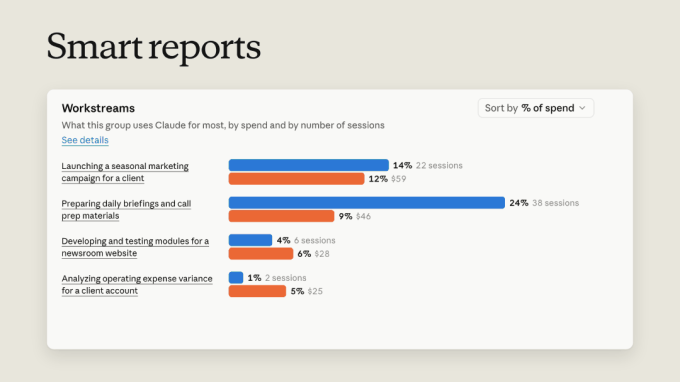
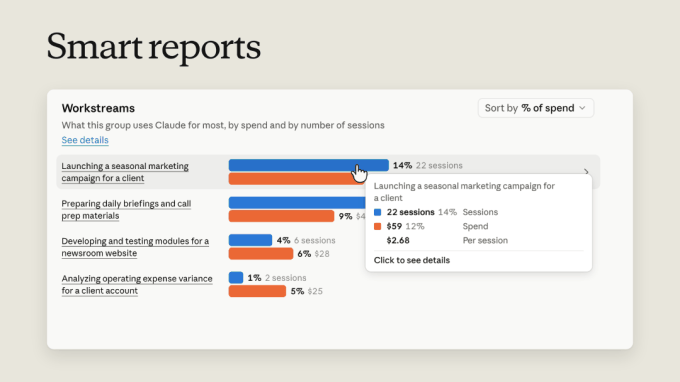
This is clearly an attempt to demonstrate the investment returns of the Anthropic tool and to inform customers on how to improve these returns, which is also a matter of great concern to large clients. Anthropic is also creating a shared team budget to enable better management of token expenditures by each team.
As companies continue to explore the best ways to deploy the AI tool, they are constantly seeking such information. Although venture capital support for its use is driving an increase in token expenditures, most of the companies comprising the S&P 500 index have not seen significant benefits as a result of deploying AI.
Software development tool company Jellyfish released a new report yesterday, based on the usage of agent-based programming tools by its 276,000 customers. The report shows that Claude Code and other tools built on the Anthropic model are still the most widely used tools, accounting for nearly one-third of all proposed code changes submitted for review. More importantly, spending on these tools has increased tenfold since the beginning of this year, and now their cost is approximately equivalent to 2% of the total project cost.
Jellyfish, the Chief Scientist, said to TechCrunch, "Even if you say that 2% is not considered high, a 10-fold increase is a growth that most CFO did not plan for in advance. We have clearly reached a stage where people realize that just spending a lot of money is no longer enough. Now, you also need to optimize it to make it truly effective."
The person in charge of AI at Jellyfish said to TechCrunch: "It took us a long time to truly see the emergence of Codex in the data, and later it was caught up by the latest model from Astra." He continued, saying that looking at the discussions on X, one can clearly feel that the competition has become even more fierce. "Everyone in Silicon Valley is saying, 'Oh, Codex is better.'"
However, Albarran believes that this is not the case. “Anthropic has only managed to gain a firm foothold by adopting a strong corporate approach, and it also has a first-mover advantage – these tools are indeed useful, and many people have already invested a great deal of effort in standardizing their work processes around them. There is no sufficient reason to switch.”
This is not just a matter of models and work processes. Business reality means that once a leading laboratory has firmly secured a client, the cost of switching is much higher than for individual programmers or small organizations. Albarran points out that major AI laboratories are investing in pre-deployment engineering ( FDE ) teams, which embed AI consultants within the client organizations to help them get off to a good start. The new reporting tool introduced this time can be seen as a “lightweight version of FDE” – providing a lighter but still hands-on form of assistance for Anthropic clients.
He said, "We have now reached a mature stage. Once you get involved, switching will become increasingly difficult because you have already invested effort. Even though they are generally similar, there are still some subtle differences, such as how they handle things like files from agents to ND. Therefore, the cost of switching is not zero."