Google's parent company, Alphabet, failed to meet expectations in both revenue and profitability this quarter. The strong expansion of its cloud business cannot conceal the fatigue in search advertising and the continuous deterioration of free cash flow. Consequently, market concerns about whether the massive AI capital investment can be transformed into tangible returns have suddenly intensified.
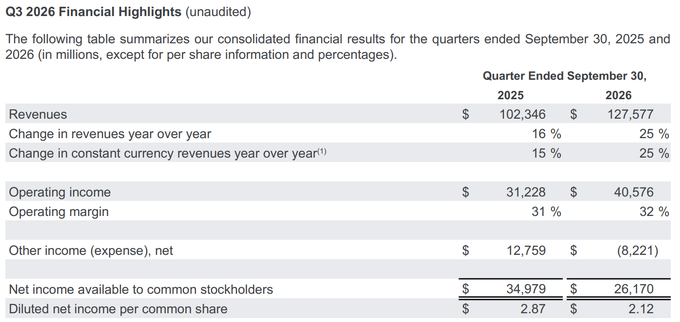
The third-quarter report shows that Alphabet had total revenue of $127.58 billion, a year-on-year increase of 25%, which is lower than the analysts' average forecast of $128.22 billion; earnings per share were $2.12, significantly falling short of Wall Street's expectations of $2.99 to $3.02.
At the same time, equity investments incurred a net loss of $866 million, which significantly dragged down net profit, which plummeted from $34.98 billion in the previous quarter to $26.17 billion.
Free cash flow in the third quarter plummeted to negative $9.07 billion, far exceeding the market's expectation of negative $3.5 billion; capital expenditure was $51.36 billion, a year-on-year increase of 114%, but lower than the market's forecast of $55.78 billion, which constitutes a warning signal for AI transactions.
After the financial report was released, the stock price of Alphabet fell by more than 10% after the market closed, erasing over half of its gains from the past six months and retracting to levels around April this year.
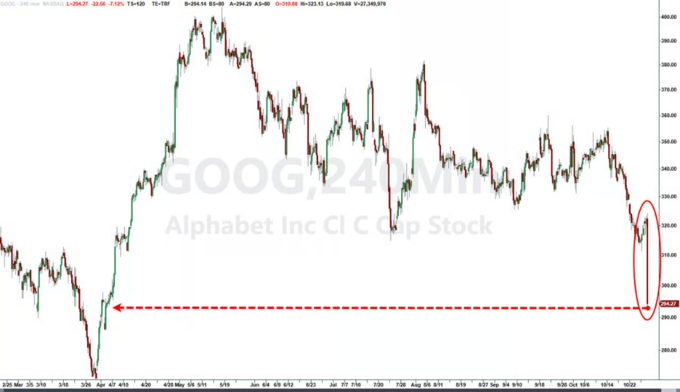
This downward trend reflects investors' growing concerns about the expenditure path of AI. While the cloud business has achieved explosive growth, the main businesses of search and advertising are facing internal erosion pressure from AI. Moreover, with free cash flow remaining negative for two consecutive quarters, the market's patience with the narrative of capital returns is becoming increasingly limited.
Cloud services alone cannot sustain the business; search advertising efforts have completely failed.
In the third-quarter report, Google Cloud is one of the few highlights. Cloud business revenue increased by 103% year-on-year to $30.71 billion, far exceeding analysts' forecast of $29.1 billion; the operating profit from cloud business was $11.1 billion, also higher than the expected $9.8 billion.
The operating profit margin of cloud services soared significantly from 23.7% in the same period last year to 36.2%, exceeding the market's estimate of around 33%.
Against this backdrop of growth, Alphabet continues to expand its enterprise-level customer commitments through multi-year cloud and AI infrastructure agreements, covering areas such as network security, retail, and financial services. TPU system sales have also been identified by management as an important source of revenue growth for this quarter.
However, other core business lines have completely failed.
Search and related business revenue increased by 12% year-on-year to $63.35 billion, which is lower than the market expectation of $64.96 billion and also below the buyers' expected growth rate of about 14%.
YouTube reported advertising revenue of $11.12 billion, a year-on-year increase of 9.2%, which fell short of the market's generally expected 10% threshold and also missed the anticipated $11.43 billion target.
Google The overall advertising revenue was 82.01 billion US dollars, lower than the expected 83.57 billion US dollars. Google The total revenue from the services segment was 96.3 billion US dollars, also falling short of the expected 98.4 billion US dollars.
Free cash flow has been negative for consecutive periods, and capital expenditures fell short of expectations.
The continuous deterioration of cash flow conditions has made the market more cautious about the investment return period of AI. In the third quarter, free cash flow was negative $9.1 billion, far below analysts' estimate of negative $3.5 billion; operating cash flow decreased by 13% year-on-year to $42.3 billion, also significantly falling short of the market's expectation of $53.9 billion.
This is the second consecutive quarter for Alphabet to experience negative free cash flow, with rolling free cash flow over the past twelve months plummeting by 73% from $73.6 billion a year ago to $19.7 billion.
Capital expenditure in the third quarter was $51.36 billion, a year-on-year increase of 114%, but it fell short of the market's expectation of $55.78 billion.
Alphabet raised its annual capital expenditure guidance for July to between $195 billion and $205 billion, more than doubling from the previous year. The current market generally expects capital expenditure to further surge to over $300 billion in 2027, while buyer institutions estimate it to be between $330 billion and $375 billion.
Alphabet, Microsoft, Amazon, and Meta are expected to invest over $700 billion in AI data centers, chips, and high-performance network infrastructure by 2026.
Equity investment losses dragged down profits, EPS far below expectations
What directly dragged down performance was the substantial losses of the Alphabet equity investment portfolio.
This segment incurred a loss of $866 million this quarter, in stark contrast to the high earnings of $990.3 million from the previous quarter. The substantial earnings of the previous quarter were mainly due to the company's holdings in SpaceX and Anthropic. Such a dramatic fluctuation in equity investments is one of the key reasons why earnings per share this quarter deviated significantly from expectations.
Operational performance also fell short of expectations. In the third quarter, operating profits amounted to $40.58 billion, a year-on-year increase of 30%, but this was lower than the market's forecast of $43.16 billion; the operating profit margin was 31.8%, which is below the expected 33.7%.
R&D expenses increased by 36% year-on-year, and revenue costs (excluding traffic acquisition costs) increased by 32% year-on-year, both exceeding the revenue growth rate of 25%, indicating ongoing pressure on cost expansion. The total number of employees increased to 204,757, a year-on-year increase of 7.7%, which is also higher than expected.
AI The product is beginning to show results, but the monetization conversion still needs to be verified.
In terms of the progress of the AI product, CEO Sundar Pichai stated in its financial report that the Gemini application has reached a user base of 1 billion, making it the fastest-growing product in Google's history. The Argon and Carbon versions have also joined the ranks of cutting-edge models, performing outstandingly in fields such as programming and network security.
YouTube Music and Premium have over 150 million subscribed users globally (including those in the trial period).
However, the progress mentioned at the product level has not yet been fully reflected in the quality of revenue. The performance of search advertising falling short of expectations to some extent reflects that the substitutive effect of AI for traditional search clicks and ad traffic is beginning to emerge.
Some insiders from Google are concerned that the company has not yet been able to fully catch up with Anthropic and OpenAI in the field of AI programming tools.
The current focus of the market has shifted from single-quarter performance to whether Alphabet can maintain a sustainable cash return path while accelerating the expansion of its AI infrastructure.