


It is alleged that a security incident worth $6.3 billion triggered a response from the entire industry. Institutions such as Tether, Circle, and Ripple have frozen billions of dollars in assets related to the incident.
Nearly $1.5 billion in long positions were liquidated, exacerbating the selling pressure and potentially pushing Bitcoin prices below $79,000.
On-chain associations also link this incident to attacks involving Bitget and Phemex, sparking new concerns among the public about the possibility of broader hacking activities related to North Korea.
The crypto market is facing another round of selling pressure, with the price of Bitcoin falling below $79,000, testing investors' confidence. What initially seemed like just another market downturn has become more concerning after a security incident reportedly exceeding $6 billion in scale; this could be one of the largest incidents in the history of cryptocurrencies. As the world's largest crypto exchange, Binance has been involved in it, which has further dampened market sentiment and raised new concerns about the security of exchanges and digital assets.
Following this incident, billions of dollars in liquidations ensued, further increasing selling pressure and triggering a wave of panic in the market. As bearish momentum strengthens, the question on hand is whether sellers have already taken control of the situation. More importantly, will this sharp correction create conditions for a rebound, or is the market heading towards an even deeper decline?
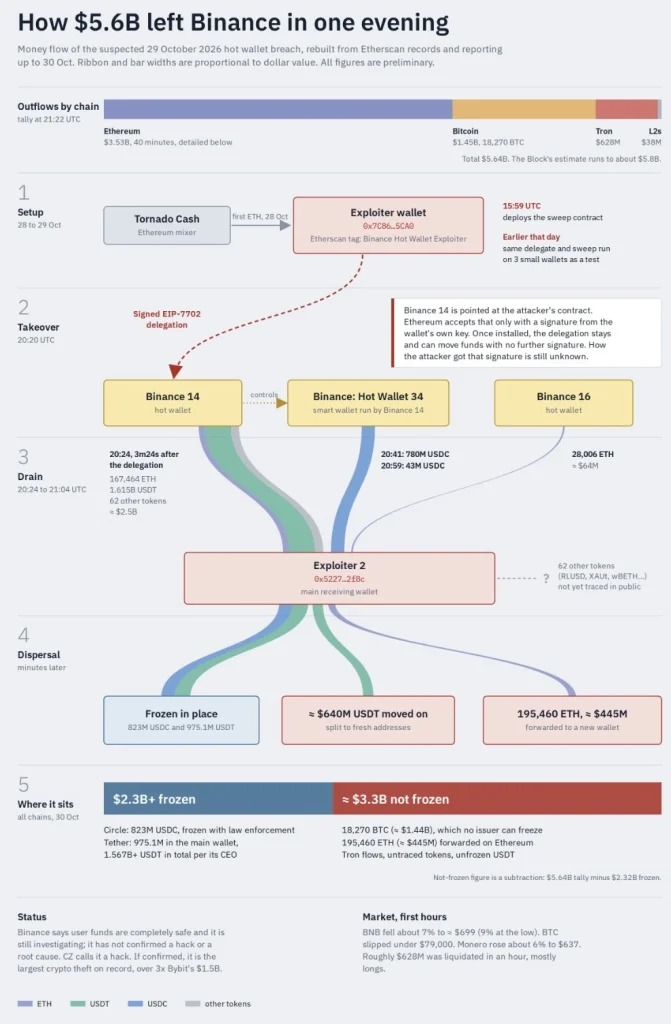
Binance $6.3 billion incident: What happened? How did the market react?
On October 29th, it was reported that an attacker transferred nearly $6.3 billion in digital assets from a wallet associated with Binance. These assets were then transferred to 10 different blockchains, with the majority of the funds being transferred within about 20 minutes. The networks affected included Ethereum, Bitcoin, Tron, XRP Ledger, Solana, Arbitrum, Optimism, Base, Avalanche, and Polygon.
Blockchain intelligence firm TRM Labs has identified Ethereum as the source of the largest outflow of funds, amounting to approximately $3.79 billion, followed by Bitcoin with about $1.47 billion, Tron with around $628 million, and XRP Ledger with nearly $296 million. Stablecoin issuers and blockchain partners quickly took action to freeze funds related to this incident, totaling nearly $2.7 billion. Tether ( USDT ) froze about $1.77 billion, Circle ( USDC ) froze about $825 million, Ripple ( RLUSD ) froze about 40 million dollars, World Liberty Financial ( USD1 ) froze about 27.8 million dollars, and Arbitrum froze approximately 84.26 million ETH and 74.6 million ARB. However, the hackers still control more than 420,000 ETH and 18,270 BTC, worth nearly $3 billion.

The investigation indicates that it may be related to attacks involving Bitget and Phemex.
A new development has emerged in the investigation after blockchain investigator ZachXBT identified a possible link between the Binance incident and another attack worth $388 million involving Bitget. According to ZachXBT, the funds stolen in both incidents were transferred through THORChain and ultimately converged at the same address, indicating that it is possible that the same attacker carried out both actions.
Further on-chain tracing of MistTrack has added another clue to the investigation. It was discovered that the stolen TRX from the Binance incident flowed into an address through Bitget Wallet Swap Bridge. Notably, this address had previously been used by attackers from Phemex. If these connections are confirmed, the Binance incident may merely be part of a series of attacks involving actors related to North Korea and cross-chain capital flows.
$1.5 billion in crypto liquidation: How does selling accelerate it?
The Binance event brought further pressure to the already weakening crypto market and triggered a wave of large-scale liquidations on derivatives exchanges. According to data from Coinglass, approximately $1.5 billion in crypto positions were liquidated over the past 24 hours, with long positions accounting for nearly $1.29 billion of that amount.
Bitcoin and Ethereum recorded their largest liquidation volumes, at $498 million and $359 million respectively, highlighting how quickly bullish positions can collapse as prices fall. When long positions using leverage fall below the required margin levels, exchanges automatically close them, resulting in additional sell orders. This creates a chain reaction: falling prices trigger forced sales, which in turn push prices down further, exposing more leveraged positions to liquidation.
What will happen next? Will the crypto market rebound?
For Bitcoin, the current challenge is to regain lost ground and prove that the selling pressure is easing. Until that happens, concerns about sharp corrections may continue to overshadow the upward trend of BTC, and could potentially trigger another wave of selling in the crypto market.