Key Points
- The Bank of Japan raises its annual ETF sales volume to $5.5 billion
- Even so, it will still take 43 years to completely liquidate its stock holdings.
- Against the backdrop of market volatility, faster sales will be launched in January 2027.
The Bank of Japan will accelerate the sale of its large holdings in exchange-traded funds (ETFs), which amount to approximately $5.45 billion annually. However, it is estimated that it will still take 43 years to completely divest from this investment portfolio.
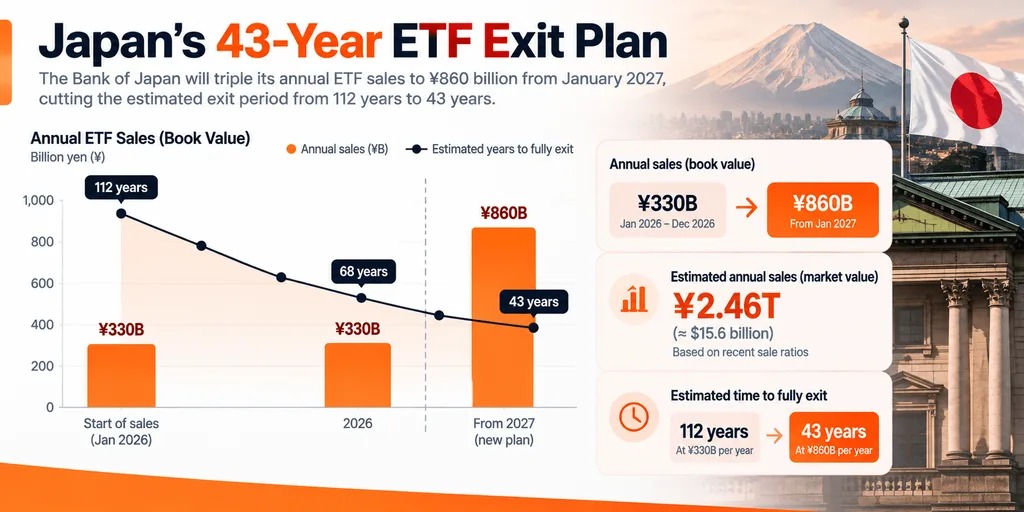
On Friday, October 30th, the Bank of Japan announced that starting from January 2027, the annual disposal volume of ETF calculated at book value will be increased from 330 billion yen to 860 billion yen.
According to the official policy decision of the Bank of Japan, the faster selling pace is expected to shorten the exit time from 112 years to 43 years, which also highlights the massive scale of assets accumulated during Japan's long-term monetary stimulus period.
Why did it take Japan 43 years to sell off its holdings of ETF?
The Bank of Japan has been purchasing stocks for many years to support the financial market and to encourage investment during periods of deflation.
These purchases have become a hallmark of Japan's unconventional monetary policy and have also resulted in the Bank of Japan holding a huge portfolio of listed securities investments.
Although the Bank of Japan stopped purchasing ETF in March 2024, selling these accumulated positions has proven to be much more complicated.
The Bank of Japan began to gradually reduce its portfolio in January 2026, with an initial target of selling JPY 330 billion per year at book value.
According to the new plan, this amount will be increased to 860 billion yen, which is approximately 5.45 billion US dollars at the current exchange rate.
However, the Bank of Japan estimates that based on recent trading activities, the market value corresponding to these annual sales could reach 2.46 trillion yen, which is approximately 15.6 billion US dollars.
This difference reflects that the relevant investment has appreciated since its initial purchase.
Even though the selling pace has accelerated, the annual sales volume still accounts for only about 0.1% of the total stock market turnover, which is higher than the previous level of around 0.05%.
This cautious approach is aimed at preventing any impact on the Japanese stock market during the exit process.
Will the sale of ETF put pressure on the Japanese stock market?
At the time of the Bank of Japan's decision, global stock markets were going through a difficult period, especially as technology companies faced questions regarding their expenditures on artificial intelligence.
This round of decline contrasts with the previous rise in the Nikkei index. Earlier on, driven by expectations of economic stimulus, the Japanese stock market had reached record levels.
The Bank of Japan also retains the ability to temporarily reduce or suspend the sale of ETF during periods of significant financial instability.
This decision also comes after a broader shift in monetary policy, as Japan is gradually moving away from the ultra-low interest rate environment that has persisted for decades.
The Bank of Japan maintained its benchmark interest rate at 1.25% on Friday, while retaining the possibility of further rate hikes.
Japan's withdrawal from ETF positions could also increase government revenue
In addition to affecting the stock market, accelerating sales may also have other consequences.
Japanese Finance Minister Masayuki Katsumura stated on Friday that faster disposal should increase the profits of the Bank of Japan and may also raise the surplus it turns over to the government.
This may provide additional financial resources at a time when Japan is considering introducing new spending measures.
However, the returns depend on the price realized when the assets are sold, and the government cannot consider the total market value of this portfolio as immediately available fiscal revenue.
At the time this decision was made, Japan was still dealing with the financial consequences of yen fluctuations and rising interest rates.
The significance of these developments on an international scale lies in the fact that Japanese investors hold a large amount of overseas assets, and changes in domestic monetary conditions can affect global capital flows.
Maya Bennett
Maya Bennett is a financial journalist who has reported on cryptocurrencies, stocks, and broader market trends. Her work focuses on Bitcoin, major digital assets, the stock market, monetary policy, as well as economic developments that influence investor sentiment. She is adept at transforming rapidly changing market news into clear and concise reports.