U.S. tech stocks faced a new wave of heavy selling on Friday. The latest financial reports and outlooks from Intel and Amazon exacerbated market concerns about the huge investment returns of AI. The selling of tech stocks spread from individual stocks to the entire semiconductor sector. Intel's stock price tumbled more than 30% at one point during trading, and the Philadelphia Semiconductor Index plummeted by about 8%.
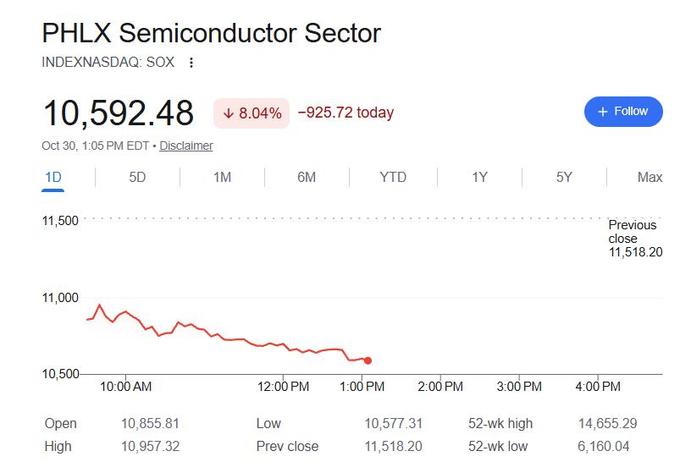
As Friday approached noon Eastern Time, the Nasdaq Composite Index fell nearly 2.7%, the Nasdaq 100 Index tumbled more than 3%, and the S&P 500 Index declined by over 1.6%. The technology sector of the S&P 500 lost over 4%. Intel, Google's parent companies Alphabet and Meta, both saw their stock prices fall below their issue prices during trading. If the Nasdaq 100 Index continues to lose about 3% by the close of trading, it will record its largest daily decline since mid-June, with the total market value of its constituent stocks evaporating by over $1 trillion in a single day.
This sell-off is no longer just a reaction to the underperformance of individual companies. As U.S. tech giants are expected to spend a total of AI billion dollars this year, investors are beginning to scrutinize capital expenditures, cash flows, and core business growth more rigorously. At the same time, large-scale stock offerings by companies such as Intel, Alphabet, and Meta have also faced declines in stock prices recently. Whether the current wave of AI investment enthusiasm can continue and when these substantial investments will yield returns have become focal points of market attention.
Chip stocks faced a collective sell-off, with some individual stocks such as AMD falling by more than 10% during the session.
As Friday approached midday Eastern Time, tech stocks became the main drag on the decline of the U.S. stock market. The S&P 500 Information Technology sector fell by more than 4%, the Nasdaq Composite Index fell by nearly 2.7%, the Nasdaq 100 Index fell by more than 3%, and the Philadelphia Semiconductor Index ( SOX ) saw its midday decline widen to about 8%.
Chip stocks almost all tumbled. Intel (INTC) once fell more than 30% during the session; as the US market approached noon, SanDisk (SNDK) fell more than 10%; AMD (AMD), Qualcomm (QCOM), and SK Hynix' US stock (SKHY) fell more than 10%; Broadcom (AVGO), Micron (MU), and TSMC's US stock (TSM) all fell more than 5%, while NVIDIA (NVDA) fell more than 4%.
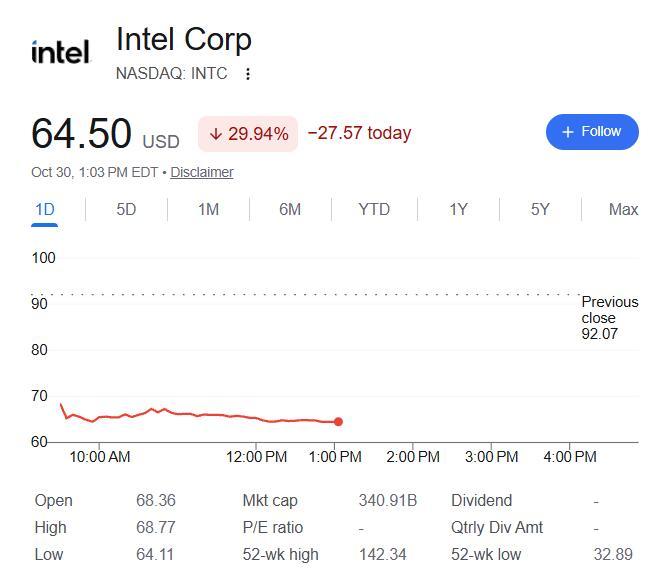
Intel's sharp decline is particularly noteworthy. The company's revenue for the first fiscal quarter and guidance for the second fiscal quarter, announced after the market closed on Thursday, both exceeded analysts' expectations, but investors remain concerned about the prospects for its business recovery. The company previously warned that supply chain issues have limited the delivery capacity of data center-related products, and the PC weak market may also continue into the first half of 2027.
Intel also expects that it will not achieve positive free cash flow this year. For a company that is striving to rebuild its manufacturing capabilities and compete for market share in data center chips, the combination of production capacity bottlenecks, weak demand from traditional businesses, and high capital expenditures has led the market to re-evaluate its transformation progress.
What is more noteworthy is that Intel has already accumulated a significant increase in its stock price prior to this. Media reports indicate that as of before the release of its financial report on Thursday, Intel's stock price had risen by about 150% for the year, partly due to the growing demand for CPU; CPU is becoming an important component in running the workloads of intelligent agents AI.
However, on Friday, analysts from D.A and Davidson downgraded Intel's rating from 'Buy' to 'Neutral', and in their report titled 'Yet to Be Resolved' ( Not fixed yet ), they pointed out that the company's operational problems remain unsolved.
Analysts wrote, "We understand that the PC market is being affected by factors at the industry level. However, when the weakness is so pronounced, it is difficult to find a reasonable basis for the current valuation levels."
This evaluation highlights the key contradiction behind Intel's sharp stock price drop: The demand for AI can drive growth in the CPU market, but it does not mean that Intel can immediately resolve production and supply chain issues, nor does it imply that the previously soaring stock price is still reasonable.
Intel's difficulties are also impacting the entire semiconductor sector. Even as the infrastructure construction under AI continues, investors have begun to distinguish between the growth in industry demand and a company's actual ability to deliver on its performance. For chip stocks that have seen significant gains before, once there are doubts about a company's performance guidance, supply capacity, or valuation, stock price adjustments can quickly intensify.
Amazon maintains its capital expenditure guidance of $220 billion for this year, and cash flow pressure comes under renewed attention.
Amazon ( AMZN ) is also under pressure. After the company announced its third-quarter results after the market closed on Thursday, its stock price fell by about 7% before the opening on Friday, and continued to decline with an initial drop of nearly 6% at the start of trading. However, as trading progressed, the decline gradually narrowed, and by midday, it had fallen by about 2%.
Amazon's net sales in the third quarter increased by 12% year-on-year to $20.194 billion, which was lower than market expectations; the diluted earnings per share were $1.89, also falling short of analyst forecasts. Although the company's operating profit reached $28.1 billion and the operating margin rose to 13.9%, a record high, this strong profitability did not fully offset market concerns regarding the quality of growth and capital investment.
Cloud computing business is a highlight in the financial reports. Amazon Web Services ( AWS ) saw its third-quarter sales increase by 39.3% year-on-year to $46 billion, marking the fastest growth rate in nearly five years, with an annualized revenue run rate of $184 billion.
However, Amazon continues to maintain its forecast for cash capital expenditures of approximately $220 billion in 2026. Over the past 12 months, the company has experienced a net outflow of $42.4 billion in free cash flow, compared to a net inflow of $14.8 billion in the same period last year; during the same time, net capital expenditures increased by $94.8 billion year-over-year, mainly reflecting growth in AI investments.
In other words, Amazon's cloud business is growing at a rapid pace, but the investment in infrastructure required to support future growth is also increasing swiftly. The market needs to determine whether the revenue and profit growth of AWS will be able to continuously cover the substantial investments in data centers, chips, and other infrastructure.
Bloomberg previously pointed out that U.S. tech giants are expected to spend a total of AI billion dollars this year. At the same time, core businesses such as advertising and e-commerce of companies like Alphabet and Amazon have begun to show signs of slowing growth, prompting investors to pay more attention to how much additional revenue AI investments can actually generate.
What the market is concerned about is not whether tech giants have no growth opportunities at all, but whether the huge investments will generate returns sufficient to support their current valuations. As capital expenditures continue to rise, free cash flows are under pressure, and the growth of traditional businesses slows down, simply emphasizing the strong demand for AI is no longer enough to satisfy investors.
Amazon's performance is a microcosm of this contradiction: AWS continues to experience strong growth, and overall profitability has also improved, but investors are still questioning when the continuously expanding AI investments will translate into more substantial free cash flow.
From Alphabet to Amazon, the return on investment of AI has become a focus during the financial reporting season.
The selling pressure on Friday was not an isolated incident, but rather a continuation of the market re-pricing triggered by the financial reports of major tech companies this week.
After releasing its financial report on Wednesday, Alphabet, the stock price plummeted by about 13% on Thursday, marking one of the largest single-day declines in the company's history, with a market value evaporating by nearly $500 billion. Investors are concerned not only about the slowdown in growth of Google's search advertising business but also about the pressure on the company's free cash flow while maintaining high AI capital expenditures.
The subsequent performance and outlook announcements from Amazon and Intel further exacerbated these concerns. Meanwhile, Meta previously stated that it would continue to make substantial investments in AI, and its new generation of intelligent agent products, Muse, are also considered to require a large amount of computing power to support. Large technology companies are continuously expanding their investment in AI infrastructure, but there is still uncertainty regarding the speed of return on such investments.
This means that the market's evaluation criteria for AI transactions are changing. Previously, investors were mainly concerned with whether companies could obtain more computing power, expand the scale of their data centers, and whether the AI business could maintain high-speed growth; nowadays, the scale of capital expenditures, financing methods, changes in cash flow, and investment return cycles have become equally important considerations.
Direxion Capital Market Director Jake Behan commented:
"This is a great example of the changes that have taken place with the AI transactions. Nowadays, the market no longer just asks how fast you can grow, but rather how much money you need to spend in order to achieve that growth."
This change is particularly important for large technology companies. AI Infrastructure construction requires continuous investment of funds. Enterprises not only need to purchase chips and build data centers but also bear the costs of electricity, networking, and operations. Even if the final demand is strong, the investment payback period may be longer than what the market previously expected.
Bloomberg reported that tech giants are raising funds for the infrastructure construction of AI by issuing bonds, conducting additional share offerings, and signing data center agreements worth billions of dollars, while also undertaking substantial future expenditure obligations. As a result, investors are beginning to pay more attention to whether these investments will squeeze cash flows, as well as whether the new AI products will be able to create sufficient commercial value.
For the market, the real question has shifted from "whether AI will grow" to "whether the growth of AI can generate economic returns that match the investment."
Tech giants show divergent trends in decline, with NVIDIA becoming one of the relatively weaker members among the Mag seven.
The intraday trends of the "Big Seven Tech Giants" ( Mag 7 ) diverged on Friday.
As of near midday, NVIDIA was the stock among the seven giants that experienced the largest decline, and it was also the only one whose decline continued to widen. Amazon initially fell by nearly 6%, but then narrowed its loss by more than half, ending the session with a decline of about 2%; Alphabet initially fell by nearly 2% in the morning session and then fell by over 1% at the beginning of midday.
Meta initially fell by more than 2%, then experienced several short-term declines, with the decline narrowing to less than 1% near midday; Microsoft also initially fell by nearly 3%, but then the decline narrowed to less than 2%; Apple fell by more than 1% in the early session, but later narrowed its loss by about half, and briefly turned higher during the session.
This indicates that although the market is generally reducing its exposure to tech stocks, investors are not selling off all large technology companies with the same intensity. Some stocks saw buying interest after declining in the morning session, suggesting that funds are still distinguishing between the business performance, cash flow situations, and valuation levels of different companies.
However, the narrowing of individual stock declines does not mean that the investment concerns regarding AI have subsided. As the financial reports of large technology companies are being released one after another, investors' tolerance for high valuations and high capital expenditures is declining. Any performance or guidance that fails to meet expectations could trigger even more severe price adjustments.
"Not yet a time of liquidation," but crowded positions and valuation pressures are beginning to emerge.
Despite the intense selling of tech stocks, some market participants believe that this does not mean that the growth logic of the AI industry has been completely overturned.
Raymond James Chief Market Strategist Matt Orton said in an interview with CNBC on Friday:
"I don't think this is a time of liquidation, but I believe that investors should seriously consider one issue: despite the still strong fundamentals, the positions held in the entire sector are still highly crowded."
This judgment reveals another risk in the current market. Over the past year, the investment boom in AI has driven a significant rise in chip stocks and related technology companies, with a large amount of capital concentrated in a few popular stocks. When financial reports and performance forecasts fail to continue to bring surprises, even if there is no fundamental reversal in fundamentals, the overcrowding of positions may amplify the selling pressure resulting from profit-taking and risk control.
Alphabet Previous financial reports have shown that the growth of core businesses such as search advertising has slowed down, and the market has immediately raised doubts about its high capital expenditures. Amazon's latest financial report has exposed that traditional e-commerce and advertising businesses are facing growth pressures, while Intel is being dragged down by PC demand and supply chain issues.
These issues are not entirely the same, yet they all point to the core concern of the market at the same time: How much additional profit and cash flow can the substantial funds invested by enterprises in AI actually generate?
Tech giants still possess strong cloud computing, advertising, consumer, and enterprise software businesses, and AI may also open up new sources of revenue in the future. However, when the growth rate of capital expenditures exceeds the rate of improvement in cash flow, the market's patience for investment returns may decline rapidly.
Therefore, the sharp decline in tech stocks on Friday was more like a concentrated re-pricing by the market of valuations, positions held, and expectations for investment returns, rather than a single signal sufficient to prove that the demand for AI has reversed.
The margin for error in financial reports is narrowing, and the market is beginning to penalize companies whose growth falls short of expectations.
Bloomberg reports that investors' reactions to companies' performance falling short of expectations are becoming more severe. This is particularly true in the technology and communications services sectors, where the magnitude of stock price adjustments after financial report releases has significantly increased.
As of about one-third of the way through the financial reporting season, the profit growth rate of companies in the S&P 500 has declined from around 32% in the second quarter to around 26%. Bloomberg Industry Research expects that the profit growth rate of the technology sector in the third quarter may slow down from nearly 77% in the previous quarter to 65%, while the communication services sector may see a decline from nearly 10% to 3.2%.
Although these growth rates are still at a relatively high level in historical terms, for technology and communications service companies that account for a large portion of the U.S. stock market, a slowdown in growth means that the market may no longer be willing to offer them the same high valuation premiums as before.
Northlight Asset Management Chief Investment Officer Chris Zaccarelli stated that in the current environment, investors are "much more sensitive than usual." They would rather sell first and then look for explanations than passively suffer losses after stock prices fall further.
He also pointed out that if the profitability in a certain sector falls short of expectations, related sectors may also quickly face repricing.
This logic was particularly evident in this week's tech stock market: after the Alphabet financial report triggered a sharp decline, the performance of Amazon and Intel further intensified market concerns regarding AI spending, growth in traditional businesses, and cash flow. These concerns spread from individual stocks to the entire semiconductor sector.
However, a peak in profit growth does not necessarily mean the end of the bull market in the U.S. stock market. Bloomberg Industry Research expects that the profit growth rate of S&P 500 companies may still be close to 20% in 2027 and the first quarter of 2028. What the market needs to determine next is the extent of the slowdown in profit growth, as well as whether companies will be able to continue to meet expectations in an environment of high interest rates, tariff pressures, and higher energy costs.
For the AI industry, the long-term demand prospects are not in conflict with short-term stock price performance. AI may still drive growth in demand for cloud computing, data centers, and chips, but as investment scales continue to expand and corporate cash flows come under pressure, the capital market will demand a clearer path to returns.
The sell-off in tech stocks on Friday reflects this change: investors are not simply rejecting AI, but are re-evaluating the price they are willing to pay for AI and how much value this unprecedented scale of infrastructure competition can actually create for shareholders.