

The cybersecurity threats of 2026 seem endless.
Just a few days after North Korea committed one of the largest thefts in its history, stealing $6.5 billion from Binance, another round of domain name hijackings added more uncertainty to the cryptocurrency experience.
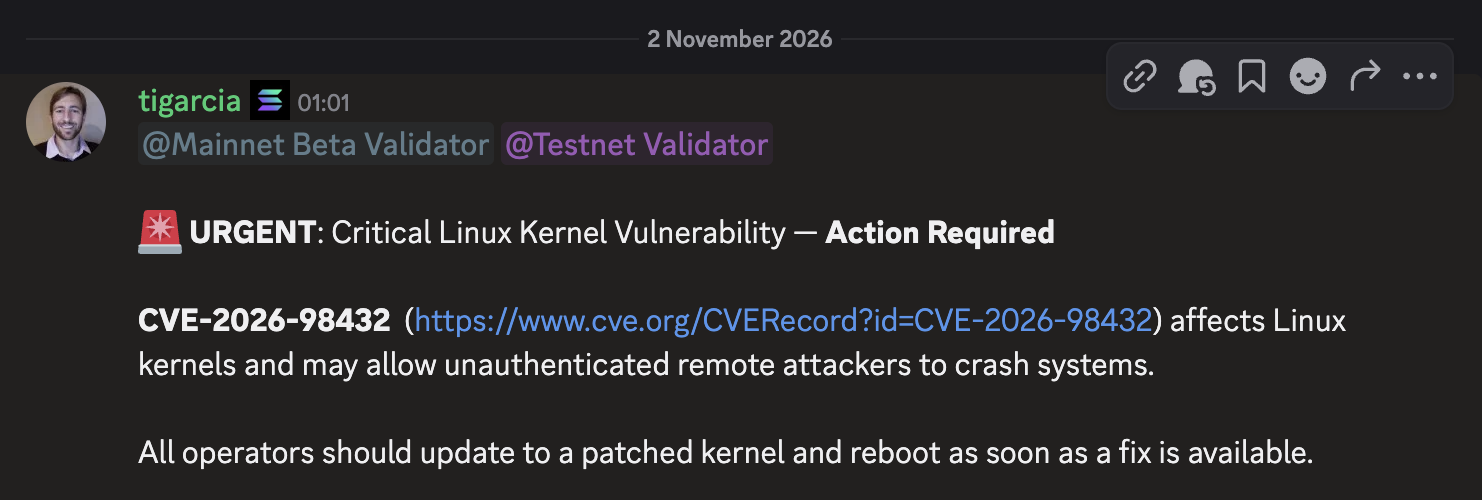
Earlier today, Solana Foundation issued an emergency notice to its validator community, requesting operators to update to the patched Linux kernel in order to guard against potential vulnerabilities.
Over 10 domain names were compromised during weekend cyberattacks.
Cybercrime is at an all-time high. As the crypto market tries to recover from the impact of the $6.5 billion heist last week, DeFi users are also facing challenges on all fronts.
Over the entire weekend, more than 10 applications suffered from domain name hijacking. Attackers implanted malicious cleaners on websites with domain names such as Stonk, Fluxbeam, and DeFi. Reports indicate that all affected websites were registered through the domain name registrar name [.] com.
According to The Block, this attack resulted in losses of approximately $138,000. Stonk and Fluxbeam have now regained control of their respective platforms.
The situation regarding the security of encrypted networks can be said to be more dangerous than ever. In the early hours of Monday, the blockchain detective Zachxbt reported that an EU entity seemed to have suffered a security breach, with the exchange losing approximately 108 million US dollars.
Earlier on, Brazil's largest cryptocurrency exchange, Mercado Bitcoin, was also reportedly subjected to an attack worth $40 million.
Linux Kernel Vulnerability May Threaten Verifiers
Although centralized exchanges and DeFi applications are clearly the main targets of cyberattacks, validator operators also need to pay close attention to potential vulnerabilities. On November 1st, Solana Foundation's person in charge of validator relations, Tim Garcia, sent an urgent message to all operators, informing them of a serious Linux kernel vulnerability that had been discovered.
If left untreated, this vulnerability may allow unauthorized remote attackers to cause the verifier system to crash, thereby affecting the normal operational time of the network. Garcia urges all operators to update to the patched kernel, and a fix is expected to be announced shortly thereafter.
Despite the constant threats, Solana has established itself as one of the most resilient and reliable blockchain networks in the industry.
As of November 2nd, Solana has achieved 1000 consecutive days of normal operation, dispelling many of the biggest doubts that have surrounded this network since its inception. In addition to its continuous and stable performance, Solana has also introduced several technical improvements this year, including Alpenglow, shortening the slot time, and increasing the block cap.
Trump says he is "paying attention" to the $6.5 billion Binance hacking incident
Although there was little suspense beforehand, FBI has confirmed that North Korea is ultimately behind the $6.5 billion hacker attack last week, which was mentioned as Binance.
After telling the media on October 30 that the government was "paying attention" to the matter, U.S. President Donald Trump subsequently stated that he was "not worried" about the hacking incident and assured reporters that "we will talk about this with North Korea."
Among crypto-native users, the threat posed by North Korea is greater than ever before. According to data from TRM Labs, North Korean hackers have stolen over $7.4 billion in crypto assets in 2026. Clearly, last week's Binance hacking incident accounted for the majority of the stolen funds, but the Drift hacking incident in April (285 million dollars) and the KelpDAO attack (292 million dollars) also caused significant losses.
For further reading: SolanaFloor
Increasing volatility in the crypto market
BTC remains above $80,000; the Federal Reserve keeps interest rates unchanged
Grok Bot How to help you trade