

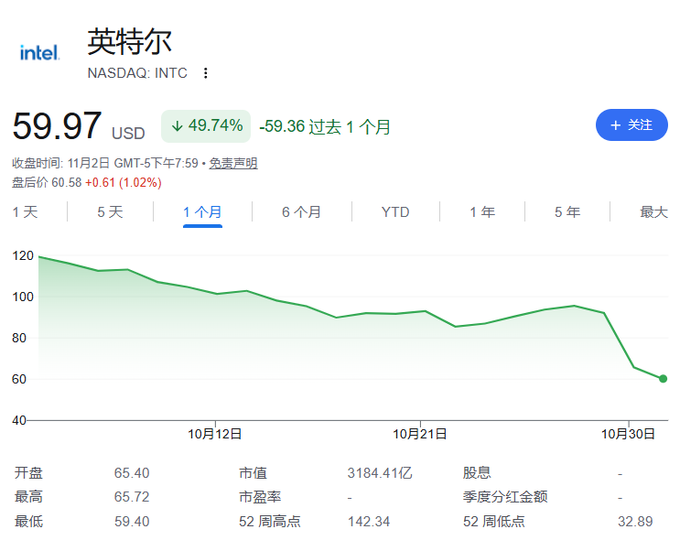
On the last trading day of October, Intel's stock price plummeted by 29%, recording the worst single-day performance since the 1970s. Throughout October, the stock price fell by a cumulative 45% – according to FactSet data, this is Intel's worst single-month performance in its history. Entering the first trading day of November, the stock price dropped another 8%.
The catalyst was a performance warning that disappointed Wall Street. Intel warned that its revenue for this quarter would be $1 billion to $2 billion lower than analysts' expectations. The reason pointed directly to the PC market: the cost of memory and other components remained high, and consumers were becoming less willing to upgrade their computers. Meanwhile, the PC business still contributes about half of Intel's revenue, and this weakness has now been completely exposed.
Just a few months ago, Intel was still the darling of the market. In August 2025, the U.S. government invested 10% in Intel; shortly thereafter, NVIDIA followed suit with a $5 billion investment. Boosted by this, Intel's stock price soared sixfold within 10 months, reaching its peak in June of this year. At that time, the market had high expectations for Intel's position in the AI trend—its CPU products were used to power the virtual machines required for applications involving Agentic AI such as those under Meta, creating a differentiated division of labor with NVIDIA and AMD's GPU.
Today, this narrative is interrupted by a quarterly warning.
Data centers become new hopes, but production capacity is already in urgent need.
Intel CEO Lip - Bu Tan is not without options. He stated that the global server processor market is expected to grow fivefold over the next five years, reaching approximately $200 billion. In the third quarter of this year, Intel's data center business saw a year-over-year increase of 78%, with revenue reaching $7.3 billion, showing strong momentum.
But then problems arose: Intel stated that it could not produce enough chips to meet the demand.
Intel attributes this to the industry-wide shortage of wafers, substrates, and memory—precisely the same factors that have also been dragging down the sales of PC.
In order to "increase capacity" for data center operations, Tan made a controversial decision: to switch the production capacity of some factories in Oregon from the state-of-the-art 18A process to the older Intel 3 process, in order to produce more chips for servers CPU.
What do OEM customers think about the "capacity reallocation" of 18A?
The cost of this decision fell on the contract manufacturing business.
18A is Intel's core technology for attracting external customers. Moving this production capacity away directly weakens Intel's confidence in demonstrating its supply capability to potential customers.
A Harvard Business School professor who served on Intel's board of directors for nearly thirty years, David Yoffie, stated bluntly: "They are concerned that if Intel does not have excess production capacity beyond what is needed to meet its own demands, then it cannot be considered a reliable supplier."
Yoffie further warns: 'If (Intel) cannot find large-scale foundry customers within one year, then the pressure on Intel's economic fundamentals will become even more pronounced.'
In response to this, an Intel spokesperson said, "The customer confidence in Intel's foundry business is built on execution. We are moving forward according to our technical roadmap; the 18A process has performed strongly, and the 14A process is also making steady progress. We continue to maintain deep interaction with our customers and focus on winning their business through consistent execution."
The Dilemma of "Competitors Are Also Customers"
The foundry business also faces another structural obstacle.
Mizuho Securities analyst Jordan Klein pointed out that Intel, as one of the few companies capable of independently manufacturing and packaging advanced chips, has "more control over its own destiny" than most chip manufacturers. However, he also emphasized: "If the production capacity is insufficient, it is tantamount to giving up revenue and profits for nothing."
Yoffie points out a deeper contradiction: chip design companies such as Broadcom and Qualcomm may be reluctant to hand over their chips to a company that also competes with them on the product side for manufacturing. He believes that there is only one solution – “to divest the foundry business. This is not only the best solution, but perhaps the only one.”
Klein, AMD is probably the only large chip manufacturer that voluntarily does not consider Intel for foundry services. The reason is that the two companies directly compete in the CPU market, which leads to 'competition, confidentiality, and privacy issues'.
Strategic Anxiety of US Semiconductors
The impact of this crisis has gone beyond the scope of just one company, Intel.
Yoffie issues a warning from a national strategic perspective: "In the end, TSMC's production capacity established in the United States can at most account for 20% to 25% of its global production capacity, and it will still take several years to achieve that. If the United States does not have local foundries, and encounters geopolitical issues or supply chain crises like the COVID-19 pandemic, it would be a disaster for both that country and the U.S. semiconductor industry."
Currently, Intel's 18A chips are in mass production at the factory in Arizona, and a second factory is under construction; the new factory in Ohio has just completed the installation of the first structural truss, but the overall project is nearly five years behind schedule.
Tan indicates that the announcement of "digital customers" will be made within the next two quarters. Whether this commitment can be fulfilled will become a key signal to whether Intel's foundry transformation can emerge from its darkest moments.