IT News on November 3rd: American semiconductor company Microchip Technology (Marvell) announced yesterday (November 2nd) that it will acquire optical communication company Lumentum in a all-stock transaction worth approximately $115 billion (Note from IT: The current exchange rate is about 766.52 billion RMB).
According to the final agreement reached by both parties, the implied enterprise value of Lumentum is approximately 115 billion US dollars (equivalent to about 766.52 billion RMB at the current exchange rate), which is about 1,132 US dollars per share (equivalent to about 7,545 RMB per share at the current exchange rate), representing a premium of about 23.9% over the stock price prior to the transaction rumors (on October 28th).
After the transaction is completed, Marvell's current shareholders are expected to hold approximately 67% of the shares in the merged company, while Lumentum's shareholders will hold about 33%. This transaction still requires approval from both parties' shareholders and regulatory authorities, and is expected to be completed in the first half of 2028.
The Chairman and CEO Matt Murphy will continue to serve as the Chairman and CEO of the merged company; Lumentum CEO Michael Hurlston and two other directors, Lumentum, will join the Marvell Board of Directors.
Market research firm CounterPoint Research believes that the core logic behind this merger is to seize the critical window for AI's data centers to transition from copper cables to optical interconnection. As the scale of AI models, cluster sizes, and data traffic rapidly expand, traditional copper connections face bottlenecks in terms of bandwidth, distance, and energy consumption. The importance of technologies such as high-speed lasers, optical transceivers, silicon photonics, and optical path switching has significantly increased.
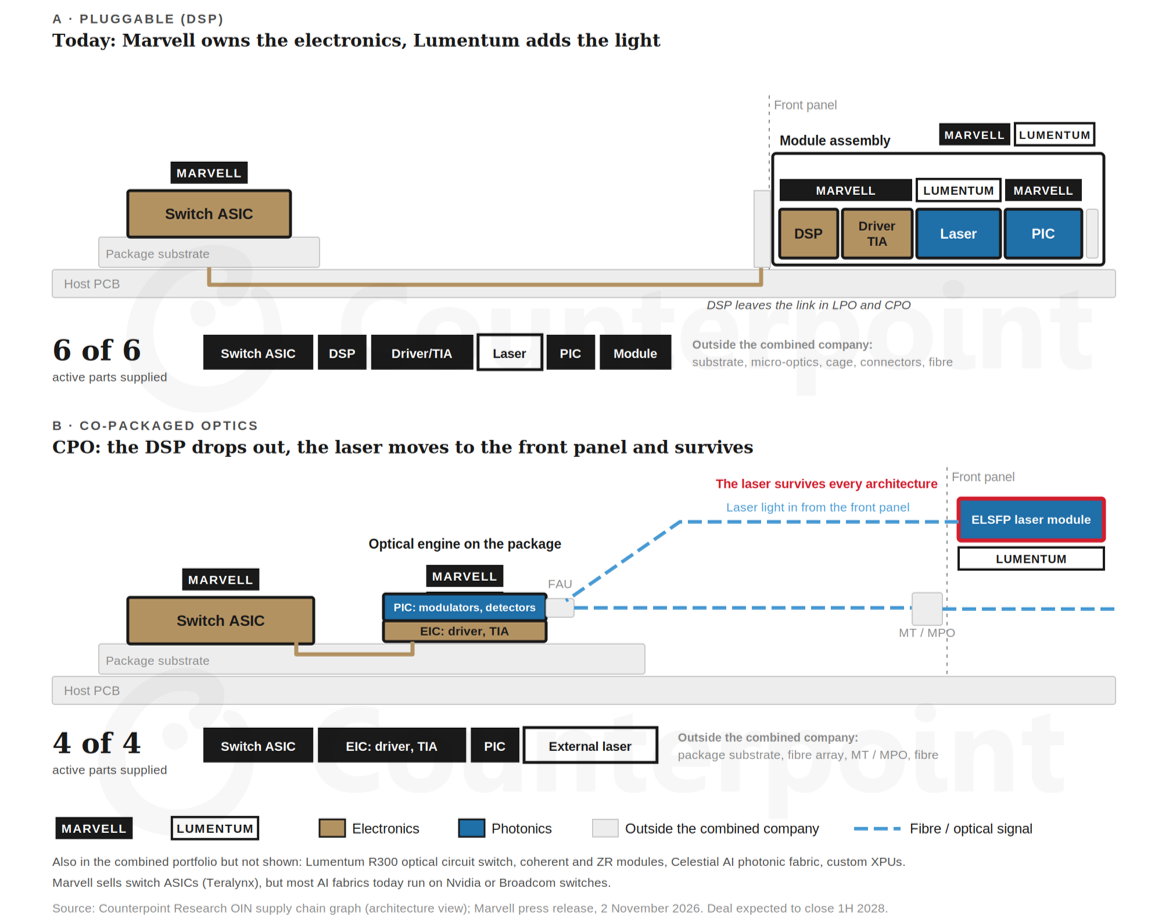
Marvell has advantages in the fields of electrical and optical interconnection, network switching, and custom XPU; Lumentum possesses manufacturing capabilities for high-performance lasers, optical transceivers, optical path switching, and compound semiconductors such as indium phosphide.
Both parties stated that after the merger, they will form a full-stack connectivity capability covering CMOS, silicon photonics, compound semiconductors, and advanced packaging and manufacturing, which can serve a variety of connection scenarios ranging from distributed data centers to within chip packaging.
Financially, both parties expect that after the merger, the company's serviceable market size will expand to $550 billion (approximately 3.67 trillion yuan at current exchange rates), and it will generate annual operational cost synergies of over $1 billion (approximately 6.665 billion yuan at current exchange rates). It is anticipated that in the first year following the completion of the transaction, the non-GAAP earnings per share of Marvell will be enhanced.
Neil Shah, Vice President of Research at Counterpoint, stated that this transaction is bold in two aspects: the financial terms are relatively aggressive, yet the strategic logic is very solid. For a long time, Maiwell has been targeting Broadcom. After acquiring Lumentum, not only were the goals achieved, but they even exceeded expectations; the production capacity of Lumentum has been fully booked until early 2029. Building a new indium phosphide (InP) wafer factory takes several years, so what Maiwell has acquired is a definite right to access scarce resources that its competitors also depend on.
Deputy Director Gareth Owen added that as the network of the AI data center migrates from copper cables to co-packaged optics, Marvell has hedged against technical route risks by acquiring lasers. Lasers are essential components that remain indispensable across architectural changes and were also a product gap for Marvell before this transaction. Upon completion of the deal, Marvell will have the capability to produce lasers in-house.
The merged company's business will cover DSP, drivers, TIA, silicon photonics, switching chips, custom XPU, Celestial AI optical network architectures, CW and EML lasers, external light sources, data communication and coherent optical modules, as well as optical circuit switches (OCS).
Broadcom is the company most comparable to this business combination, which uses custom chips in conjunction with its own indium phosphide wafer factories. However, Mellanox has taken further steps in the areas of optical modules, coherent optical communication, and OCS.
As of November 2026, Marvell acquired Lumentum for a corporate value of approximately $115 billion (equivalent to about 766.52 billion yuan at current exchange rates), which can be regarded as the largest "completed agreement" merger and acquisition in the history of the semiconductor industry.
Previously, the largest merger and acquisition record in the semiconductor industry was held by AMD, which completed the acquisition of Xilinx (Xilinx) in 2022, with a final transaction value of approximately $49 billion (about 326.604 billion yuan at current exchange rates). However, if acquisitions that were ultimately rejected or withdrawn are also taken into account, it is second only to Broadcom's proposed acquisition of Qualcomm for about $121 billion (about 806.513 billion yuan at current exchange rates).
Bloomberg reports that, according to data compiled by Bloomberg, the acquisition of Lumentum is the largest equity transaction this year in terms of value. It is also the second-largest technology deal of all time, only surpassed by the acquisition of xAI by SpaceX. Excluding the merger of SpaceX and xAI, this is the largest merger and acquisition of the year and also the largest in the global technology industry to date.