Predictions from market analysts show that the Democratic Party has nearly a two-thirds chance of sweeping both houses in the midterms, which is precisely the election outcome that Wall Street's forecasting models consider the least favorable for the U.S. stock market.
JPMorgan Chase, citing market forecasting data, stated that as of November 1st, the probability of Democrats gaining control of both the House of Representatives and the Senate was 66%. In JPMorgan Chase's range of forecasts, a "blue wave" (a decisive victory for the Democrats) was the only scenario that included the possibility of a decline in stock prices. All other outcomes—whether the Democrats win only the House of Representatives, the Republicans retain control of both chambers, or a divided Congress—indicated an increase in stock prices.
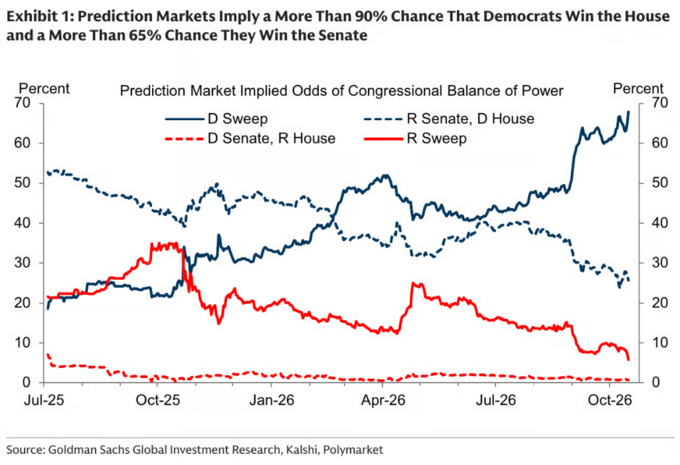
For the AI sector, the impact of Democrats sweeping Congress is particularly direct. Goldman Sachs predicts that a Congress controlled by Democrats will initiate investigations into large tech companies regarding AI development, security practices, and data collection, and will push to exclude data centers from additional depreciation, research and development tax credits, and other tax incentives. There is even a possibility of introducing a federal consumption tax on data center power consumption. J.P. Morgan categorizes this as an "investigation risk" faced by business leaders associated with Trump's donors, with tech giants also included in this group.
Blue Wave: The Only Scenario That Pressures the Stock Market
The probability of the Democratic Party sweeping both chambers has been continuously rising in the past few months. According to JPMorgan Chase, at the beginning of October, this probability was 62%, while the probability of a divided Congress was 29%; by the time of the election, the likelihood of a divided Congress had dropped to 26%, and the chances of the Republican Party holding both chambers were just 7%. The probability of the Republican Party holding the House of Representatives and the Democratic Party holding the Senate was even lower, at 1%.
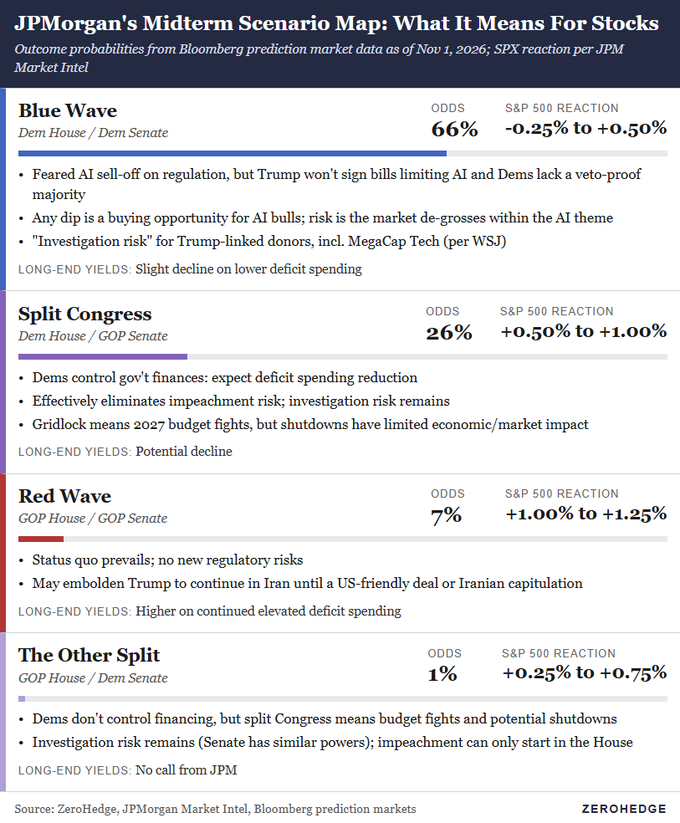
JPMorgan's scenario forecasting shows that if the Democrats win only the House of Representatives, the S&P 500 index is expected to rise by 0.5% to 1%; if the Republicans retain both chambers, the increase is anticipated to be 1% to 1.25%; in the rare scenario where the Republicans have the House and the Democrats have the Senate, the increase would be around 0.25% to 0.75%. Only in the "blue wave" scenario does the bank's forecast include a possibility of a decline.
Goldman Sachs analysts Alec Phillips and Abhay Duggirala have reached similar conclusions regarding the regulatory outlook. They expect that any bipartisan AI agreement will be centered around voluntary testing and self-regulation, imposing limited burdens on AI companies, and that the construction of national data centers is unlikely to resume under any election outcome. However, if Democrats take control of Congress, the pace of regulatory and investigative actions is expected to accelerate significantly.
AI Regulation: The Core Target of the Democratic Agenda
JPMorgan Chase believes that if the Democrats sweep both houses of Congress, they will undoubtedly push forward with AI regulatory legislation – although the actual implementation is quite challenging, as Trump has clearly stated that he will not sign any bill that restricts the expansion of AI. Moreover, the Democrats cannot achieve the majority required to override a veto in both houses simultaneously. Trump previously told the media that in such a deadlock, “I will veto everything.”
JPMorgan Chase pointed out that for investors who are bullish on AI, a decline in stock price after the selection could present an opportunity to buy, but the risk lies in the market taking the opportunity to significantly reduce their positions within the AI theme.
Goldman Sachs expects that the Democratic Congress may also exert pressure on fiscal matters: restoring the spending cuts from last year's fiscal package, which would result in an additional expenditure of about $85 billion in 2027, including approximately $55 billion for medical subsidies and $18 billion for nutrition programs; restoring the expanded Affordable Care Act subsidies would add another about $50 billion per year.
The leader of the House Minority Party, Hakeem Jeffries, according to a report by Goldman Sachs, stated that there are plans to rapidly advance measures to expand healthcare subsidies, reverse tariffs, and hold a vote on the Iran war issue.
Tariffs: Regardless of who wins, tax rates will rise
Goldman Sachs warns that even if Democrats attempt to dismantle some tariffs, most likely targeting imported goods from Canada, the actual effect will be limited.
After the election, Goldman Sachs expects Trump to announce the results of a 301 investigation targeting overcapacity in industry. These results, when combined with the current tariffs of 10% to 12.5% for forced labor, will essentially restore tariff rates with various trading partners to the levels before the Supreme Court ruled that such tariffs were unconstitutional. Goldman Sachs predicts that as a result, the effective tariff rates in the United States will rise by nearly 2 percentage points.
This means that, regardless of the outcome of the mid-term elections, the cost pressures brought about by trade frictions will not dissipate with a change of administration, and the uncertainties faced by corporate supply chains and profit margins will continue to exist.
Iran: Post-election Variables of Military Risk
In the dimension of geopolitics, the election results have a substantial impact on the trajectory of the Iranian situation.
JPMorgan Chase believes that a Republican sweep in the elections could encourage Trump to continue exerting pressure on Iran until an agreement is reached that they deem beneficial to the United States, or until Iran makes concessions. If Democrats take control of Congress, they might cut related military funding or invoke the War Powers Act to demand troop withdrawal, but such actions would have to wait until the new Congress is seated in January.
JPMorgan Chase energy expert Brendan Henrici pointed out that as of 2027, the fair value swap for WTI crude oil is currently trading around $88, while the normal price range is between $65 and $70. This means that the oil hedging options available to stock investors have significantly narrowed, and JPMorgan Chase suggests that it might be prudent to moderately increase downward protection. Goldman Sachs, on the other hand, has just raised its forecast for Brent crude oil to reflect the risk of supply disruptions.
Polls and Early Voting: Uncertainty Remains in the Senate
Goldman Sachs interprets market forecasts as indicating that the Democratic Party has a win rate of over 90% in the House of Representatives and over 65% in the Senate. It is also stated that the national electoral landscape has swung in favor of the Democrats by 10 to 11 percentage points compared to 2024, with the market implying approximately 236 Democratic seats in the House of Representatives. The outcome for the Senate is more difficult to predict.
Goldman Sachs data shows that since 2002, Republican Senate candidates have averaged a 3-percentage-point lead over final polls in states leaning Republican; in highly competitive districts, candidates with a lead of less than 2.5 percentage points only had a 60% chance of winning in the end. Among the current Republican Senate seats, there is only one seat in North Carolina where Democrats have a lead of more than 3 percentage points.
As of last Wednesday, over 43 million Americans had completed early voting, nearly 10 million more than in the same period of 2022. In Texas, the increase in early voting was 50%, and in South Carolina it was 83%. In states that released data on party registration, there were approximately 6.8 million votes for the Democratic Party and about 5.2 million votes for the Republican Party. However, JPMorgan Chase pointed out that early voting has historically favored the Democratic Party, while voting on election day tends to favor the Republican Party.
There are also disagreements regarding the assessment of voters' concerns between the two parties. JPMorgan Chase cites recent polls from CNBC and Fox News, indicating that corruption has surpassed cost of living as the primary motivation for voting; however, Goldman Sachs' data from Harris Poll shows that cost of living is still far ahead, with government corruption coming in second, and only 2% of voters listing AI as the primary issue.
Historical seasonality: In the long run, there is evidence to support a bull market after such selections.
Apart from short-term uncertainties, historical data provides a longer-term reference for the market. JPMorgan Chase's Craig Cohen indicates that since 1950, the S&P 500 index has recorded gains in the year following each mid-term election, with an average increase of about 15%. The worst performance occurred in the year following the mid-term elections of 1986, but as he says, "This was clearly more related to the market crash of 1987 than to political developments in Washington."
More specific data shows that the S&P 500 index rose by an average of 5.4% in the three months following the mid-term elections, 11.4% in six months, 12.5% in nine months, and 14.7% in twelve months. Since 1990, the returns over six months, nine months, and twelve months have been positive each time. At the position level, JPMorgan Chase’s Delta One team stated that their “divided congress” paired trading portfolio has reached a two-year high.
Goldman Sachs added that if Democrats take control of the Senate, Trump will face pressure to quickly complete personnel appointments in order to get them approved by the Republican majority before the end of the year. The Senate controlled by Democrats could block his nominations, and although Trump can appoint acting officials in cabinet agencies such as the Treasury Department, he would not be able to do the same in the Federal Reserve or the judicial system.