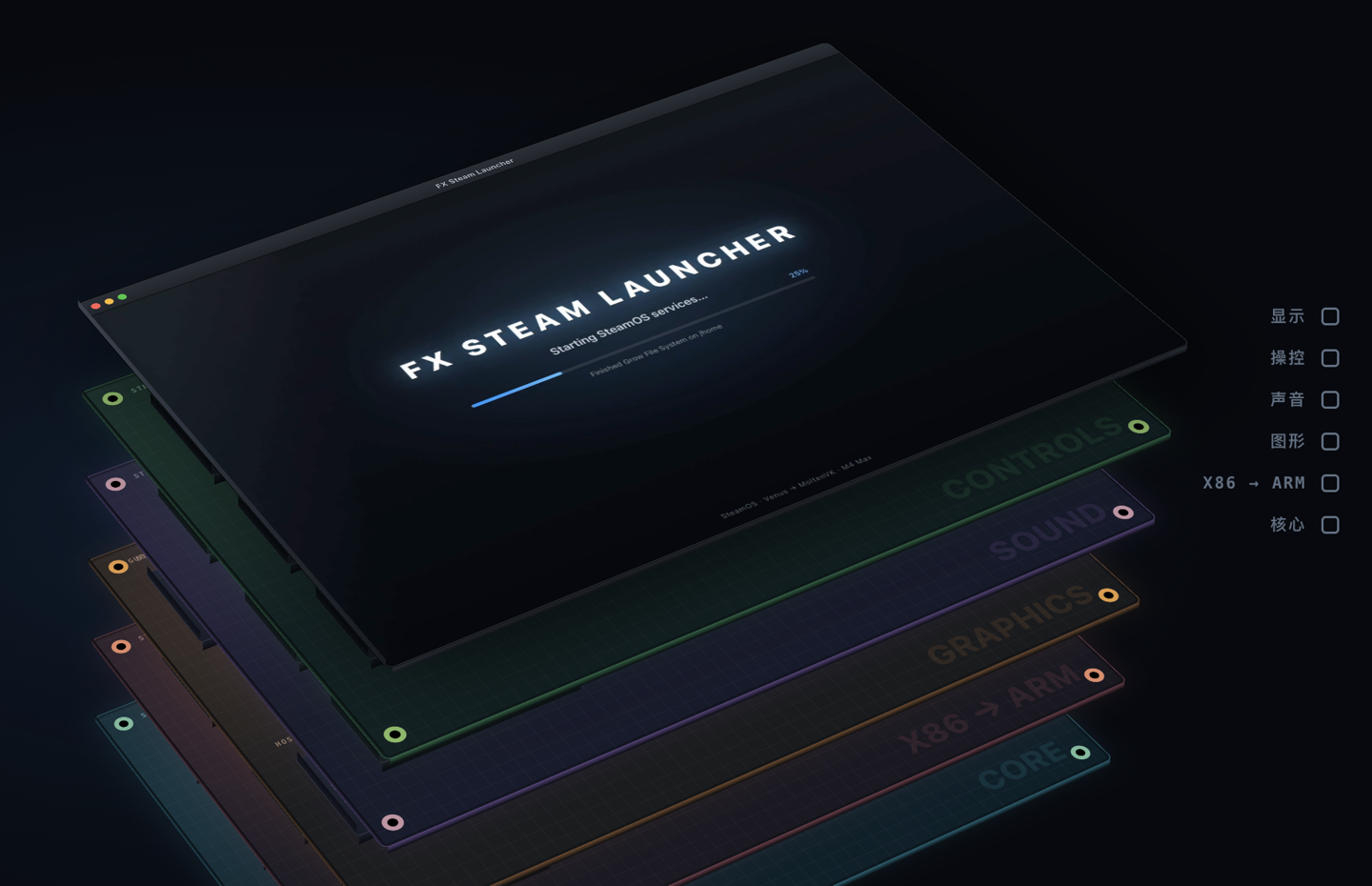
News from IT on November 3rd: Recently, a developer has launched an open-source project named FX Steam Launcher. The main purpose of this project is to encapsulate the SteamOS environment into an independent application, allowing users to launch Steam just like they would any regular Mac application, and to directly download and run Windows games. IT provides the project address: https://fxgl.github.io/steamac.
Regarding the compatibility of DirectX games, FX Steam Launcher mainly provides two conversion solutions: The first is to use the Proton compatibility layer of SteamOS to convert DirectX 12 to Vulkan, and then further to Apple's Metal graphics API; the second solution involves using the experimental DXMT project to convert DirectX games 10 and 11 to Metal API in order to be compatible with some older Windows games.
Compared to CrossOver, FX Steam Launcher requires a double-layer graphics API conversion when running modern games, so the performance loss may be more noticeable. However, its advantage lies in the use of an instant compilation mechanism, allowing users to start playing immediately after launching the game without the need for any additional complex configurations. In addition, this project also supports compatibility solutions for some anti-cheat systems. Theoretically, any game that can run normally on Steam Deck and connect to the server has a chance to run on Mac.
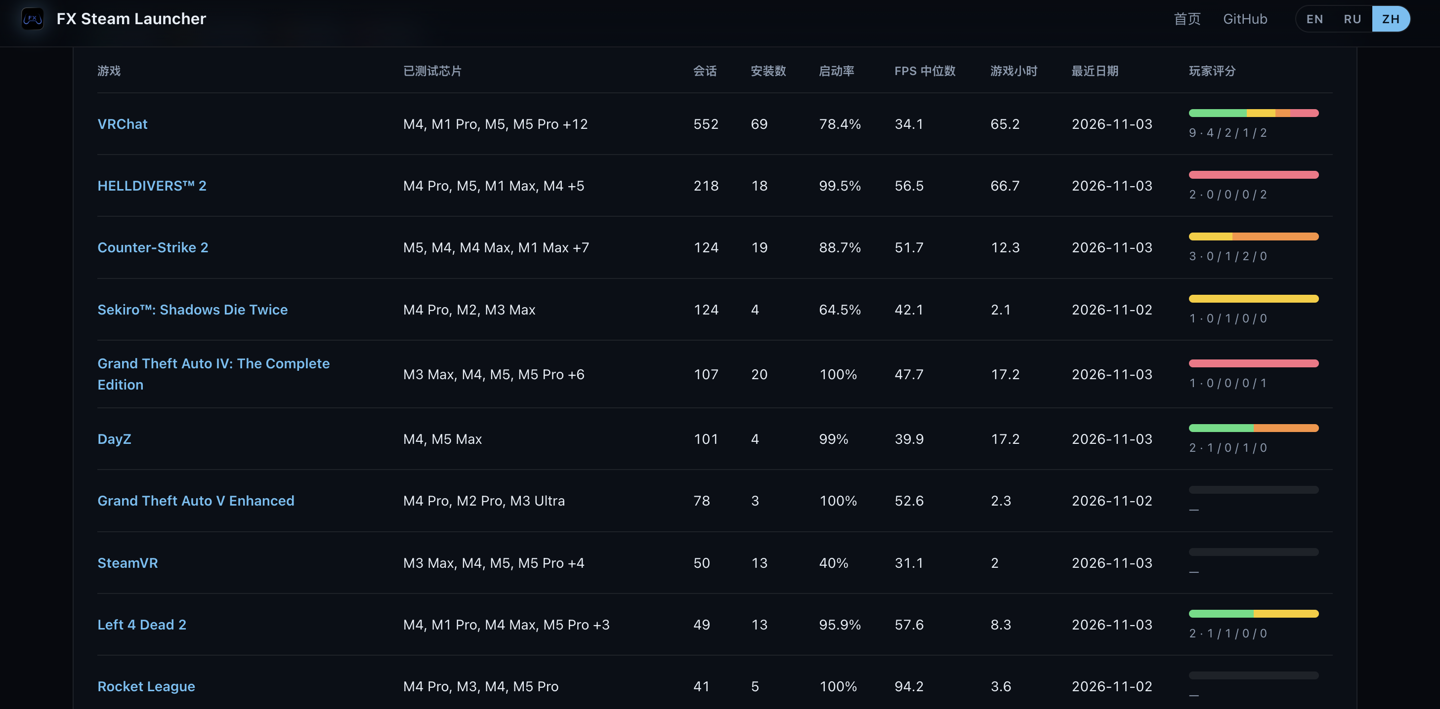
In terms of peripheral support, this project provides compatibility with keyboards, mice, and game controllers. Additionally, the software supports flexible allocation of CPU and memory resources, and is capable of properly invoking Apple's built-in Metal Performance HUD performance monitoring tool.
Foreign media ETA Prime once conducted actual tests using the Mac mini equipped with M4 Max chips. When running "The Witcher 3" at a resolution of 1080P with high graphics settings, the frame rate was about 70 FPS; when running "Sword Star" with a resolution of 800P and high graphics settings, it was also able to achieve a frame rate of about 70 FPS. Considering that the native graphics performance of the M4 Max is close to that of the RTX 5070 Laptop graphics card, these test results also reflect that the performance loss caused by multi-layer graphics API conversion cannot be ignored.