Key Points
- The Nasdaq 100 index fell 10.4% from its October record high.
- Market concerns about AI spending have caused the valuation of tech stocks to evaporate trillions of dollars.
- The decline in Intel and the semiconductor sector has deepened Wall Street's correction this cycle.
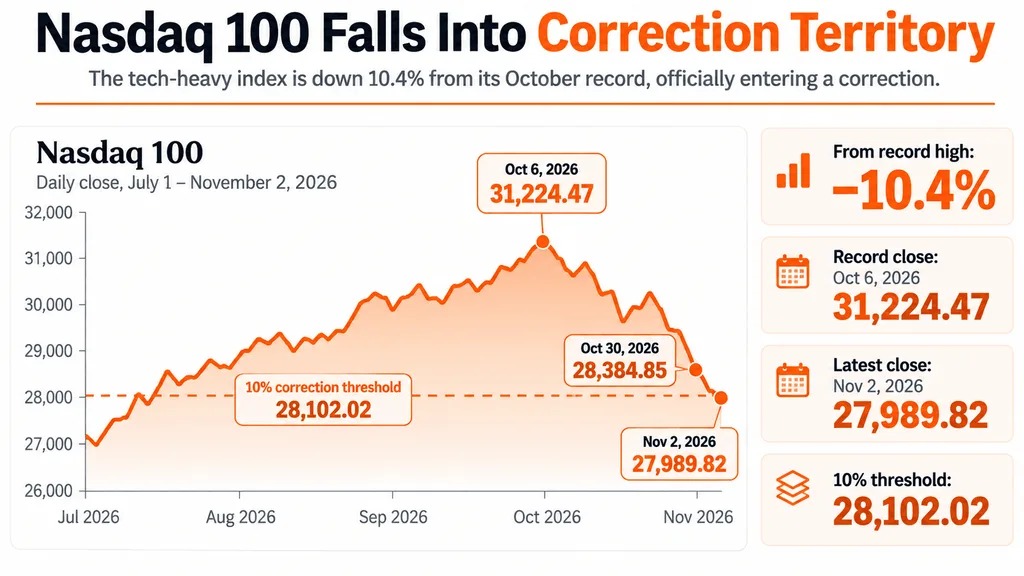
On November 2nd, the NASDAQ 100 index officially entered a correction zone. As investors continued to sell stocks related to artificial intelligence amid growing concerns about massive tech spending, the index fell by 10.4% from its record high set in October.
According to NASDAQ index data, this benchmark index, which has a high weight of technology stocks, closed at 27,989.82 points on Monday, down 1.39% for the day. In contrast, on October 6th, the index reached a record closing level of 31,224.47 points, marking the third time in 2026 that the index has entered a correction phase.
Why has the NASDAQ 100 index fallen?
After the financial report releases of several of the largest technology companies in the United States—including Alphabet, Amazon, and Meta—caused disappointing market reactions, this cycle of adjustments has further accelerated.
Despite these companies investing heavily in the AI sector, investors are increasingly concerned about debt financing, declining free cash flow, and the time it takes for infrastructure investments to translate into sustainable profits.
Other semiconductor companies also performed weakly. Marvell fell by about 12.7% on Monday, AMD fell by 7.5%, and Micron fell by nearly 5.9%.
This weak trend is increasingly affecting the companies that provide funding for the expansion of AI. Oracle plans to raise $20 billion through stock and bond issuance, which has exacerbated market concerns about how much additional capital is still needed in this industry.
As previously indicated by the outflow of funds from technology funds, investors are increasingly inclined to withdraw their capital from companies with high valuations that are related to AI, rather than giving up on the stock market as a whole.
AI Stocks plummet, while the broader market remains relatively stable
Nasdaq's round of adjustments has exposed an unusual division within Wall Street.
On Monday, the Dow Jones Industrial Average rose by about 0.4%, while the Nasdaq Composite Index fell by 1.1%, and the S&P 500 Index declined by 0.5%.
In October of last year, despite the weak performance of the market-weighted benchmark index, the stock prices of 72% of the companies comprising the S&P 500 index rose.
This divergence indicates that the market is increasingly questioning the valuation of AI, rather than pricing for a consistent deterioration in the overall U.S. economy.
Even though NVIDIA's revenue has grown strongly, it has not been able to dispel concerns in the market regarding whether its largest customer will be able to maintain their infrastructure budget indefinitely.
What will happen to the NASDAQ 100 index next?
The immediate question at hand is whether this correction is merely a temporary reset of the AI valuation, or whether it marks the beginning of a deeper downturn in the tech market.
Investors are paying attention to the next round of corporate financial reports, especially the results released by AMD on November 3rd. They are also monitoring borrowing costs and announcements related to future data center expenditures.
Recently, the financial performance of Apple and Palantir has also highlighted how strictly Wall Street is evaluating corporate profit margins and AI profitability.
Maya Bennett
Maya Bennett is a financial journalist with experience reporting on cryptocurrencies, stocks, and broader market trends. Her areas of focus include Bitcoin, major digital assets, the stock market, monetary policy, as well as economic developments that influence investor sentiment. She is adept at transforming rapidly changing market situations into clear and concise reports.