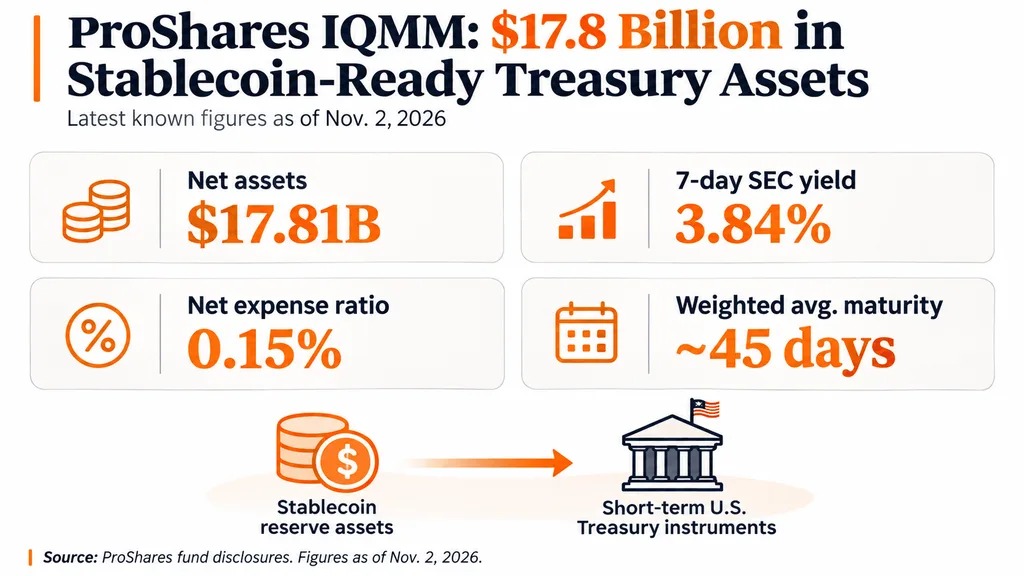
The fund was launched in February 2026, targeting institutions that manage stablecoin reserves under the framework of the GENIUS Act, highlighting the emerging competition for U.S. Treasury yields surrounding the digital dollar.
IQMM invests solely in cash and short-term U.S. government bonds, with the remaining duration of each investment limited to 93 days or less.
This structure matches the reserve requirements under the GENIUS Act, allowing eligible stablecoin issuers to include this ETF as part of their supported assets.
Unlike traditional money market funds, IQMM is traded on exchanges, its net asset value is calculated twice a day, and settlement for the same day is provided.
These features are particularly attractive to companies that manage billions of dollars in redeemable tokens.
Its annual net fee rate of 0.15% provides a continuous source of management fees. Taking $17.81 billion in assets as an example, this fee rate is equivalent to approximately $26.7 million per year, assuming that the asset size and fee rate remain unchanged.
This opportunity is attracting competitors. Franklin Templeton has adjusted its institutional funds to adapt to regulated stablecoin reserves, while BlackRock has also previously restructured a US Treasury bond liquidity fund targeting the same market.
Who really profits from US debt trading?
Its economic logic begins with customers exchanging dollars for stablecoins.
The issuer invests eligible reserve assets in instruments that generate interest, while holders typically receive tokens intended to maintain a value of $1.
The reserve income generated thereby supports the issuers of stablecoins, while asset management companies charge investment management fees.
Circle reflects the scale of this business. In the second quarter of 2026, the company's reserve income reached $667.7 million, accounting for over 95% of its total revenue.
However, revenue does not equal profit. Distribution partners, hosting service providers, and operating expenses also consume a considerable portion of the income.
Hidden Risks in the Currency Market ETF Focused on Stablecoins
If investors redeem stablecoins quickly, the issuer may need to sell a large number of ETF holdings to raise cash.
As the adoption of stablecoins expands, the beneficiaries of this opportunity are no longer limited to token issuers, but also extend to asset management companies, custodian institutions, and financial intermediaries.
Ethan Mercer
Ethan Mercer is a financial journalist who covers cryptocurrency, stocks, and the global economy. He studied economics and finance before turning to market reporting, with a particular focus on Bitcoin, stocks, monetary policy, and investor sentiment. His work focuses on explaining daily market fluctuations and the broader trends behind them.