On the eve of a presidential election that is bound to change American culture irrevocably, Hillary Clinton took to the stage at a rally in Virginia to run for the position of America's first female president.
"We'll have a lot of work to do – from building infrastructure to programming, and then to developing new applications," she said. "I don't know who created Pok é mon Go, but I'm trying to figure out how to get them to 'Pok é mon Go to the polls'."
Ten years later, the United States once again faced election day. Nowadays, most application developers no longer write code themselves, thanks to AI; and Pok mon Go have also been sold to a company wholly owned by Saudi Arabia's sovereign wealth fund. The only thing that hasn't changed about that political moment is that the meme " Pok mon Go to the polls " still emerges on every election day.
"That statement was very bold and confident, but it also sounded quite unrealistic and a bit cheesy," said Cesar Ruiz, de, and Castilla, who were elected members of the Philadelphia District Committee, to TechCrunch. "I don't know how much mainstream media cared about it at the time, but everyone on the internet was making jokes and discussing it."
Thereafter, the fate of digital culture and American politics became increasingly inseparable. During his first term, Trump dominated public opinion through tweets, and later on... Presidential campaign activities would hire meme managers; the White House would invite podcast hosts and content creators to press conferences; Elon Musk even formed his own advisory team under Trump, named after that adorable doge meme, before subsequently cutting back on international aid programs.
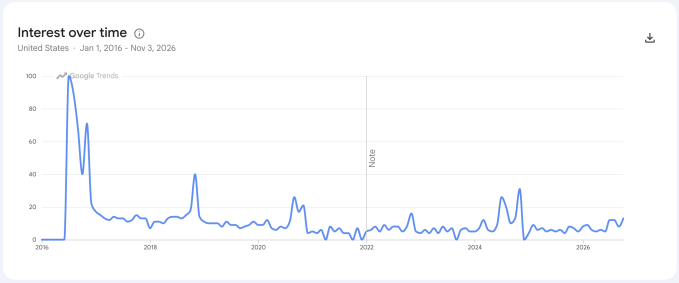
The 2016 elections were a monumental moment in the history of the internet; we all witnessed it firsthand – our politics not only became more divided, but also further fragmented online. Political influencer Organizer Memes told TechCrunch. She taught Generation Z activists how to reach their peers online through memes. “That was a relic of an optimistic political era that has now passed.”
Today, even those who were not of voting age in 2016 regard that year as a cultural turning point, sometimes even calling it "the last good year." This sentiment is more of a nostalgia for the internet era before the flood of AI junk content than anything political; back then, we used social media to connect with friends, rather than endlessly scrolling through information streams pushed by algorithms that featured people we didn't follow at all.
Spotify reported that in the first 3 weeks of this year, user-made playlists containing the title "2016" surged by 790%; at that time, the company also changed the Instagram introduction to "Starting to miss 2016 again."
Don't forget, at that time, the internet had already regarded 2016 as a cursed year, and this was the case even before the elections. Just a few months ago, Slate, a columnist, was wondering how 2016 compared to 1348, the year when the Black Death spread across Europe.
“[ Pok é mon Go to the polls ] belong to that ‘single internet’ era. Back then, Facebook, Twitter, and Tumblr would still exchange content with each other, unlike the current chaotic situation where we have 25 platforms. Moreover, we didn’t even need them at that time.” said Organizer Memes.
Organizer Memes also pointed out that some cultural symbols that seemed more important back in the day – such as people's obsession with Harambe – have not endured as long as “Pok é mon Go to the polls”.
Perhaps it's because we are destined to remember “Pok é mon Go to the polls” again every few years, on every election day; and this meme applies to both camps. For the right wing, it is a way to mock the Democratic Party; for the left wing, it is a shared expression of awkward sighs.
“It’s like all the kids in the class are telling a joke, and then the teacher joins in, and suddenly it’s not funny anymore.” Mack Finkel, who was campaigning at a polling station on Tuesday on behalf of a medical workers’ union, told TechCrunch, “I feel there’s a typical sense of awkwardness among millennials, which is also why all my friends are rewatching HBO’s Girls.”
Clinton's somewhat clunky comment from ten years ago can be seen as the precursor to the later meme “Kamala is brat”. Former Vice President Harris was initially not popular among some left-leaning young voters due to her background as a prosecutor, but when she became the only alternative to Trump, they switched to supporting her. Generation Z has packaged this candidate's memorable quotes by creating gorgeous, absurd videos with a “fan-made editing” style. The overall aesthetic borrows from the style of Charli XCX’s album “Brat”, which also served as the soundtrack for the summer of 2024.
"In the past, the comments I saw about Harris were all jokes referring to her as a police officer, such as her history related to truancy laws when she was the Attorney General of California," Jess Rauchberg, an assistant professor of communications at Leeds University, told TechCrunch at that time. "Now what we see is the same meme-style humor, but it has turned into a form of support."
It's hard to say why jokes like “Pok é mon Go to the polls” still make us laugh today – perhaps it's a mockery of Clinton, or maybe it's a way to express solidarity with those who persist in voting year after year, even as we become more cynical with each passing year.
“Pok is mon Go to the polls” is an exhortation to others to take the time to vote and to take election day seriously. At the same time, it acknowledges that older politicians who did not grow up in the era of social media are disappointing. It is wrapped in enough irony to appear detached and calm; yet, it remains a nearly desperate but sincere request to friends: Please, go vote.