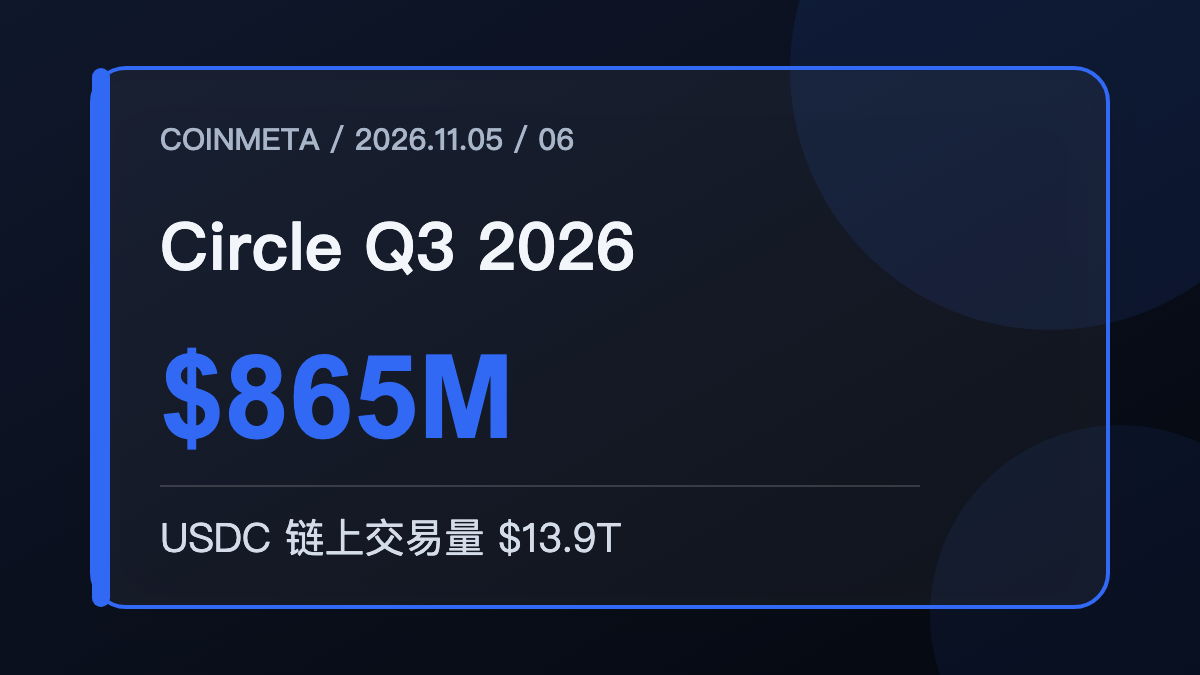


Circle Announces Third Quarter 2026 Results: Total revenue and reserve income amounted to 865 million US dollars, a year-on-year increase of 17%; net profit from continuing operations was 226 million US dollars, a year-on-year increase of 5%; adjusted EBITDA was 317 million US dollars, a year-on-year increase of 85%. Meanwhile, the end-of-period USDC circulation was 73.9 billion US dollars, virtually unchanged from the same period last year, while the quarterly on-chain transaction volume reached 13.9 trillion US dollars, a year-on-year increase of 49%. What is most noteworthy is not any single profit figure, but rather that Circle is transitioning from "making money from reserve interest" to a more complex model involving platforms, payments, and on-chain infrastructure.
The trading volume hasn't increased, but the transaction activity has significantly risen.
USDC The end-of-period circulation amount is 73.9 billion US dollars, with no year-on-year change; the quarterly average circulation amount is 73.3 billion US dollars, showing a year-on-year increase of 8%. These two figures are not contradictory: the end-of-period figure is a snapshot of a single day, while the average value reflects the scale for the entire quarter. The stability at the end of the period indicates that the asset scale did not continue to expand rapidly, while the increase in the average value shows that it remained higher than the same period last year for most of the quarter.
On-chain transaction volume reached 13.9 trillion US dollars, a year-on-year increase of 49%, indicating that the same unit USDC is being used more frequently. Circulation volume measures "how large the pool is," while transaction volume measures "how fast the money flows." For payment networks, the latter can reflect activity levels, but high transaction volumes do not necessarily equate to high revenue, as on-chain transfers can come from transactions, arbitrage, cross-chain activities, and internal fund allocation. The market needs to continue observing whether these activities can be transformed into platform fees or customer loyalty for businesses.
When interest rates decline, the income structure begins to change.
The reserve income of Circle is $657.6 million, which is a decrease from $711.2 million in the same period last year; other revenues have risen from $28.52 million to $207.3 million. Total revenue still increased by 17%, mainly due to the significant expansion of non-reserve revenues. The reserve return rate is 3.5%, which is a decrease of 61 basis points year-on-year, and this also explains why the model of earning interest solely from holding short-term safe assets is under pressure.
This is precisely the core sensitive point for stablecoin companies: when interest rates are high, reserve assets can generate substantial returns; when interest rates fall, the circulation volume must increase, or other revenues such as platform services, payments, and transactions must take over. The data for this quarter Circle indicate that the second path has already begun to contribute significantly, but its sustainability still needs to be verified in subsequent quarters.
Distribution costs determine how much of the revenue can be retained.
Total revenue and reserve income reached $864.9 million, but distribution, transaction, and other costs amounted to $411.6 million. After deducting these costs, the remaining revenue was $453 million, a year-on-year increase of 55%, with a profit margin of 52%, which is about 12.91 percentage points higher than the previous year. Stablecoin issuers need to share economic benefits with trading platforms, wallets, and channel partners; therefore, total revenue does not equal the amount of money that the company can freely dispose of.
The distribution and transaction costs for this season are lower than those of the same period last year, while revenue has increased, leading to a wider profit margin after deducting distribution costs. This is also an important reason why the growth rate of EBITDA is significantly higher than the total revenue growth rate after the adjustment. In the future, investors should observe both reserve income, the distribution ratio, and the proportion of USDC on their own platforms, rather than just focusing on the circulation scale.
On the platform, USDC has become even more important.
At the end of the period, the value of USDC within the platform reached $13.9 billion, a year-on-year increase of 36%; the average daily weighted proportion was 18.1%, up 4.62 percentage points from the previous year. Keeping more of USDC within the platforms that Circle can directly serve may mean that the company can get closer to corporate payments, settlements, and developer activities, rather than merely existing as an underlying issuer.
Circle's payment network reached an annualized total payment volume of $41.3 billion this quarter. The company also signed a final agreement to acquire Tazapay, which brings in over $25 billion in annualized payments, more than 60 banking and fintech partners, and covers local payment channels in over 100 markets. The transaction is expected to be completed in 2027, although it still requires regulatory approval. Approximately 60% of Tazapay's transaction volume already includes stablecoins, which directly connects this acquisition with Circle's existing business.
Arc Pushes the company towards a more significant role in infrastructure
Circle announced that the public mainnet of Arc was launched on September 16th. On the first day, over 100 institutions and ecosystem builders participated, and it was natively integrated with USDC. The company also completed the genesis mining of 10 billion ARC tokens, planning to use them for network security, utility, and governance, with a transition to a proof-of-stake mechanism scheduled for 2027.
This step not only makes Circle a stablecoin issuer, but also turns it into a builder of a new network. The opportunity lies in placing settlement, payment, and developer tools on more controllable infrastructure; the risks include network cold starts, token governance, regulation, and ecological investment. The launch of the public mainnet is just the beginning. What truly needs to be verified is whether the use by traders, developers, and enterprises will continue to grow, rather than how long the list of participants on the first day is.
Why is the net profit growth rate lower than EBITDA?
Net profit from continuing operations was $226 million, a year-on-year increase of 5%, and after adjustment, EBITDA grew by 85%. The difference between the two figures stems from different measurement methods: EBITDA excludes interest, taxes, depreciation and amortization, as well as some adjustment items, and is closer to a non-GAAP (Generally Accepted Accounting Principles) indicator that reflects operational performance; net profit, on the other hand, includes a more comprehensive range of expenses and other income impacts. During the same period last year, there were also higher levels of other income and tax benefits, which raised the base for comparison.
Therefore, a 85% increase cannot be directly interpreted as a corresponding increase in shareholders' final profits. It indicates that core operating profits have improved relatively quickly, but investors still need to refer to the financial statements prepared in accordance with Generally Accepted Accounting Principles (GAAP) to examine expenses, taxes, equity, and one-time factors. Especially when a company is expanding its payment network and launching new chains, infrastructure investments may lead to further divergence in profit figures across different measurement criteria.
Circle is proving the second curve.
The most clear signal from this financial report is that: USDC the outstanding share volume at the end of the period did not increase year-on-year, however Circle the total revenue and revenue after deducting distribution costs still increased, with other revenues becoming a new driving force. The payment network, as well as USDC, Tazapay, and Arc within the platform, together form a "non-interest-only" growth curve.
However, this curve is still in the verification phase. The volume of on-chain transactions needs to be converted into sustainable income, acquisitions must be successfully approved and integrated, the new mainnet must see real usage, and other sources of revenue growth must also prove that they are not due to temporary factors for a single quarter. Circle has already demonstrated the direction from reserve earnings towards becoming a financial infrastructure; the next step is to prove that this more substantial and complex model can continue to generate profits even in times of declining interest rates and intensified competition.