

After the trading sentiment cooled down around AI and Intel's stock price suffered a heavy blow due to weak guidance, AMD's financial report delivered what the market wanted to see: not only were the third-quarter revenues and profits significantly stronger than expected, but the fourth-quarter revenue forecast also far exceeded Wall Street's expectations, indicating that AI's data center business is still experiencing accelerated growth.
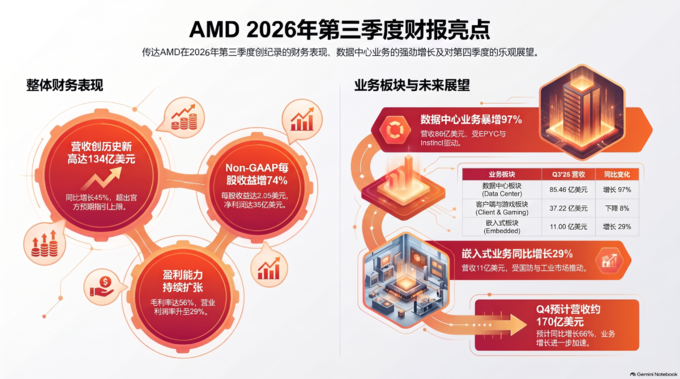
After the U.S. stock market closed on Tuesday, March 3rd, Eastern Time, AMD announced that in the third quarter of 2026, revenue increased by 45% year-on-year to $13.377 billion, setting a new record for a single quarter. This figure was about 2.3% higher than analysts' expectations and also exceeded the company's own guidance range of $13.3 billion at the upper end. Excluding GAAP metrics, earnings per share (EPS) increased by 74% year-on-year to $2.09, more than 6% above analysts' forecasts; the operating margin also rose by 5 percentage points to 29%, surpassing the market's expectation of 28%.
The most core highlight of the financial report is still the data center business driven by demand for AI. In the third quarter, AMD data center revenue increased by 97% year-on-year to $8.546 billion, which is about 3.3% higher than market expectations, and accounted for 64% of the company's total revenue, up from 47% a year ago. AMD stated that this growth mainly came from strong demand for EPYC servers CPU, as well as record-breaking sales brought about by the launch of the Instinct MI450 series GPU.
More importantly, AMD has provided a revenue guidance for the fourth quarter of approximately $17 billion, with a fluctuation range of 3%. The median value in this guidance indicates that not only will this quarter's revenue set a new record for a single quarter, but the growth rate will also accelerate, with a year-over-year increase of about 66% and a quarter-over-quarter increase of about 27%, which is $700 million higher than the median expectation of analysts and more than 4% higher.
AMD CEO Su Zifeng stated that the product demand for the company's Instinct and EPYC products continues to grow. With the increase in production of rack-level AI systems Helios and the sixth-generation EPYC (Xiaolong) servers CPU Venice, the company expects its revenue to grow even more rapidly in the fourth quarter.
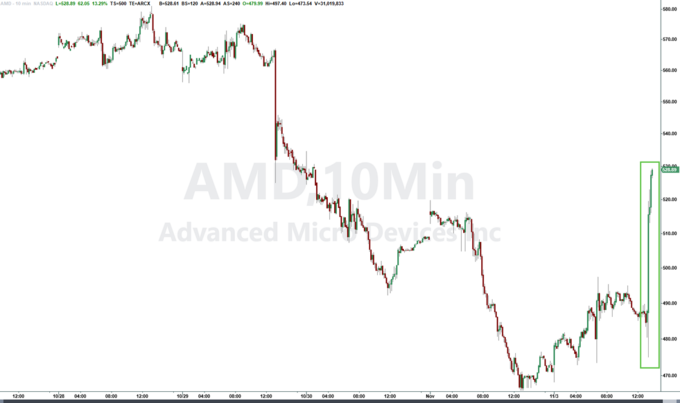
After the financial report was released, the stock price of AMD rose by nearly 3.7% during regular trading on Tuesday, and the post-market increase once approached 10%.
Analysis suggests that the significant post-market rally is due to the financial report meeting several stringent market conditions: Firstly, the third-quarter performance far exceeded expectations, indicating that the demand for AI is being translated into actual revenue and profits. Data center revenue nearly doubled, and there is clear customer validation. Customers such as OpenAI, Meta, Anthropic, and Microsoft are present within the Helios ecosystem. Secondly, given that the stock price has already risen by over 100% this year, and there are concerns that if the performance exceeds expectations by a small margin, it may lead to selling pressure, the guidance that still significantly surpassed expectations under these high expectations provided sufficient momentum for upward revisions.
Thirdly, this financial report reflects a further widening of the narrative gap between AMD and Intel. In the fourth quarter, AMD's revenue guidance median is nearly 10% higher than Intel's corresponding period guidance. Intel has recently caused market concerns due to PC and cost pressures, whereas AMD has proven that it benefits more directly from AI's infrastructure expansion through the growth in its data center business. Even though its client and gaming businesses are under pressure, AI's data center has become the main driver for the company's overall rapid growth.
Finally, the impact of free cash flow falling short of expectations was temporarily overlooked by the market. During the AI capacity ramp-up phase, increases in inventory and capital expenditures are more easily interpreted by investors as preparations for growth in the fourth quarter and beyond. As long as the revenue guidance is strong enough, the short-term fluctuations in cash flow have a relatively limited impact on stock prices.
Third quarter exceeded expectations across the board: Revenues set a new record for a single quarter, and profit leverage continued to be unleashed.
AMD In the third quarter, revenue reached $13.377 billion, a year-on-year increase of 45%. The growth rate slowed slightly compared to 50% in the second quarter, but it still set a new record for the highest single-quarter revenue, which is 15.5% higher than the previous record. GAAP Under this measurement, the gross margin in the third quarter increased by 2 percentage points to 56% year-on-year; operating profit was $2.832 billion, up 123% year-on-year; net profit was $2.428 billion, up 95% year-on-year; and the diluted EPS was $1.46.
Under the non-GAAP criteria that the market pays more attention to, the improvement in AMD profitability is more evident:
- The gross profit margin for non-GAAP products is 56%, which represents a year-on-year increase of 2 percentage points and remains flat compared to the second quarter, in line with the company's own guidance.
- Non-GAAP reported operating profits of $3.923 billion, a year-on-year increase of 75%, exceeding market expectations of around $3.67 billion;
- The operating profit margin for non-GAAP entities is 29%, which represents a year-on-year increase of 5 percentage points and a month-on-month increase of 2 percentage points;
- Non-GAAP net profit of $3.471 billion, a year-on-year increase of 77%;
- Non-GAAP diluted EPS to $2.09, a year-on-year increase of 74%.
AMD Chief Financial Officer ( CFO ) Jean Hu stated that revenue in the third quarter increased by 45% year-on-year to a record level, and non- GAAP EPS grew by 74% year-on-year, indicating that as the scale of the data center business expands, the operational leverage of the AMD business model is beginning to be evident.
From a cost perspective, in the third quarter, AMD spent $2.803 billion on research and development, which is higher than analysts' forecast of $2.72 billion, representing a year-over-year increase of about 31%. However, due to faster revenue growth, the cost ratio actually decreased: non-operating expenses accounted for 27% of revenue, which is lower than 30% in the same period last year and 29% in the previous quarter.
Data center capacity nearly doubles: AI GPU and EPYC CPU work together to drive this growth
AMD The most critical business this season is still the data center.
In the third quarter, data center revenue reached $8.546 billion, a year-on-year increase of 97%, which is slightly lower than the 107% growth in the second quarter, but a 27% increase from the previous quarter, exceeding market expectations of $8.27 billion. Along with this strong growth, this business segment accounted for 64% of total revenue, approximately 1.4 times that of a year ago. The department's operating profit was $2.882 billion, which is 2.7 times the $1.074 billion from the same period last year, and the department's operating profit margin was about 33.7%.
According to AMD, the growth of data centers is driven by two main factors:
Firstly, there is a strong demand for server processors with AMD EPYC. As cloud providers and enterprise customers continue to expand their AI infrastructure, the role of CPU in training, inference, AI, agent scheduling, and model-related services has once again gained attention.
Secondly, AMD Instinct GPU sales have set new records, especially since the launch of the GPU series from MI450. AMD stated in its announcement that Anthropic, Meta, Microsoft, OpenAI, and Helios are already running models and workloads on the first batch of AMD Helios rack-level solutions. Helios is powered by the MI450 series and the sixth-generation EPYC CPU.
This means that AMD is attempting to shift from a single supplier of GPU to a full-stack AI infrastructure provider that offers CPU, GPU, networking, software, and rack-level systems. This is particularly important for the market, as it determines whether AMD will be able to continue to gain market share in the AI accelerator market, which is dominated by NVIDIA.
The fourth-quarter guidance was the biggest surprise: A median revenue of $17 billion far exceeded market expectations.
If the third quarter can be described as "exceeding expectations," then the guidance for the fourth quarter is what truly ignited the stock price in this financial report.
AMD expects revenue in the fourth quarter to be approximately $17 billion, with a fluctuation of 3%, meaning the range is roughly $16.49 billion to $17.51 billion. The median of this forecast corresponds to a year-over-year increase of about 66% and a month-over-month increase of about 27%, which is significantly higher than the analysts' median expectation of around $16.3 billion.
The gross margin guidance for non-GAAP products is around 55%, slightly lower than the 56% in the third quarter, which may reflect the short-term impact of increased sales of new products, the ramp-up of system-level products, and changes in the product portfolio. However, with a revenue scale of $17 billion, the market is more concerned about the acceleration of revenue growth and operational leverage, rather than a slight decline in gross margin.
A more tangible comparison is that the median revenue guidance for AMD in the fourth quarter is $17 billion, while Intel's company-wide revenue guidance last week was approximately $15 to $16 billion. A few years ago, AMD was still seen as a challenger trying to snatch market share from Intel's shadow; today, driven by AI's data centers, AMD's single-quarter revenue is expected to exceed Intel's entire company's quarterly revenue range.
Su Zifeng stated in the financial report:
"The product requirements for Instinct and EPYC continue to increase, and as we expand the production of Helios and ' Venice ', we expect growth to further accelerate in the fourth quarter."
Jean Hu also indicates that the outlook for the fourth quarter reflects an acceleration in revenue and profit growth, driven by strong demand for the data center product portfolio.
The client and game are still a drag, but they no longer determine the AMD narrative.
Compared to the high growth of data centers, the performance of client and gaming businesses has shown a clear divergence.
In the third quarter, AMD generated revenue of $3.722 billion from its client and gaming services, a year-on-year decrease of 8% and a month-on-month decrease of 3%. Among this:
- Client revenue amounted to $2.949 billion, a year-on-year increase of 7%, but it was lower than the market's expectation of around $3.03 billion;
- Game revenue amounted to $773 million, a year-on-year decrease of 40%, but it was higher than the market's expectation of around $634 million.
The growth in client business mainly comes from the sales of Ryzen mobile processors; the decline in gaming business is due to a reduction in revenue from semi-customized chips and graphics cards. The operating profit of this department was 573 million US dollars, which is lower than the 867 million US dollars from the same period last year and also slightly lower than the previous quarter.
This part explains why there were concerns about AMD in the market before the financial report. Intel previously warned that the PC market was impacted by factors such as rising memory costs, which led to a sharp sell-off in its stock price. Investors were once worried that AMD would also be dragged down by the PC cycle. However, AMD's latest financial report shows that although the client and gaming segments are not strong, the growth in AI data centers is sufficient to drive the overall performance direction.
In other words, AMD's current core valuation logic has shifted from 'increasing shares on PC and server CPU' to 'expanding infrastructure on AI'.
Embedded business resumes growth, driven by industries, automotive, and aerospace defense
Embedded business revenue in the third quarter was $1.109 billion, a year-on-year increase of 29% and a month-on-month increase of 14%, exceeding market expectations of around $1.07 billion.
According to AMD, the growth of this business is mainly driven by the aerospace and defense, automotive, communications, and industrial terminal markets. In the third quarter, the embedded division achieved operating profits of $453 million, which is higher than the $283 million in the same period last year, with a departmental profit margin exceeding 40%.
At the product level, AMD has started providing Versal AI Core XQRVC1902 aerospace-grade adaptive SoC samples this season, which are designed for space missions lasting up to 15 years. In addition, Kodiak AI announced that its next-generation autonomous truck platform will use AMD EPYC processors, and AMD also launched agentic tools for embedded system design.
Although the scale of embedded businesses is not as large as that of data centers, their high profit margins and diverse application scenarios help AMD reduce its dependence on a single terminal market.
Free cash flow has decreased by more than 60%, with inventory and accounts receivable occupying a significant portion of cash.
This financial report is not without flaws. The most obvious weakness is that the free cash flow is significantly lower than expected.
AMD In the third quarter, the operating cash flow was 1.202 billion US dollars, lower than 1.788 billion US dollars in the same period last year; capital expenditure was 648 million US dollars, a year-on-year increase of 151%, which is basically in line with the market expectation of 647 million US dollars; free cash flow was only 554 million US dollars, lower than the market expectation of around 1.05 billion US dollars, a year-on-year decrease of 64%. The free cash flow ratio dropped from 14% in the second quarter to 4%, compared to 17% a year ago and 25% in the first quarter.
The pressure on cash flow mainly comes from the occupation of working capital:
- Accounts receivable amount to $1.928 billion, a year-on-year increase of nearly 78%;
- Inventories amount to $2.995 billion, which is approximately 4.7 times that of a year ago;
- Prepayments and other assets amount to $1.07 billion;
- At the same time, accounts payable amounted to $2.313 billion, which partially offset the cash flow pressure.
As of the end of the third quarter, the inventory of AMD reached $11.463 billion, a significant increase from $7.92 billion at the end of last year. The market may interpret this as stockpiling in preparation for the delivery of AI products and system-level solutions, especially since the company needs to secure production capacity, memory, circuit boards, and supply chain resources in advance before the increase in shipments of Helios, MI450, and “Venice”. However, if future revenue conversion falls short of expectations, high inventory could also become a risk factor that attracts investors' attention.
In terms of capital structure, at the end of the period, AMD had a total of $15.776 billion in cash, cash equivalents, and short-term investments, and $7.079 billion in total debt, indicating that the net cash position was still relatively ample.