IT News on November 5th: According to Bloomberg, the American humanoid robotics company Agility Robotics is set to become the first US-based company to go public focusing on humanoid robots, marking an important step forward for this emerging industry. However, there are still many issues in the humanoid robotics industry that need to be verified.
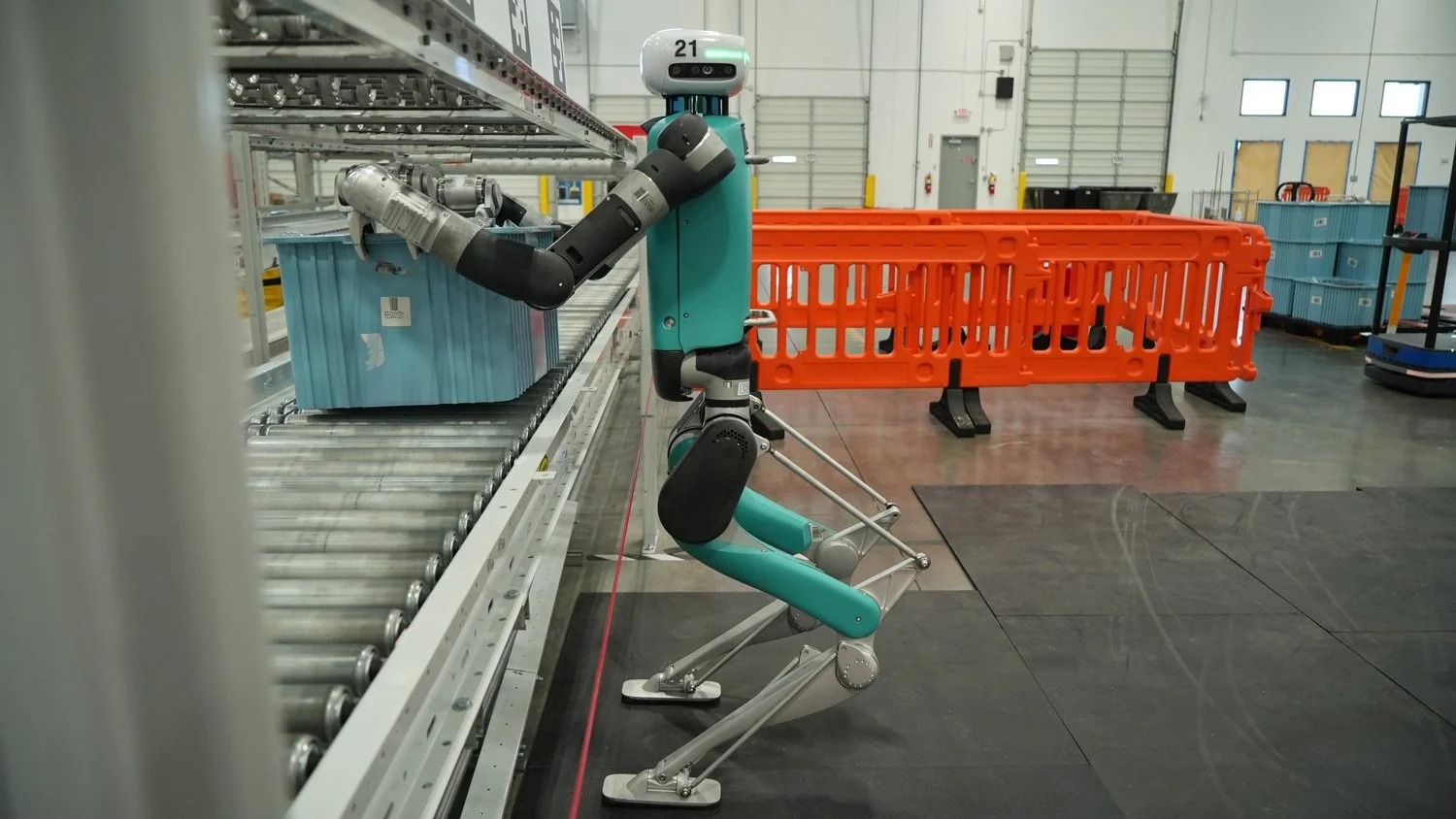
This startup will list its shares on NASDAQ this Thursday local time, with the stock code “AGLT”. Previously, Agility Robotics completed a merger with the special purpose acquisition company Churchill Capital Corp and XI. According to the company's statement, after this transaction is completed, Agility Robotics will have approximately $465 million in cash on hand (note from IT: the current exchange rate is about 3.109 billion yuan) (excluding related fees), which includes a private equity investment of about $201 million (about 1.344 billion yuan at the current exchange rate) led by Foxconn, a major iPhone partner of Apple. Other well-known investors include NVIDIA, Amazon, and SoftBank Vision Fund Phase II.
Agility Robotics is one of many humanoid robot development companies. These robots are designed based on the human form and are typically capable of walking upright, although some also use wheeled mobility systems. Currently, humanoid robots are mainly used in commercial scenarios such as warehouses and factories. Chinese company Yushu Technology went public in Shanghai in August of this year, while Agility Robotics is the first of its kind to go public in the United States.
This startup, headquartered in Oregon, USA, currently has about 400 employees and is further expanding its collaboration with GXO Logistics to deploy its robots in more logistics facilities. In addition, the company is also working with AGCO on a pilot project in the manufacturing industry.
Agility Robotics CEO Peggy Johnson ( Peggy Johnson ) said in an interview that as AI extends from the digital world to the real world, the subsequent development may be the more noteworthy part. What she meant is that artificial intelligence is being applied to robots and other hardware devices.
Johnson stated, "Introducing intelligent robots into more workplaces holds tremendous opportunities. When machines and humans truly begin to work together, the way many things are done will undergo fundamental changes."
Agility Robotics believes that its latest humanoid robot, Digit 5, has the potential to alleviate the labor shortage issue, especially in the warehousing industry. This robot was released in September of this year and is capable of performing more complex tasks such as loading materials onto equipment, sorting parts, and inspecting items.
In contrast, the previous generation of Digit 4 was mainly responsible for relatively simple tasks such as stacking plastic storage boxes. Digit 5 is also capable of operating safely in the vicinity of people, whereas earlier versions had to operate behind physical safety isolation facilities, which limited the robots' ability to take over human work.
Agility Robotics indicates that the company has currently received commitments for more than $300 million (approximately 2.006 billion RMB at current exchange rates) in Digit five-year orders. The company's robots have been put into use by 9 customers, and it is currently engaged in active sales negotiations with over 30 potential business clients.
This startup has committed to deploying Digit at 12 customer facilities and plans to expand its potential customer base to 100 by the end of 2027, covering multiple industries such as automotive, retail, and pharmaceuticals.
Johnson cited a 2024 study by Deloitte ( Deloitte ) which indicates that by 2033, the number of jobs in the U.S. manufacturing sector that cannot be filled is expected to increase to approximately 1.9 million.
She stated, "The labor gap that Digit is adept at filling continues to expand. Many companies are not sure how to find enough staff to complete those jobs that are difficult to recruit for and have a high turnover rate."
Johnson previously served as the CEO of Magic Leap, a company specializing in augmented and mixed reality. She believes that as Wall Street gradually comes to recognize this new industry category, the market still needs to go through a process of awareness and learning. However, she stated that Agility Robotics should be evaluated according to the same standards as other automation technology providers, including metrics such as job throughput and accuracy.
She stated, "I think a very noteworthy point is that Digit 5 supports wireless upgrades, which allows us to teach it new skills. As robots are deployed in more locations, we will collect an increasing amount of data, and this data will form a self-reinforcing training loop."
Currently, humanoid robots that walk on two legs, such as Digit 5, still face some unique challenges. Compared to similar devices that use wheeled movement, these robots have lower predictability during operation and pose a higher safety risk to people around them.
Johnson stated that as one of the first humanoid robotics companies to go public, Agility Robotics has indeed felt a certain amount of pressure. She said, "We are the first company to go public, and other companies will be watching our performance. They will pay attention not only to our relevant financial indicators but also to our safety record."
However, she added that over the past few years, while carrying out actual deployments in different environments, the company has accumulated a great deal of experience.
Johnson stated, "Demonstrations can show what technology is capable of, but it is only with actual deployment that you can understand which solutions are truly feasible. Over the past three years, we have learned a lot. Now, we are able to enter these facilities, undertake practical work, and generate income by providing services."