Newsletter
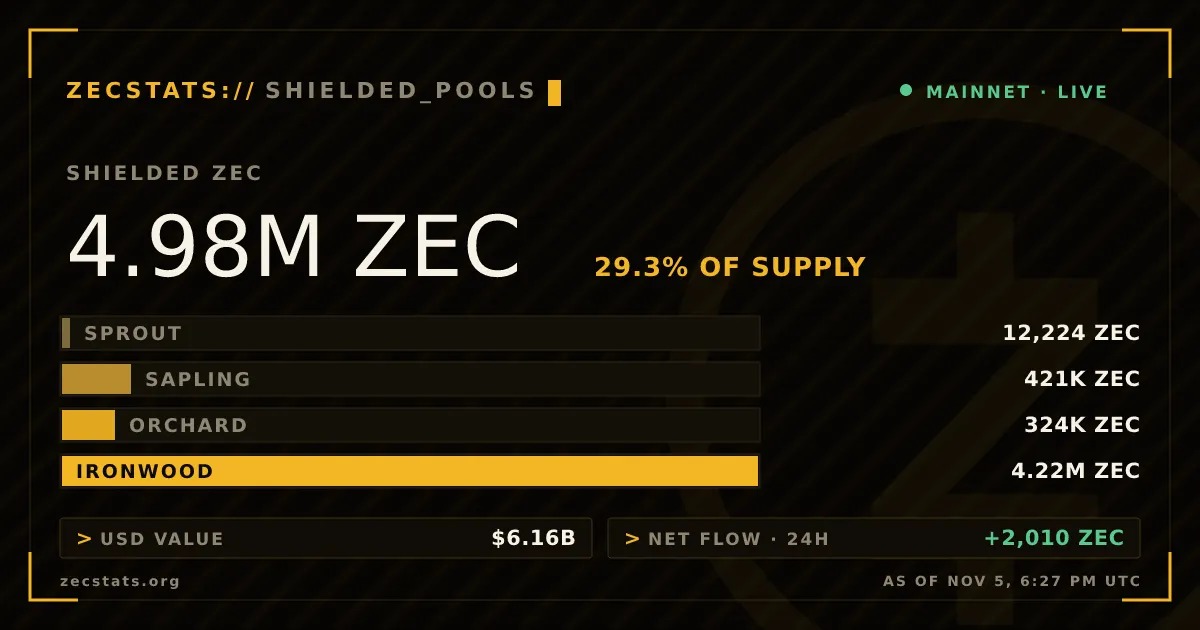
Approximately 12,224 ZEC remain in Zcash's initial privacy pool Sprout, valued at around 15 to 16 million US dollars at current prices.
NU7 The upgrade will render these tokens unusable for spending if the holders have not completed the migration before activation.
This upgrade also promises to triple the transaction confirmation speed, while removing outdated technologies from the network.
Zcash is preparing to disable its earliest privacy technology, which could render millions of dollars in cryptocurrency inaccessible to their owners—even if they still possess the passwords and private keys required to access their wallets.
According to the data updated on Thursday by ZecStats, approximately 12,224 ZEC remain in the initial privacy pool Sprout of this cryptocurrency.
Calculated based on recent market prices, these holdings are worth approximately 15 to 16 million US dollars; when the network is upgraded with NU7, they may actually be frozen.
“NU7 (Block 3,543,405) will render the v4 transaction invalid, therefore the remaining assets in Sprout will not be able to be spent: they are frozen, rather than destroyed,” Zecstats writes in its information card regarding Sprout.
This upgrade is scheduled to be activated at block 3,543,405, expected to occur on Thursday evening in US time. The exact deadline will depend on the speed at which the blockchain processes new blocks, rather than a preset clock time.
Why would Zcash freeze millions of dollars in crypto assets?
Unlike Bitcoin, where transactions are usually visible to anyone who can view the blockchain, Zcash allows users to hide the transaction amounts and the addresses involved. This is achieved through zero-knowledge proof technology, which enables the verification of transaction validity without disclosing any private details.
Sprout is a technology introduced by Zcash in 2016, but the team later launched more advanced privacy systems, including Sapling, Orchard, and Ironwood. Sprout has not been accepting new deposits for many years, but existing holders were still able to withdraw their funds previously.
NU7 will change this: it will cancel v4 transactions, which is the only format for transferring coins from Sprout. According to the technical specifications of that network, transactions using this format will become invalid after activation.
This decision is aimed at solving common problems encountered when maintaining old software: supporting outdated technologies increases complexity and can lead to potential security vulnerabilities.
Sprout The initial privacy system required a large amount of computing resources, and its outdated transaction verification mechanism also brought about the risks that developers hoped to eliminate.
Developers have not technically destroyed these coins. They will still be included in the circulation and issuance calculations of Zcash. In theory, access could be restored during a future network upgrade, but this is not guaranteed, and the team has not shown any interest in doing so.
In fact, the specification clearly warns that the reactivation of these funds' spending functions may never happen.
What will happen to the owners of Zcash?
The most affected are existing users. If someone's ZEC is still within Sprout, it must be transferred through a compatible extraction mechanism before the upgrade activation; otherwise, they may lose access indefinitely.
Addresses starting with “zc” help users identify old wallet records. Ordinary ZEC holders using modern, supported wallets do not need to migrate coins out of “Sprout”, however, it is still important to keep the wallet software up-to-date.
Even blockchain technology cannot identify the owners of the remaining Sprout balances. As a result, no one knows how many of these balances belong to users who are still actively using their accounts, and how many are inaccessible due to the loss of private keys.
At the same time, NU7 also brings a benefit to everyone else: according to Zcash Foundation, the target block interval for Zcash will be reduced from 75 seconds to 25 seconds, which means that transactions should be able to obtain their first confirmation nearly three times faster.