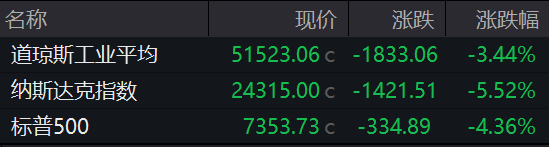


Overnight, U.S. stocks suffered the most severe one-day decline since the COVID-19 pandemic in 2020, with the Nasdaq 100 index plummeting by more than 6%, resulting in a loss of market value of up to $2.3 trillion in a single day. This storm swept through almost all assets, with no sector being spared, from chip giants to defensive consumer stocks.
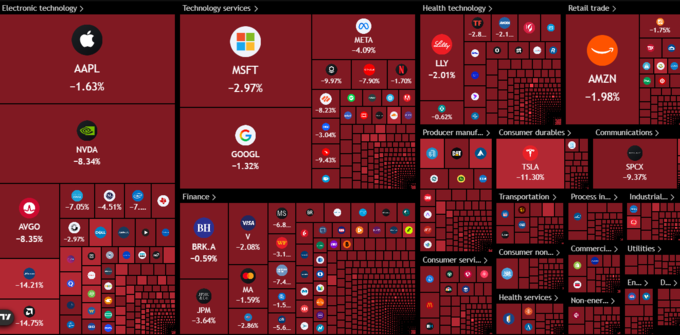
Goldman Sachs stock trader John Flood described the sudden market changes as "another completely different day" and stated bluntly, "The level of pain has reached a high." PenderFund Capital, the chief investment officer, compared the current situation to the moments of collapse during the internet bubble and the subprime mortgage crisis. He said, "The entire market is too focused on AI as a single theme, and the disintegration of that theme itself has been too violent. This was something that was bound to happen sooner or later."
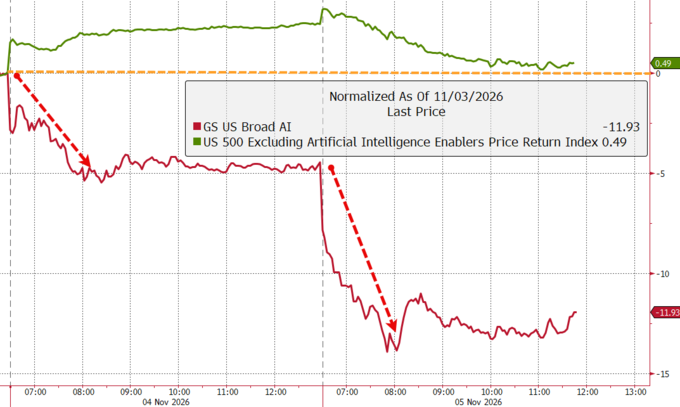
From a rise on Wednesday to a plummet overnight, market logic underwent a fundamental shift in just 48 hours. The Democrats swept both houses in the mid-term elections to Congress, and markets had previously bet that a politically divided Washington would check Trump's power and accelerate the end of the Iran war. Now, investors are rapidly reevaluating a key narrative: a Democratic-led legislative body may put a brake on spending related to artificial intelligence and data center construction.
What is more concerning is that there are still no clear signs of stabilization in this round of selling. Institutional buyers are absent en masse, retail investors continue to sell net, and the forced liquidation of systematic strategy funds may continue. Several market participants pointed out that the lowest point of this round of decline is likely not yet reached.
Chip stocks suffer a "massive wipeout," and the tech sector is bleeding heavily
The hardest-hit areas on Thursday were concentrated in the core of the artificial intelligence industry chain. The Philadelphia Semiconductor Index tumbled 12% in a single day, recording the largest one-day decline since March 2020. The cumulative decline since its peak on June 22 this year has exceeded 38%, officially marking the entry into a bear market.
NVIDIA, the company with the highest global market value, tumbled more than 9% in a single day, experiencing the largest decline since January 2025, wiping out all of its gains for the year; storage stocks suffered a heavy blow, with SanDisk plummeting by 22% and Western Digital falling by 17%; the NeoClouds sector led the declines again, having lost about 20% since the election.
The stocks in Goldman Sachs' largest short basket fell by nearly 8%, including unprofitable tech stocks such as Roku and Peloton. The index of these stocks fell by 7.7%, while high-risk companies with heavier debt burdens tumbled by about 4%. The Russell 2000 Small Cap Index plummeted by around 4.5%, entering a technical adjustment zone.
Volatility soars, signaling a deeper market adjustment
Market panic indicators are also showing alarm signals. The VIX index soared to its highest level since early April, while the Chicago Board Options Exchange Volatility Index (VIX) jumped 11.57 points in a single day, closing at 28.18, setting a new high since March of this year; the VIX expected volatility indicator recorded the largest one-day point increase since the " Volmageddon " event in 2018.
Another technical signal worth noting is that the implied volatility of options tracking the short-term fluctuations of QQQ has for the first time since the end of July been at a premium to the long-term volatility of the S&P 500 ETF ( SPY ). This is generally seen as a precursor to investors being highly confused about the market trend. The spread between the spot price of VIX and the three-month futures price has widened to its widest level since April 2025, and historically this pattern often indicates a deeper decline.
Nomura strategist Charlie McElligott pointed out that the current market's negative gamma exposure is "huge in scale," which means that downward price movements will continue to trigger a trend acceleration mechanism, and the self-reinforcing selling pressure has not yet dissipated.
Retail investors' voluntary selling coincides with forced liquidations by institutions.
The selling structure during this round of market collapse features a combination of retail investors actively selling off their holdings and institutional investors forcibly reducing their leverage.
Vanda Research data shows that within 30 minutes of the opening on Thursday, retail investors sold a record amount of U.S. individual stocks in a single period since October, with the sales mainly concentrated in technology stocks. The overall volume of sales is expected to match the peak level of capital outflows at the end of July.
At the same time, UBS pointed out that retail selling triggered the risk control mechanisms of the futures market as well as the forced liquidation of leveraged positions ETF, which further amplified the downward trend. Founder ETFs partner and portfolio manager Michael Monaghan described the current market as experiencing a double overlay of "buyers' strike" and "forced liquidation by small hedge funds (pod shops)": large, pure long-position funds have stopped buying on dips, while hedge funds are selling all types of positions across the board.
Goldman Sachs' Prime Brokerage data confirms this chaotic situation: the rotation and hedging liquidations from the previous day had temporarily stabilized the market, but on Thursday it evolved into a comprehensive "delta-one deleveraging" in the tech sector.
Democratic Blue Wave Reshaping the Narrative AI
In the initial reaction following the announcement of the election results, market trends were precisely the opposite of the collapse seen on Thursday. On Wednesday, investors generally bet that the divided landscape in Washington would check Trump's power and push the Iran war towards a conclusion, thereby alleviating inflation and interest rate pressures, leading to a clear rebound in the stock market.
However, these buyers who entered at lower prices were quickly swallowed up by the reversal in market trends. JonesTrading Institutional Services Chief Market Strategist Michael O ' Rourke stated that the buying entries were "too quick." He pointed out that although the profit expectations for next year make the price-earnings ratios of related tech stocks seem not high, once there is a structural change in the policy environment, the prospects for data center construction will fundamentally change, and the original profit forecasts will also become invalid.
It is precisely this policy-induced repricing that has directly hit a group of companies that have the highest market valuations and are most dependent on AI capital expenditures.
The lows have not yet arrived, and divisions prevail in the market.
When the selling pressure will end is a clear point of disagreement in the market.
UBS analysts stated that retail investors showed a slight buying trend in the afternoon of Thursday, which may be close to a temporary "surrender point," but the selling by systematic risk control funds is expected to continue on Friday on a scale of over $100 billion. The analysts predict that the liquidity in the U.S. futures market will be the thinnest during Asian trading hours on Monday, which could lead to a repeat of the decline patterns seen in August 2024 and April 2025—where selling from Thursday to Friday triggers hedge funds to liquidate their positions before the opening on Monday, marking the true low point at that time.
Analyst Dan Ives warns that chip stocks still have 10% to 12% of further downside potential; however, Tom Lee from Fundstrat holds the opposite view, stating that the sell-off in this AI sector is a "excessive reaction" and predicts that tech stocks will rebound 20% from their current levels.
President Eric Diton stated that he has gradually reduced his holdings in AI and instead increased his positions in energy stocks to hedge against the risks of high oil prices, saying, 'This sell-off has been extremely intense. The optimism we had a few days ago can no longer be maintained.'