CBN News 2026-11-06 08:10:14 Listen to the news
Author: Chu Chu
Editor-in-Chief: Ge WeierThe S&P 500 index recorded its largest single-day decline since April 2025; the Philadelphia Semiconductor Index fell by 12.25%; international oil prices rebounded, and the yield on 10-year U.S. Treasury bonds dropped to 4.84%.
On Thursday (the 5th), the three major U.S. stock indices closed down significantly, erasing all of their gains from the previous trading day. The results of the mid-term elections in the United States sparked concerns among investors regarding the approval and construction prospects of artificial intelligence (AI) data centers. There was a concentrated sell-off in sectors such as chips, storage, and optical communications, with selling pressure also affecting sectors like finance and healthcare.
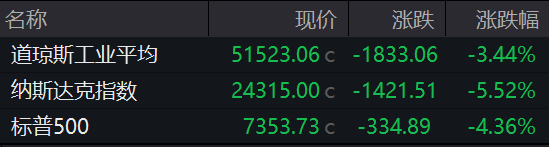
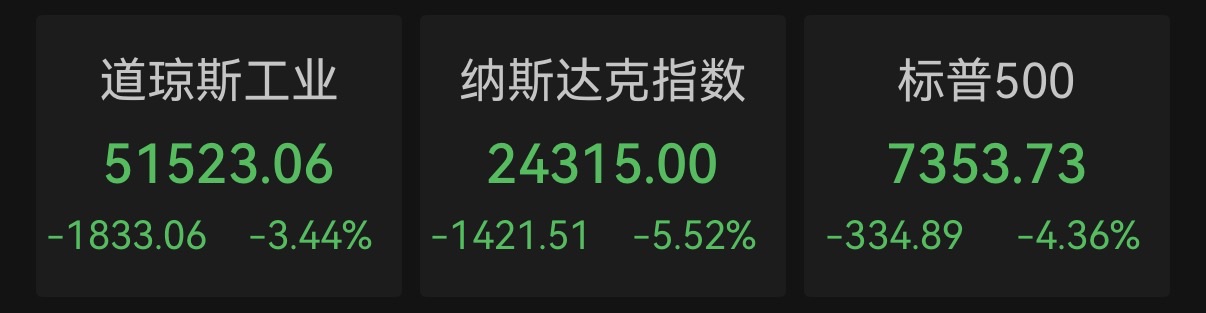
As of the close, the Dow Jones Industrial Average fell by 1,833.06 points, a decrease of 3.44%, to 51,523.06 points; the S&P 500 Index fell by 334.89 points, a decrease of 4.36%, to 7,353.73 points, recording the largest single-day decline since April 2025; the Nasdaq Composite Index fell by 1,421.52 points, a decrease of 5.52%, to 24,315.00 points, and has retraced approximately 11.9% from its historical high close on October 6, entering a correction zone. Previously, investors had already expressed doubts about the return cycle and financing conditions of AI capital expenditures, and the policy uncertainties after the election further exacerbated the selling pressure on related stocks.
【Popular Stocks Performance】
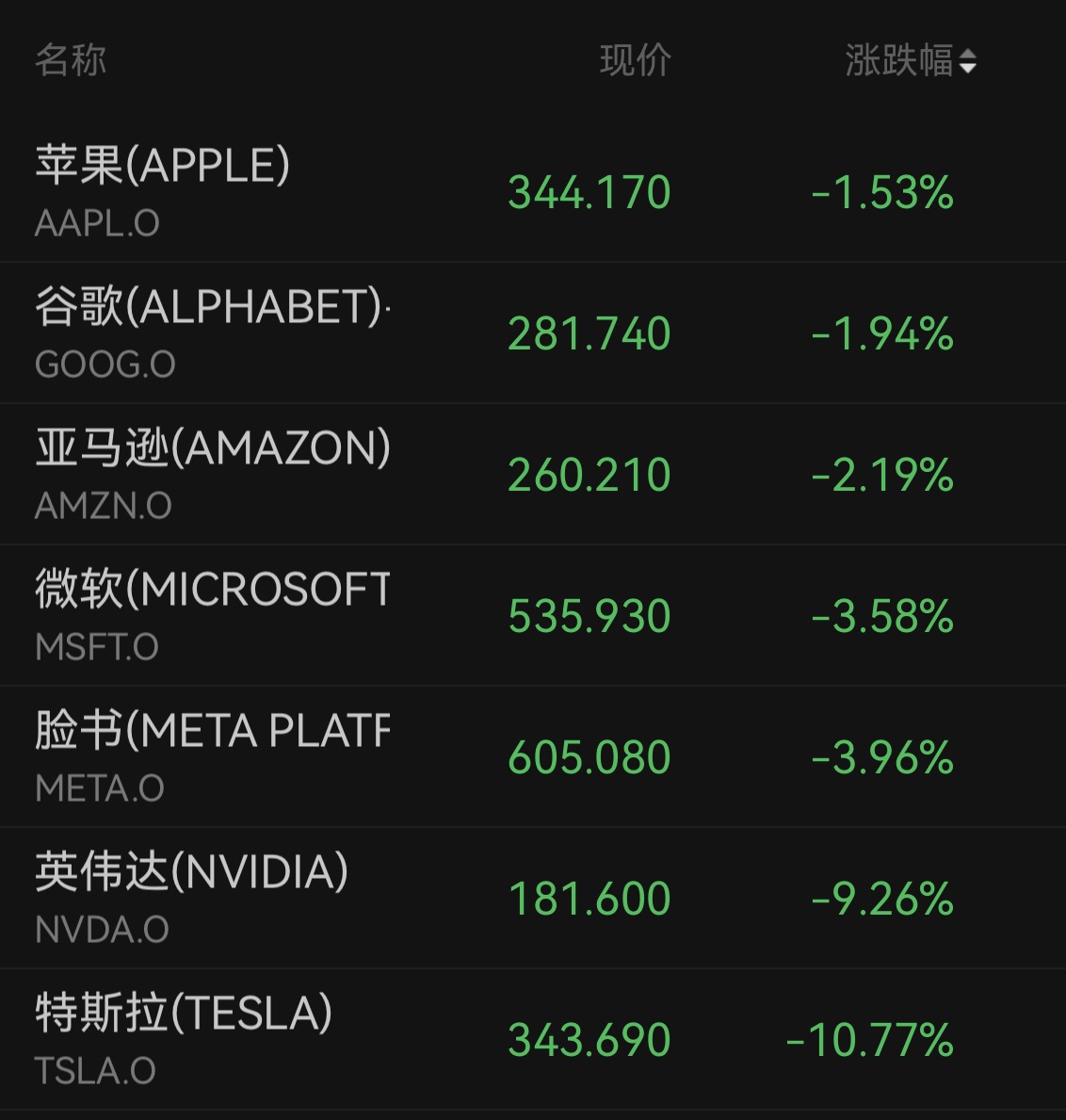
Leading tech stocks declined across the board. Tesla fell more than 10%, NVIDIA fell more than 9%, Meta, Microsoft fell more than 3%, Amazon fell more than 2%, and Google and Apple fell more than 1%. Tech heavyweight stocks weakened collectively, exerting a significant drag on major stock indices.
AI The industry chain has encountered a wave of mass selling. The Philadelphia Semiconductor Index fell by 12.25%, recording the largest single-day decline since March 2020. AMD Fell by more than 17%, Micron Technology fell by more than 16%, TSMC ADR and Broadcom both fell by more than 10%.
Storage and optical communication stocks led the decline, with Sandisk falling by more than 22%, Western Data and Micron Technology falling by more than 17%, Seagate falling by more than 16%; Lumentum fell by more than 18%, and related companies fell by nearly 13%.
Sell pressure affected both servers and cloud computing companies; Dell fell nearly 15%, CoreWeave fell nearly 10%, and Oracle fell nearly 7%.
Other sectors were unable to withstand the market downturn. Despite a rebound in international oil prices, ExxonMobil still fell by more than 2%, and Chevron fell by nearly 2%; JPMorgan Chase fell by more than 4%, while Eli Lilly and UnitedHealth both fell by more than 3%.
Most popular Chinese concept stocks rose, with the NASDAQ China Golden Dragon Index increasing by 0.43% to 5747.08 points. NetEase rose by more than 4%, JD.com by more than 3%, Alibaba, Bilibili, and Pinduoduo by more than 2%; NIO fell by more than 3%, Xpeng Motors by more than 2%, and Baidu by more than 1%.
【Market Overview】
The prospects for data center construction have become an important variable for investors to re-evaluate AI trading. After the Democratic Party won the mid-term elections, the market began to pay attention to policy changes at the congressional, state, and local levels, fearing that stricter approval requirements and construction restrictions could affect the capital expenditure plans of technology companies.
On the previous trading day, the market mainly focused on the positive effects of reduced political uncertainty and a sharp drop in oil prices; on Thursday, investors turned their attention to whether data center projects could proceed as planned. For chip, storage, and equipment suppliers that rely on new data center construction to drive orders, project delays may affect the timing of revenue realization, thereby shaking the growth expectations that previously supported valuations.
Ipek Ozkadeskaia, a senior analyst at UBS Bank ( Swissquote Bank ), stated that the momentum of the US government's support for the construction of AI may have weakened over the past two years, and the impact of related investments on employment, the economy, and the environment is expected to come under closer scrutiny.
In her comments published on that day, she pointed out that if large cloud service providers could slow down their spending while maintaining the business growth brought about by previous investments, their operating prospects might not necessarily deteriorate; however, companies that supply chips and equipment for the construction of AI may face a more challenging environment. The different impacts on builders and suppliers have further divided investors' opinions regarding the AI industry chain.
UBS strategists expect that the suspension of data center construction may slow down the expansion pace that was to continue until 2028, with about 30% of the additional capacity originally expected to be added by 2028 at risk of being affected. Market concerns have extended from the regulatory policies themselves to the sustainability of future orders, project deliveries, and capital expenditures.
Jay Hartfield, CEO of Infrastructure Capital Advisors ( Infrastructure Capital Advisors ), described the sell-off of tech stocks on that day as a "real panic," believing that concerns about the decline in chip stocks and a possible slowdown in AI investment are important reasons for the market's pressure.
In terms of economic data, the U.S. Department of Labor announced on the same day that as of the week ending October 31, the number of initial unemployment claims adjusted for seasonality decreased by 6,000 to 189,000 people, with the previous week's figure revised upward from 194,000 to 195,000 people. The four-week moving average, which fluctuates less, also decreased by 2,250 to 194,750 people.
As of the week of October 24th, the number of people continuously applying for unemployment benefits increased by 23,000 to 1.718 million, while the previous figure was revised down from 1.701 million to 1.695 million. The insured unemployment rate remained at 1.1%. The number of first-time applicants decreased, while the number of reapplicants rose, showing a divergence in trends between these two indicators.
The market will next focus on the October non-farm payroll report to be released on Friday. Changes in new jobs, unemployment rates, and average hourly wages will provide further evidence for assessing labor demand and wage pressures. Whether the employment data can change investors' perceptions of the interest rate path will also affect the subsequent performance of the stock and bond markets.
U.S. Treasury yields have clearly declined. Data from the U.S. Treasury Department at the end of the day showed that the yield for 2-year Treasuries was 4.46%, down 12 basis points from the previous trading day; the yield for 10-year Treasuries was 4.84%, down 6 basis points; and the yield for 30-year Treasuries was 5.25%, down 3 basis points. The decline in short-term yields was greater than that in long-term yields, with the spread between 10-year and 2-year yields widening to 38 basis points.
Regarding the situation in the Middle East, according to CCTV News, on the evening of the 5th local time, the Iranian Navy announced that in the afternoon of the same day, two oil tankers, which Iran referred to as "violating regulations," ran aground on mines and caught fire in the eastern part of the Strait of Hormuz. The safety of shipping in the strait remains uncertain.
According to CCTV news, on the evening of the 5th, the Houthi rebels in Yemen issued a statement claiming that in the past 24 hours, the Saudi-led coalition forces launched 61 airstrikes against Yemen, resulting in civilian casualties. The Houthis also stated that they used drones to attack King Fahd International Airport in Dammam, Saudi Arabia, that same night, causing disruptions to air traffic. The Saudi side has not yet responded to these allegations.
【Large-Cap Performance】
International oil prices have rebounded, and markets continue to assess the potential impact of the U.S. election results on the situation in Iran, as well as the risks faced by Middle Eastern energy supplies. U.S. crude oil has once again surpassed $90 per barrel, with Brent crude approaching the $100 mark. The settlement price of light crude oil futures for December delivery at the New York Mercantile Exchange rose by $2.40, an increase of 2.72%, to $90.52 per barrel; the settlement price of Brent crude oil futures for January delivery of the following year at the London Intercontinental Exchange rose by $3.67, an increase of 3.88%, to $98.29 per barrel.
Precious metals settlement prices have risen. COMEX In December, gold futures rose by $40.50, an increase of 0.99%, to $4,113.50 per ounce; silver futures in December rose by $0.094, an increase of 0.18%, to $52.376 per ounce.
Article Author